Frank Tioguem Teagho, Mohamed Sennour, Matthieu Maziere, André Galtier, Anne-Françoise Gourgues-Lorenzon
{"title":"Cleavage fracture of high strength tempered martensite and mixed tempered martensite + upper bainite medium carbon steel","authors":"Frank Tioguem Teagho, Mohamed Sennour, Matthieu Maziere, André Galtier, Anne-Françoise Gourgues-Lorenzon","doi":"10.1007/s10704-025-00898-4","DOIUrl":null,"url":null,"abstract":"<div><p>This work focuses on the relationships between microstructure and cleavage fracture of a high strength, medium carbon, low alloy steel. The local approach to brittle fracture was applied to both a tempered martensitic microstructure and a mixed tempered martensite + upper bainite microstructure. Three tempering levels were considered to vary the carbide size distribution. Tensile tests were carried out at −196 °C on smooth and notched tensile specimens, followed by fracture surface investigations and finite element analysis.</p><p>In tempered martensite microstructures, both from actual cleavage initiation sites as well as from Smith’s model predictions, the fracture mechanism and the cleavage fracture stress were driven by the size of coarser M<sub>3</sub>C carbides (namely, the 2% coarser particles). The presence and spatial distribution of upper bainite packets in the tempered martensite matrix governed cleavage fracture initiation of the mixed microstructures, leading to lower and more scattered values of the cleavage fracture stress.</p></div>","PeriodicalId":590,"journal":{"name":"International Journal of Fracture","volume":"250 1","pages":""},"PeriodicalIF":2.8000,"publicationDate":"2025-11-29","publicationTypes":"Journal Article","fieldsOfStudy":null,"isOpenAccess":false,"openAccessPdf":"","citationCount":"0","resultStr":null,"platform":"Semanticscholar","paperid":null,"PeriodicalName":"International Journal of Fracture","FirstCategoryId":"5","ListUrlMain":"https://link.springer.com/article/10.1007/s10704-025-00898-4","RegionNum":3,"RegionCategory":"工程技术","ArticlePicture":[],"TitleCN":null,"AbstractTextCN":null,"PMCID":null,"EPubDate":"","PubModel":"","JCR":"Q3","JCRName":"MATERIALS SCIENCE, MULTIDISCIPLINARY","Score":null,"Total":0}
引用次数: 0
Abstract
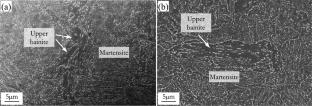
This work focuses on the relationships between microstructure and cleavage fracture of a high strength, medium carbon, low alloy steel. The local approach to brittle fracture was applied to both a tempered martensitic microstructure and a mixed tempered martensite + upper bainite microstructure. Three tempering levels were considered to vary the carbide size distribution. Tensile tests were carried out at −196 °C on smooth and notched tensile specimens, followed by fracture surface investigations and finite element analysis.
In tempered martensite microstructures, both from actual cleavage initiation sites as well as from Smith’s model predictions, the fracture mechanism and the cleavage fracture stress were driven by the size of coarser M3C carbides (namely, the 2% coarser particles). The presence and spatial distribution of upper bainite packets in the tempered martensite matrix governed cleavage fracture initiation of the mixed microstructures, leading to lower and more scattered values of the cleavage fracture stress.
期刊介绍:
The International Journal of Fracture is an outlet for original analytical, numerical and experimental contributions which provide improved understanding of the mechanisms of micro and macro fracture in all materials, and their engineering implications.
The Journal is pleased to receive papers from engineers and scientists working in various aspects of fracture. Contributions emphasizing empirical correlations, unanalyzed experimental results or routine numerical computations, while representing important necessary aspects of certain fatigue, strength, and fracture analyses, will normally be discouraged; occasional review papers in these as well as other areas are welcomed. Innovative and in-depth engineering applications of fracture theory are also encouraged.
In addition, the Journal welcomes, for rapid publication, Brief Notes in Fracture and Micromechanics which serve the Journal''s Objective. Brief Notes include: Brief presentation of a new idea, concept or method; new experimental observations or methods of significance; short notes of quality that do not amount to full length papers; discussion of previously published work in the Journal, and Brief Notes Errata.

 求助内容:
求助内容: 应助结果提醒方式:

 京公网安备 11010802042870号


