Van-The Vo, Abhijit. N. Kadam, Thuy-An Nguyen and Sang-Wha Lee
{"title":"Interferometric optical sensors based on porous silicon grafted with styrenic moieties for highly enhanced VOC detection","authors":"Van-The Vo, Abhijit. N. Kadam, Thuy-An Nguyen and Sang-Wha Lee","doi":"10.1039/D5RA07263H","DOIUrl":null,"url":null,"abstract":"<p >The majority of volatile organic compounds (VOCs) are hazardous pollutants that pose significant risks to human health and the environment. Thus, the development of a smart sensing system for the early identification of VOCs would be in high demand, particularly those enabling rapid detection with high sensitivity and long-term stability. In this study, an interferometric optical sensor was rationally devised through the facile non-atmospheric thermolysis of polystyrene (PS) pre-loaded into a porous silicon (pSi) template prepared <em>via</em> electrochemical anodization. During the thermolysis, styrenic carbon fragments were covalently grafted onto the pore walls of pSi to form a PS-grafted pSi composite (pSi-PS). This composite was subsequently utilized as a scaffold for grafting poly(4-chlorostyrene) (PPCS) <em>via</em> a second thermolysis step, consequently yielding the double-grafted pSi composite (pSi-PS-PPCS). The obtained samples were subsequently employed as an interferometric optical sensor for the sensitive detection of various VOCs, including ethanol, isopropanol, isobutanol, <em>n</em>-hexane, methyl ethyl ketone (M. E. K.), and ethyl acetate. The sensitivity of the optical response to those VOCs exhibited the following order: <em>n</em>-hexane < ethanol < isopropanol < M. E. K. < isobutanol < ethyl acetate. Notably, the double-grafted pSi-PS-PPCS sensor exhibited significantly higher sensitivity than both pristine pSi and single-grafted pSi-PS. The highly enhanced sensitivity of pSi-PS-PPCS, particularly toward isobutanol and ethyl acetate vapors, was mainly attributed to strong intermolecular interactions (such as hydrophobic, hydrogen bonding effects and/or strong interplay of π–π interactions) between the VOC analytes and the chlorine-substituted phenyl moieties of the grafted PPCS.</p>","PeriodicalId":102,"journal":{"name":"RSC Advances","volume":" 56","pages":" 48083-48091"},"PeriodicalIF":4.6000,"publicationDate":"2025-12-05","publicationTypes":"Journal Article","fieldsOfStudy":null,"isOpenAccess":false,"openAccessPdf":"https://pubs.rsc.org/en/content/articlepdf/2025/ra/d5ra07263h?page=search","citationCount":"0","resultStr":null,"platform":"Semanticscholar","paperid":null,"PeriodicalName":"RSC Advances","FirstCategoryId":"92","ListUrlMain":"https://pubs.rsc.org/en/content/articlelanding/2025/ra/d5ra07263h","RegionNum":3,"RegionCategory":"化学","ArticlePicture":[],"TitleCN":null,"AbstractTextCN":null,"PMCID":null,"EPubDate":"","PubModel":"","JCR":"Q2","JCRName":"CHEMISTRY, MULTIDISCIPLINARY","Score":null,"Total":0}
引用次数: 0
Abstract
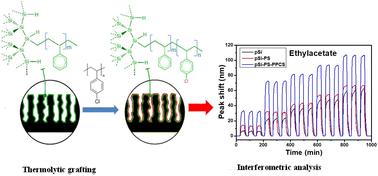
The majority of volatile organic compounds (VOCs) are hazardous pollutants that pose significant risks to human health and the environment. Thus, the development of a smart sensing system for the early identification of VOCs would be in high demand, particularly those enabling rapid detection with high sensitivity and long-term stability. In this study, an interferometric optical sensor was rationally devised through the facile non-atmospheric thermolysis of polystyrene (PS) pre-loaded into a porous silicon (pSi) template prepared via electrochemical anodization. During the thermolysis, styrenic carbon fragments were covalently grafted onto the pore walls of pSi to form a PS-grafted pSi composite (pSi-PS). This composite was subsequently utilized as a scaffold for grafting poly(4-chlorostyrene) (PPCS) via a second thermolysis step, consequently yielding the double-grafted pSi composite (pSi-PS-PPCS). The obtained samples were subsequently employed as an interferometric optical sensor for the sensitive detection of various VOCs, including ethanol, isopropanol, isobutanol, n-hexane, methyl ethyl ketone (M. E. K.), and ethyl acetate. The sensitivity of the optical response to those VOCs exhibited the following order: n-hexane < ethanol < isopropanol < M. E. K. < isobutanol < ethyl acetate. Notably, the double-grafted pSi-PS-PPCS sensor exhibited significantly higher sensitivity than both pristine pSi and single-grafted pSi-PS. The highly enhanced sensitivity of pSi-PS-PPCS, particularly toward isobutanol and ethyl acetate vapors, was mainly attributed to strong intermolecular interactions (such as hydrophobic, hydrogen bonding effects and/or strong interplay of π–π interactions) between the VOC analytes and the chlorine-substituted phenyl moieties of the grafted PPCS.
期刊介绍:
An international, peer-reviewed journal covering all of the chemical sciences, including multidisciplinary and emerging areas. RSC Advances is a gold open access journal allowing researchers free access to research articles, and offering an affordable open access publishing option for authors around the world.


 求助内容:
求助内容: 应助结果提醒方式:

 京公网安备 11010802042870号


