Feasibility, Acceptability, and Preliminary Performance of Check In for Exchange of Clinical and Key Information: A Communication Guide to Facilitate Pre-Encounter Huddles with Medical Interpreters Prior to Conversations Around Serious Illness.
Mei-Ean Yeow, Daniel K Partain, Heather J Carmack, Megan Brandeland, Graciela D Porraz Capetillo, Karen M Fischer, Abraham Labrada Santiago, Ibrahim S Karakus, Amelia Barwise
{"title":"Feasibility, Acceptability, and Preliminary Performance of Check In for Exchange of Clinical and Key Information: A Communication Guide to Facilitate Pre-Encounter Huddles with Medical Interpreters Prior to Conversations Around Serious Illness.","authors":"Mei-Ean Yeow, Daniel K Partain, Heather J Carmack, Megan Brandeland, Graciela D Porraz Capetillo, Karen M Fischer, Abraham Labrada Santiago, Ibrahim S Karakus, Amelia Barwise","doi":"10.1177/26892820251390817","DOIUrl":null,"url":null,"abstract":"<p><strong>Background: </strong>Patients with non-English Language Preference are at risk of adverse health outcomes, particularly at end of life and during serious illness. Medical interpreters often feel unprepared to interpret conversations about serious illness. Best practice guidelines recommend a pre-encounter huddle between clinician and interpreter to better prepare both providers. The CHECK-IN (Check in for Exchange of Clinical and Key Information) guide is a simple communication tool designed to facilitate this pre-encounter huddle. We describe the results of a pilot feasibility study of the CHECK-IN guide performed in a simulation environment. The primary objectives of the study were to evaluate the feasibility, acceptability, and preliminary performance of the CHECK-IN guide.</p><p><strong>Methods: </strong>This U.S.-based study is a single-center simulation-based nonblinded randomized pilot feasibility study. Participating clinicians were randomized to usual practice (control) vs. introduction to the CHECK-IN guide (intervention). Clinicians completed pre- and post-session surveys. Participating clinicians were evaluated using the Faculty Observation Rating Scale (FORS), Interpreter Scale (IS), and Interpreter Impact Rating Scale (IIRS).</p><p><strong>Results: </strong>Participants had a highly favorable opinion on the acceptability, appropriateness, and feasibility of the CHECK-IN tool; 91% of participants agreed/strongly agreed on the acceptability of the tool, 91% agreed/strongly agreed on the appropriateness of the tool, and 100% agreed/strongly agreed on the feasibility of the tool. There were no statistical differences between control and intervention groups for the IS, IIRS, and FORS scores.</p><p><strong>Conclusion: </strong>The CHECK-IN guide is a promising tool to guide a pre-encounter huddle between clinician and interpreter, thereby improving interpreter-mediated communication when having conversations about serious illness.</p>","PeriodicalId":74394,"journal":{"name":"Palliative medicine reports","volume":"6 1","pages":"533-541"},"PeriodicalIF":1.3000,"publicationDate":"2025-10-27","publicationTypes":"Journal Article","fieldsOfStudy":null,"isOpenAccess":false,"openAccessPdf":"https://www.ncbi.nlm.nih.gov/pmc/articles/PMC12670661/pdf/","citationCount":"0","resultStr":null,"platform":"Semanticscholar","paperid":null,"PeriodicalName":"Palliative medicine reports","FirstCategoryId":"1085","ListUrlMain":"https://doi.org/10.1177/26892820251390817","RegionNum":0,"RegionCategory":null,"ArticlePicture":[],"TitleCN":null,"AbstractTextCN":null,"PMCID":null,"EPubDate":"2025/1/1 0:00:00","PubModel":"eCollection","JCR":"Q4","JCRName":"HEALTH CARE SCIENCES & SERVICES","Score":null,"Total":0}
引用次数: 0
Abstract
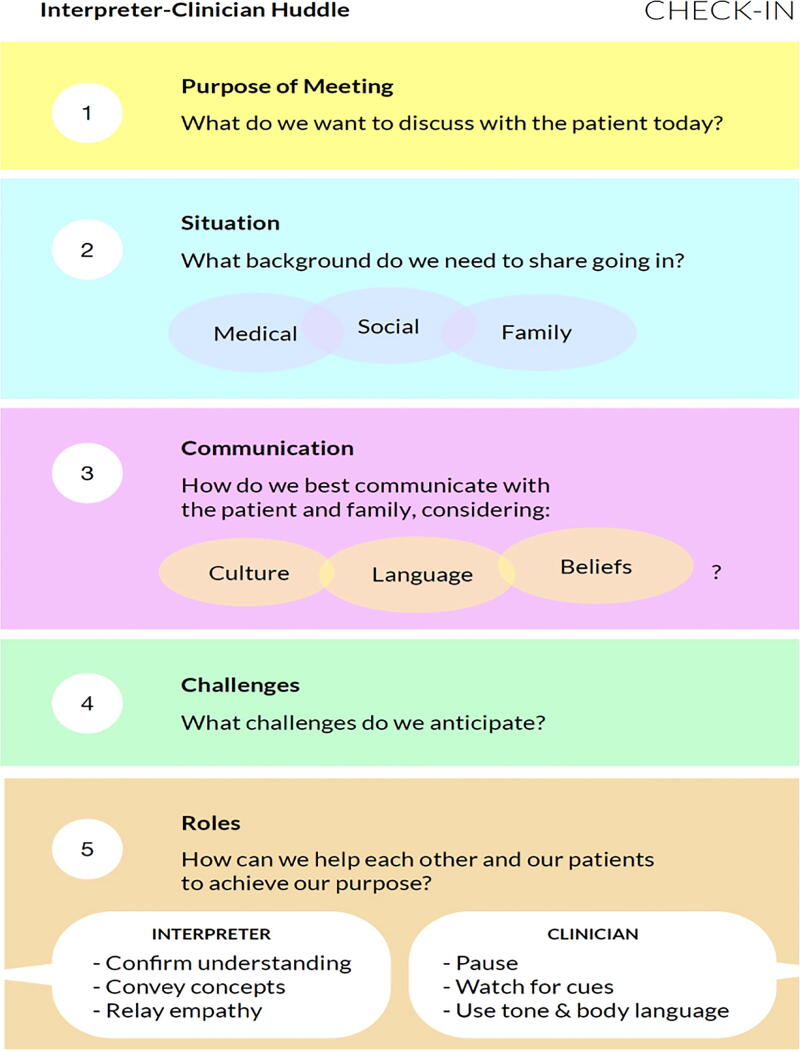
Background: Patients with non-English Language Preference are at risk of adverse health outcomes, particularly at end of life and during serious illness. Medical interpreters often feel unprepared to interpret conversations about serious illness. Best practice guidelines recommend a pre-encounter huddle between clinician and interpreter to better prepare both providers. The CHECK-IN (Check in for Exchange of Clinical and Key Information) guide is a simple communication tool designed to facilitate this pre-encounter huddle. We describe the results of a pilot feasibility study of the CHECK-IN guide performed in a simulation environment. The primary objectives of the study were to evaluate the feasibility, acceptability, and preliminary performance of the CHECK-IN guide.
Methods: This U.S.-based study is a single-center simulation-based nonblinded randomized pilot feasibility study. Participating clinicians were randomized to usual practice (control) vs. introduction to the CHECK-IN guide (intervention). Clinicians completed pre- and post-session surveys. Participating clinicians were evaluated using the Faculty Observation Rating Scale (FORS), Interpreter Scale (IS), and Interpreter Impact Rating Scale (IIRS).
Results: Participants had a highly favorable opinion on the acceptability, appropriateness, and feasibility of the CHECK-IN tool; 91% of participants agreed/strongly agreed on the acceptability of the tool, 91% agreed/strongly agreed on the appropriateness of the tool, and 100% agreed/strongly agreed on the feasibility of the tool. There were no statistical differences between control and intervention groups for the IS, IIRS, and FORS scores.
Conclusion: The CHECK-IN guide is a promising tool to guide a pre-encounter huddle between clinician and interpreter, thereby improving interpreter-mediated communication when having conversations about serious illness.


 求助内容:
求助内容: 应助结果提醒方式:

 京公网安备 11010802042870号


