{"title":"The impact of thyroid disorders on the gut microbiome: emerging mechanisms and clinical relevance.","authors":"Isabela Busto Silva, Manuel Puig-Domingo","doi":"10.20945/2359-4292-2025-0075","DOIUrl":null,"url":null,"abstract":"<p><p>The thyroid-gut axis represents a dynamic interaction between the intestinal microbiota and thyroid function, with growing evidence linking gut dysbiosis to thyroid diseases. The gut microbiome, comprising over 100 trillion microorganisms, influences immune modulation, iodine metabolism, and thyroid hormone regulation. Short-chain fatty acids, produced by beneficial gut bacteria, support immune homeostasis and thyroid function, while pathogenic bacteria and lipopolysaccharides trigger inflammatory pathways that impair thyroid activity. Alterations in gut microbiota composition have been associated with autoimmune thyroid diseases, including Hashimoto's thyroiditis and Graves' disease. Dysbiosis increases intestinal permeability, antigen exposure, and immune activation, exacerbating thyroid autoimmunity. A reduction in short-chain fatty acids-producing bacteria weakens immune tolerance, promoting inflammatory cytokine release and autoantibody production. Recent studies highlight microbial metabolites such as tryptophan derivatives and their role in immune regulation. Gut dysbiosis is also implicated in thyroid nodules and cancer. Decreased butyrate-producing bacteria and increased inflammatory bacterial taxa have been observed in thyroid malignancies. Microbiota influence iodine and selenium bioavailability, essential for thyroid hormone synthesis, and modulate sodium-iodide symporter expression, affecting thyroid cancer response to radioactive iodine therapy. Microbiome-targeted interventions, including probiotics, prebiotics, dietary modifications, and fecal microbiota transplantation, may restore microbial balance, enhance immune regulation, and improve thyroid treatments. This review synthesizes our current understanding of the thyroid-gut axis, indicating that the intestinal microbiota and its metabolites may act directly or indirectly on the thyroid gland, highlighting potential clinical implications and paving the way for therapeutic strategies targeting the intestinal microbiota.</p>","PeriodicalId":54303,"journal":{"name":"Archives of Endocrinology Metabolism","volume":"70 Spe1","pages":"e250075"},"PeriodicalIF":2.3000,"publicationDate":"2025-12-03","publicationTypes":"Journal Article","fieldsOfStudy":null,"isOpenAccess":false,"openAccessPdf":"https://www.ncbi.nlm.nih.gov/pmc/articles/PMC12679698/pdf/","citationCount":"0","resultStr":null,"platform":"Semanticscholar","paperid":null,"PeriodicalName":"Archives of Endocrinology Metabolism","FirstCategoryId":"3","ListUrlMain":"https://doi.org/10.20945/2359-4292-2025-0075","RegionNum":4,"RegionCategory":"医学","ArticlePicture":[],"TitleCN":null,"AbstractTextCN":null,"PMCID":null,"EPubDate":"","PubModel":"","JCR":"Q4","JCRName":"ENDOCRINOLOGY & METABOLISM","Score":null,"Total":0}
引用次数: 0
Abstract
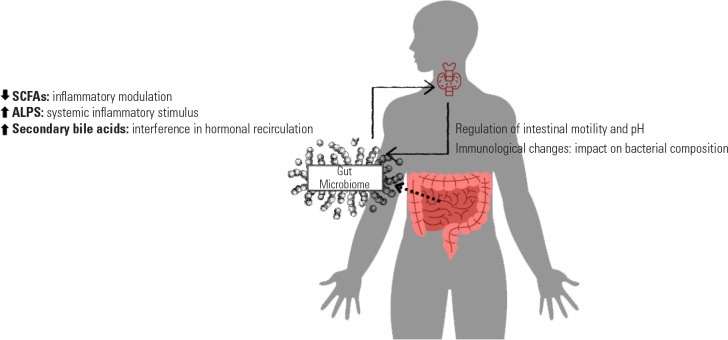
The thyroid-gut axis represents a dynamic interaction between the intestinal microbiota and thyroid function, with growing evidence linking gut dysbiosis to thyroid diseases. The gut microbiome, comprising over 100 trillion microorganisms, influences immune modulation, iodine metabolism, and thyroid hormone regulation. Short-chain fatty acids, produced by beneficial gut bacteria, support immune homeostasis and thyroid function, while pathogenic bacteria and lipopolysaccharides trigger inflammatory pathways that impair thyroid activity. Alterations in gut microbiota composition have been associated with autoimmune thyroid diseases, including Hashimoto's thyroiditis and Graves' disease. Dysbiosis increases intestinal permeability, antigen exposure, and immune activation, exacerbating thyroid autoimmunity. A reduction in short-chain fatty acids-producing bacteria weakens immune tolerance, promoting inflammatory cytokine release and autoantibody production. Recent studies highlight microbial metabolites such as tryptophan derivatives and their role in immune regulation. Gut dysbiosis is also implicated in thyroid nodules and cancer. Decreased butyrate-producing bacteria and increased inflammatory bacterial taxa have been observed in thyroid malignancies. Microbiota influence iodine and selenium bioavailability, essential for thyroid hormone synthesis, and modulate sodium-iodide symporter expression, affecting thyroid cancer response to radioactive iodine therapy. Microbiome-targeted interventions, including probiotics, prebiotics, dietary modifications, and fecal microbiota transplantation, may restore microbial balance, enhance immune regulation, and improve thyroid treatments. This review synthesizes our current understanding of the thyroid-gut axis, indicating that the intestinal microbiota and its metabolites may act directly or indirectly on the thyroid gland, highlighting potential clinical implications and paving the way for therapeutic strategies targeting the intestinal microbiota.
期刊介绍:
The Archives of Endocrinology and Metabolism - AE&M – is the official journal of the Brazilian Society of Endocrinology and Metabolism - SBEM, which is affiliated with the Brazilian Medical Association.
Edited since 1951, the AE&M aims at publishing articles on scientific themes in the basic translational and clinical area of Endocrinology and Metabolism. The printed version AE&M is published in 6 issues/year. The full electronic issue is open access in the SciELO - Scientific Electronic Library Online e at the AE&M site: www.aem-sbem.com.
From volume 59 on, the name was changed to Archives of Endocrinology and Metabolism, and it became mandatory for manuscripts to be submitted in English for the online issue. However, for the printed issue it is still optional for the articles to be sent in English or Portuguese.
The journal is published six times a year, with one issue every two months.


 求助内容:
求助内容: 应助结果提醒方式:

 京公网安备 11010802042870号


