
Sesquiterpenoids from Chloranthus holostegius var. shimianensis: Structures and anti-inflammatory activities
IF 3.4
2区 生物学
Q2 BIOCHEMISTRY & MOLECULAR BIOLOGY
引用次数: 0
Abstract
Seven previously undescribed sesquiterpenoids, designated as chloranholosins N‒T (1–7), including two acorane-type sesquiterpenoids (1–2), two lindenane-type sesquiterpenoids (3–4), and three eudesmane-type sesquiterpenoids (5–7), together with six known analogues (8–13) were isolated from the whole plants of Chloranthus holostegius var. Shimianensis. Their structures and absolute configurations were elucidated by a comprehensive method including the spectroscopic data, electronic circular dichroism calculations, and single-crystal X-ray diffraction. Compounds 5 and 6 are the first instances of eudesmane-type sesquiterpenoids with tigloyl and senecioyl substitutions at C-15, respectively. Additionally, the isolates were evaluated for their inhibitory activities against LPS induced nitric oxide production in RAW 264.7 macrophage cells. Among them, compounds 5 and 10 showed significant inhibitory activities with IC50 values of 9.35 ± 1.49 and 3.94 ± 0.69 μM, respectively. Compounds 1, 3, 4, 6, 9, and 12 showed moderate inhibitory activities with IC50 values from 10.48 to 35.36 μM, compared with that of the positive drug dexamethasone at 15.01 ± 1.33 μM.

石绵青花倍半萜类化合物的结构及抗炎活性。
从石棉兰(Chloranthus holostegius vars . shimianensis)全株中分离到7个先前未被描述的倍半萜类化合物N-T(1-7),包括2个栎烷型倍半萜类(1-2)、2个椴树烷型倍半萜类(3-4)和3个桉树烷型倍半萜类(5-7),以及6个已知的类似物(8-13)。通过光谱数据、电子圆二色性计算和单晶x射线衍射等综合方法对其结构和绝对构型进行了分析。化合物5和6是第一个在C-15上分别取代tigloyl和senecioyl的eudesane型倍半萜类化合物。此外,我们还评估了分离物对LPS诱导的RAW 264.7巨噬细胞产生一氧化氮的抑制活性。其中化合物5和10的IC50值分别为9.35±1.49 μM和3.94±0.69 μM,具有较强的抑制活性。化合物1、3、4、6、9和12的IC50值为10.48 ~ 35.36 μM,而阳性药物地塞米松的IC50值为15.01±1.33 μM。
本文章由计算机程序翻译,如有差异,请以英文原文为准。
求助全文
约1分钟内获得全文
求助全文
来源期刊
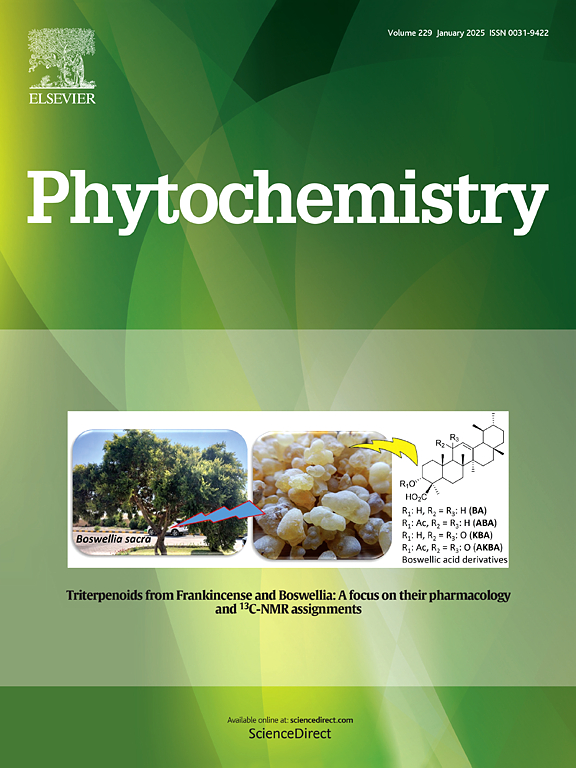
Phytochemistry
生物-植物科学
CiteScore
6.40
自引率
7.90%
发文量
443
审稿时长
39 days
期刊介绍:
Phytochemistry is a leading international journal publishing studies of plant chemistry, biochemistry, molecular biology and genetics, structure and bioactivities of phytochemicals, including ''-omics'' and bioinformatics/computational biology approaches. Phytochemistry is a primary source for papers dealing with phytochemicals, especially reports concerning their biosynthesis, regulation, and biological properties both in planta and as bioactive principles. Articles are published online as soon as possible as Articles-in-Press and in 12 volumes per year. Occasional topic-focussed special issues are published composed of papers from invited authors.
 求助内容:
 应助结果提醒方式:


 京公网安备 11010802042870号


