Belgüzar Nilay Türkan, Lars-Michael Schöpper, Lari Vainio, Christian Frings
{"title":"When affordances are not universal: The negative compatibility effect is modulated by task type and spatial association","authors":"Belgüzar Nilay Türkan, Lars-Michael Schöpper, Lari Vainio, Christian Frings","doi":"10.3758/s13414-025-03202-7","DOIUrl":null,"url":null,"abstract":"<div><p>Humans prepare motor actions when perceiving objects that afford specific behaviors, highlighting the tight link between perception and action. For example, seeing a graspable object like a mug can trigger hand movements aligned to its handle – a phenomenon known as the object affordance effect. Vainio et al. (<i>Quarterly Journal of Experimental Psychology</i> <i>64</i>, 1094–1110, 2011) demonstrated this can produce a negative compatibility effect (NCE). This occurs when a spatially compatible prime object eliciting an affordance (e.g., a mug), but to be ignored, precedes a target requiring a spatial response. Given that task demands shape response execution (e.g., Schöpper & Frings, <i>Attention, Perception & Psychophysics</i>, <i>86</i>, 171–185, 2024), we hypothesized that the effect of affordance would vary accordingly. In Experiment 1, participants performed three tasks: arrow direction discrimination, shape discrimination, and circle localization. In all tasks, the time interval between the affordance object (a mug) and the onset of the target, as well as the compatibility between the mug and the response, varied. The arrow task replicated the NCE – responses were slower in compatible trials at short intervals. No compatibility effects were observed in the shape task. Notably, the localization task revealed a positive compatibility effect (PCE). The variation in compatibility effects suggests task-dependent affordances. Experiment 2 manipulated the target position relative to the fixation to investigate the PCE in the localization task and explore the differences in the compatibility effect. Although the PCE was not replicated, the NCE now also appeared for location tasks. Our results suggest that task constraints shape the compatibility effect, and distractor-induced affordances engage inhibitory mechanisms only when spatial features are relevant.</p></div>","PeriodicalId":55433,"journal":{"name":"Attention Perception & Psychophysics","volume":"88 1","pages":""},"PeriodicalIF":1.7000,"publicationDate":"2025-12-02","publicationTypes":"Journal Article","fieldsOfStudy":null,"isOpenAccess":false,"openAccessPdf":"","citationCount":"0","resultStr":null,"platform":"Semanticscholar","paperid":null,"PeriodicalName":"Attention Perception & Psychophysics","FirstCategoryId":"102","ListUrlMain":"https://link.springer.com/article/10.3758/s13414-025-03202-7","RegionNum":4,"RegionCategory":"心理学","ArticlePicture":[],"TitleCN":null,"AbstractTextCN":null,"PMCID":null,"EPubDate":"","PubModel":"","JCR":"Q3","JCRName":"PSYCHOLOGY","Score":null,"Total":0}
引用次数: 0
Abstract
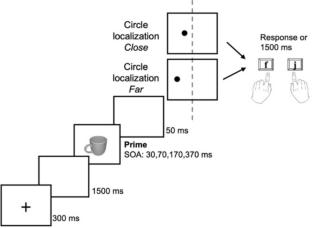
Humans prepare motor actions when perceiving objects that afford specific behaviors, highlighting the tight link between perception and action. For example, seeing a graspable object like a mug can trigger hand movements aligned to its handle – a phenomenon known as the object affordance effect. Vainio et al. (Quarterly Journal of Experimental Psychology64, 1094–1110, 2011) demonstrated this can produce a negative compatibility effect (NCE). This occurs when a spatially compatible prime object eliciting an affordance (e.g., a mug), but to be ignored, precedes a target requiring a spatial response. Given that task demands shape response execution (e.g., Schöpper & Frings, Attention, Perception & Psychophysics, 86, 171–185, 2024), we hypothesized that the effect of affordance would vary accordingly. In Experiment 1, participants performed three tasks: arrow direction discrimination, shape discrimination, and circle localization. In all tasks, the time interval between the affordance object (a mug) and the onset of the target, as well as the compatibility between the mug and the response, varied. The arrow task replicated the NCE – responses were slower in compatible trials at short intervals. No compatibility effects were observed in the shape task. Notably, the localization task revealed a positive compatibility effect (PCE). The variation in compatibility effects suggests task-dependent affordances. Experiment 2 manipulated the target position relative to the fixation to investigate the PCE in the localization task and explore the differences in the compatibility effect. Although the PCE was not replicated, the NCE now also appeared for location tasks. Our results suggest that task constraints shape the compatibility effect, and distractor-induced affordances engage inhibitory mechanisms only when spatial features are relevant.
期刊介绍:
The journal Attention, Perception, & Psychophysics is an official journal of the Psychonomic Society. It spans all areas of research in sensory processes, perception, attention, and psychophysics. Most articles published are reports of experimental work; the journal also presents theoretical, integrative, and evaluative reviews. Commentary on issues of importance to researchers appears in a special section of the journal. Founded in 1966 as Perception & Psychophysics, the journal assumed its present name in 2009.

 求助内容:
求助内容: 应助结果提醒方式:

 京公网安备 11010802042870号


