
Tribocorrosion of additively manufactured and wrought Ti6Al4V in a saline environment
IF 7.2
1区 工程技术
Q1 ENGINEERING, MECHANICAL
引用次数: 0
Abstract
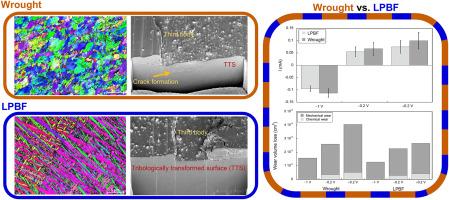
Laser powder bed fusion (LPBF) and wrought Ti6Al4V were compared from a tribocorrosion perspective in 0.9 % NaCl, distinguishing between mechanical and chemical (oxidative) wear through potential-controlled measurements. The aim was to elucidate the manufacturing- and potential-dependent tribocorrosion mechanisms in a saline environment. While both manufacturing methods resulted in excellent corrosion resistance, the LPBF titanium alloy exhibited a finer, distinct microstructure, higher microhardness, and greater tribocorrosion resistance under applied cathodic and anodic potentials in saline than the wrought alloy. More available slip systems, lower grain boundary density, easier crack formation and propagation at the oxide-subsurface interface, and more oxidized third-body particles were responsible for the higher mechanical and chemical volume loss of wrought samples. These features were related to the microstructural differences; the wrought titanium alloy consisted of a β phase, along with α phase, and a lower grain boundary density, whereas the LPBF alloy possessed α/α′ phases and a higher grain boundary density.
增材制造和变形Ti6Al4V在盐水环境中的摩擦腐蚀
从摩擦腐蚀的角度比较了激光粉末床熔合(LPBF)和变形Ti6Al4V在0.9% NaCl中的摩擦腐蚀,通过电位控制测量区分了机械磨损和化学(氧化)磨损。目的是阐明在盐水环境中制造和潜在依赖的摩擦腐蚀机制。虽然两种制造方法都具有优异的耐腐蚀性,但与变形合金相比,LPBF钛合金在盐水中阴极和阳极电位作用下表现出更细、更独特的微观组织、更高的显微硬度和更强的耐摩擦腐蚀性能。更多有效的滑移体系、更低的晶界密度、更容易在氧化-亚表面界面处形成和扩展裂纹,以及更多氧化的第三体颗粒是造成变形试样力学和化学体积损失较大的原因。这些特征与微观结构差异有关;变形后的钛合金由β相和α相组成,晶界密度较低,而LPBF合金由α/α′相组成,晶界密度较高。
本文章由计算机程序翻译,如有差异,请以英文原文为准。
求助全文
约1分钟内获得全文
求助全文
来源期刊
Wear
工程技术-材料科学:综合
CiteScore
8.80
自引率
8.00%
发文量
280
审稿时长
47 days
期刊介绍:
Wear journal is dedicated to the advancement of basic and applied knowledge concerning the nature of wear of materials. Broadly, topics of interest range from development of fundamental understanding of the mechanisms of wear to innovative solutions to practical engineering problems. Authors of experimental studies are expected to comment on the repeatability of the data, and whenever possible, conduct multiple measurements under similar testing conditions. Further, Wear embraces the highest standards of professional ethics, and the detection of matching content, either in written or graphical form, from other publications by the current authors or by others, may result in rejection.
 求助内容:
求助内容: 应助结果提醒方式:

 京公网安备 11010802042870号


