
Mapping strategies for unresolved CFD-DEM modeling of fluid-solid flows: Latest developments and perspectives
IF 4.7
2区 材料科学
Q2 ENGINEERING, CHEMICAL
引用次数: 0
Abstract
The accurate transfer of discrete particle information to continuum Eulerian fields, known as mapping or coarse-graining, plays a critical role in unresolved CFD-DEM modeling, governing both numerical stability and physical fidelity. Over the years, a variety of strategies have been proposed, spanning from local methods such as the satellite point scheme to non-local approaches based on kernel functions, diffusion, or hybrid formulations. Each method balances trade-offs between smoothness, conservation, computational efficiency, and applicability to complex grid configurations or non-spherical particles. This perspective summarizes the general methodology, representative implementations, and typical applications of existing mapping algorithms, and analyzes their respective merits and limitations. Particular attention is given to challenges associated with small grid-to-particle size ratios, irregular geometries, computational costs, and multi-physics coupling. Emerging directions, including adaptive and hybrid schemes, consistency with turbulence modeling, extensions to polydisperse and non-spherical particles, and machine learning-aided mapping acceleration, are discussed. Continued efforts in these areas promise to improve the robustness, accuracy, and scalability of CFD-DEM simulations, ultimately enabling more generalized and reliable modeling of complex multiphase flows in both research and industrial applications.

未解决的CFD-DEM流固流建模的映射策略:最新发展和观点
将离散粒子信息准确地传递到连续欧拉场,即映射或粗粒化,在未解析的CFD-DEM建模中起着关键作用,控制着数值稳定性和物理保真度。多年来,已经提出了各种策略,从局部方法(如卫星点方案)到基于核函数、扩散或混合公式的非局部方法。每种方法都在平滑性、守恒性、计算效率以及对复杂网格结构或非球形粒子的适用性之间进行了权衡。本观点总结了现有映射算法的一般方法、代表性实现和典型应用,并分析了它们各自的优点和局限性。特别关注与小网格与颗粒尺寸比、不规则几何形状、计算成本和多物理场耦合相关的挑战。讨论了新兴方向,包括自适应和混合方案,与湍流建模的一致性,扩展到多分散和非球形粒子,以及机器学习辅助的映射加速。在这些领域的持续努力有望提高CFD-DEM模拟的鲁棒性、准确性和可扩展性,最终在研究和工业应用中实现更广泛、更可靠的复杂多相流建模。
本文章由计算机程序翻译,如有差异,请以英文原文为准。
求助全文
约1分钟内获得全文
求助全文
来源期刊
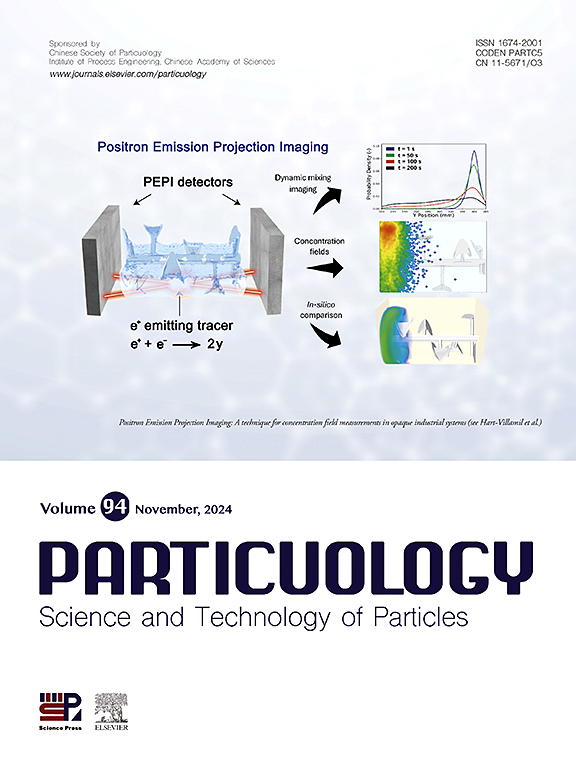
Particuology
工程技术-材料科学:综合
CiteScore
6.70
自引率
2.90%
发文量
1730
审稿时长
32 days
期刊介绍:
The word ‘particuology’ was coined to parallel the discipline for the science and technology of particles.
Particuology is an interdisciplinary journal that publishes frontier research articles and critical reviews on the discovery, formulation and engineering of particulate materials, processes and systems. It especially welcomes contributions utilising advanced theoretical, modelling and measurement methods to enable the discovery and creation of new particulate materials, and the manufacturing of functional particulate-based products, such as sensors.
Papers are handled by Thematic Editors who oversee contributions from specific subject fields. These fields are classified into: Particle Synthesis and Modification; Particle Characterization and Measurement; Granular Systems and Bulk Solids Technology; Fluidization and Particle-Fluid Systems; Aerosols; and Applications of Particle Technology.
Key topics concerning the creation and processing of particulates include:
-Modelling and simulation of particle formation, collective behaviour of particles and systems for particle production over a broad spectrum of length scales
-Mining of experimental data for particle synthesis and surface properties to facilitate the creation of new materials and processes
-Particle design and preparation including controlled response and sensing functionalities in formation, delivery systems and biological systems, etc.
-Experimental and computational methods for visualization and analysis of particulate system.
These topics are broadly relevant to the production of materials, pharmaceuticals and food, and to the conversion of energy resources to fuels and protection of the environment.
 求助内容:
 应助结果提醒方式:


 京公网安备 11010802042870号


