
A continuum mechanics approach for the deformation of non-Euclidean origami generated by piecewise constant nematic director fields
IF 6.2
2区 工程技术
Q2 MATERIALS SCIENCE, MULTIDISCIPLINARY
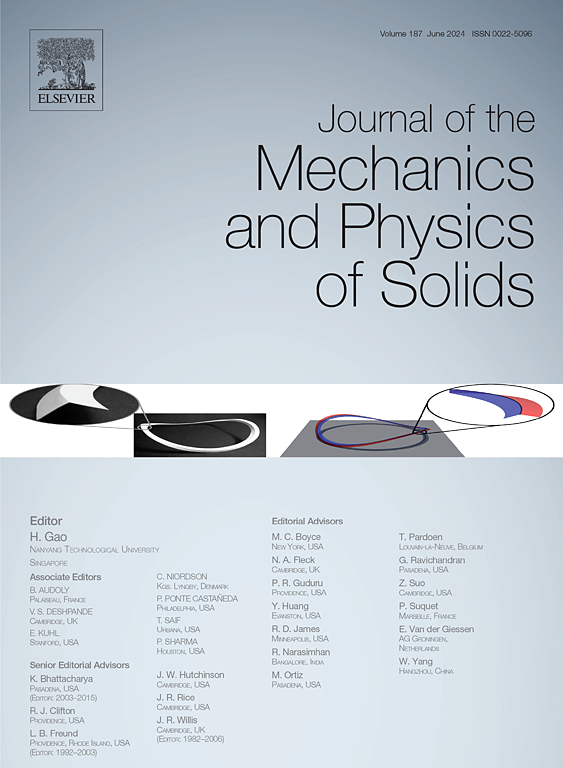
Journal of The Mechanics and Physics of Solids
Pub Date : 2026-02-01
Epub Date: 2025-12-02
DOI:10.1016/j.jmps.2025.106460
引用次数: 0
Abstract
We merge classical origami concepts with active actuation by designing origami patterns whose panels undergo prescribed metric changes. These metric changes render the system non-Euclidean, inducing non-zero Gaussian curvature at the vertices after actuation. Such patterns can be realized by programming piecewise constant director fields in liquid crystal elastomer (LCE) sheets. In this work, we address the geometric design of both compatible reference director patterns and their corresponding actuated configurations. On the reference configuration, we systematically construct director patterns that satisfy metric compatibility across interfaces. We prove the existence and uniqueness of compatible director fields at a vertex for the generic case, up to orthogonal duals. The Gaussian curvature of the actuated vertex is computed based on the compatible director fields. On the actuated configuration, we develop a continuum mechanics framework to analyze the kinematics of non-Euclidean origami. In particular, we fully characterize the deformation spaces of three-fold and four-fold vertices and establish analytical relationships between their deformations and the director patterns. Building on these kinematic insights, we propose rational designs of large director patterns: one based on a quadrilateral tiling with alternating positive and negative actuated Gaussian curvature, and the other combining three-fold and four-fold vertices governed by a folding angle theorem. Remarkably, both designs achieve compatibility in both the reference and actuated states. We also propose a design strategy for active metamaterials based on the periodic non-Euclidean origami. The active metamaterials can have two modes of motions by folding or stimulating. We anticipate that our geometric framework will facilitate the design of non-Euclidean/active origami structures and broaden their application in active metamaterials, soft actuators, and robotic systems.
非欧几里得折纸由分段常向列方向场产生的变形的连续介质力学方法
我们通过设计折纸图案,其面板经过规定的度量变化,将经典折纸概念与主动驱动相结合。这些度量变化使系统非欧几里得,在驱动后在顶点处诱导非零高斯曲率。这种模式可以通过在液晶弹性体(LCE)片上分段编程来实现。在这项工作中,我们讨论了兼容的参考指示器模式及其相应的驱动配置的几何设计。在参考配置上,我们系统地构建了满足跨接口度量兼容性的指令模式。我们证明了在一般情况下,直至正交对偶,在一个顶点处相容方向域的存在唯一性。基于兼容的方向域计算被驱动顶点的高斯曲率。在驱动构型上,我们建立了一个连续力学框架来分析非欧几里得折纸的运动学。特别是,我们充分表征了三重和四重顶点的变形空间,并建立了它们的变形与指向图案之间的解析关系。在这些运动学见解的基础上,我们提出了大型定向模式的合理设计:一个基于四边形平铺,具有交替的正负驱动高斯曲率,另一个结合由折叠角定理控制的三重和四重顶点。值得注意的是,两种设计在参考和驱动状态下都实现了兼容性。我们还提出了一种基于周期性非欧几里得折纸的活性超材料设计策略。活性超材料有两种运动模式:折叠运动模式和刺激运动模式。我们预计我们的几何框架将促进非欧几里得/活性折纸结构的设计,并扩大其在活性超材料,软致动器和机器人系统中的应用。
本文章由计算机程序翻译,如有差异,请以英文原文为准。
求助全文
约1分钟内获得全文
求助全文
来源期刊
CiteScore
9.80
自引率
9.40%
发文量
276
审稿时长
52 days
期刊介绍:
The aim of Journal of The Mechanics and Physics of Solids is to publish research of the highest quality and of lasting significance on the mechanics of solids. The scope is broad, from fundamental concepts in mechanics to the analysis of novel phenomena and applications. Solids are interpreted broadly to include both hard and soft materials as well as natural and synthetic structures. The approach can be theoretical, experimental or computational.This research activity sits within engineering science and the allied areas of applied mathematics, materials science, bio-mechanics, applied physics, and geophysics.
The Journal was founded in 1952 by Rodney Hill, who was its Editor-in-Chief until 1968. The topics of interest to the Journal evolve with developments in the subject but its basic ethos remains the same: to publish research of the highest quality relating to the mechanics of solids. Thus, emphasis is placed on the development of fundamental concepts of mechanics and novel applications of these concepts based on theoretical, experimental or computational approaches, drawing upon the various branches of engineering science and the allied areas within applied mathematics, materials science, structural engineering, applied physics, and geophysics.
The main purpose of the Journal is to foster scientific understanding of the processes of deformation and mechanical failure of all solid materials, both technological and natural, and the connections between these processes and their underlying physical mechanisms. In this sense, the content of the Journal should reflect the current state of the discipline in analysis, experimental observation, and numerical simulation. In the interest of achieving this goal, authors are encouraged to consider the significance of their contributions for the field of mechanics and the implications of their results, in addition to describing the details of their work.
 求助内容:
 应助结果提醒方式:


 京公网安备 11010802042870号


