
Lack of Social and Physical Opportunity are key barriers to adopting alternative pig farming systems
IF 5.3
2区 环境科学与生态学
Q2 ENVIRONMENTAL SCIENCES
Environmental Development
Pub Date : 2026-03-01
Epub Date: 2025-11-26
DOI:10.1016/j.envdev.2025.101395
引用次数: 0
Abstract
In high-income countries, pig production predominantly occurs in conventional indoor systems, but interest in alternative systems is growing. This research applied social science frameworks to understand barriers and facilitators influencing adoption of alternative pig farming practices. Using the COM-B model (Capability-Opportunity-Motivation = Behaviour) and Theoretical Domains Framework, semi-structured interviews and focus groups were conducted with stakeholders from conventional indoor and alternative (free-range and organic) systems. Eighteen interviews (Conventional: n = 9; Alternative: n = 9) and two focus groups (Conventional: n = 5; Alternative: n = 4) explored individual- and industry-level factors affecting the adoption of alternative systems, with pig farming stakeholders. Participants were recruited through purposive sampling, and data were analysed using a deductive Framework approach. Barriers to adoption related to Capability (e.g., shortage of skilled staff, lack of knowledge of alternative farming methods), Motivation (e.g., alternative farming perceived as a hobby), and Opportunity (e.g., power dynamics in the industry, profitability). Facilitators included Capability (e.g., diversification of activities) and Opportunity (e.g., availability of woodlands, support from family and community). The majority of the identified barriers related to lack of opportunity, highlighting the need for a physical and social environment that facilitates the development of alternative pig farming systems. A supportive regulatory and physical environment are essential in progressing alternative pig farming systems.
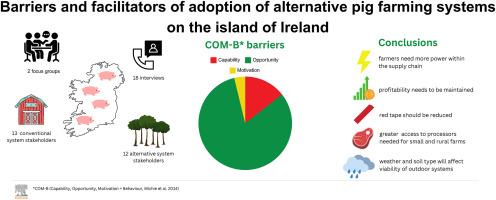
缺乏社会和物质机会是采用替代养猪系统的主要障碍
在高收入国家,生猪生产主要发生在传统的室内系统中,但对替代系统的兴趣正在增长。本研究应用社会科学框架来了解影响采用替代养猪方法的障碍和促进因素。使用COM-B模型(能力-机会-动机=行为)和理论领域框架,对来自传统室内和替代(自由放养和有机)系统的利益相关者进行了半结构化访谈和焦点小组。18个访谈(传统:n = 9;替代:n = 9)和两个焦点小组(传统:n = 5;替代:n = 4)与养猪业利益相关者探讨了影响采用替代系统的个人和行业层面的因素。参与者通过有目的的抽样招募,并使用演绎框架方法分析数据。采用的障碍与能力(例如,缺乏熟练的员工,缺乏对替代农业方法的知识),动机(例如,将替代农业视为一种爱好)和机会(例如,行业中的权力动态,盈利能力)有关。促进因素包括能力(例如,活动的多样化)和机会(例如,林地的可用性,家庭和社区的支持)。所确定的大多数障碍与缺乏机会有关,强调需要一个促进发展替代养猪系统的物质和社会环境。支持性的监管和自然环境对于发展替代性养猪系统至关重要。
本文章由计算机程序翻译,如有差异,请以英文原文为准。
求助全文
约1分钟内获得全文
求助全文
来源期刊
Environmental Development
Social Sciences-Geography, Planning and Development
CiteScore
8.40
自引率
1.90%
发文量
62
审稿时长
74 days
期刊介绍:
Environmental Development provides a future oriented, pro-active, authoritative source of information and learning for researchers, postgraduate students, policymakers, and managers, and bridges the gap between fundamental research and the application in management and policy practices. It stimulates the exchange and coupling of traditional scientific knowledge on the environment, with the experiential knowledge among decision makers and other stakeholders and also connects natural sciences and social and behavioral sciences. Environmental Development includes and promotes scientific work from the non-western world, and also strengthens the collaboration between the developed and developing world. Further it links environmental research to broader issues of economic and social-cultural developments, and is intended to shorten the delays between research and publication, while ensuring thorough peer review. Environmental Development also creates a forum for transnational communication, discussion and global action.
Environmental Development is open to a broad range of disciplines and authors. The journal welcomes, in particular, contributions from a younger generation of researchers, and papers expanding the frontiers of environmental sciences, pointing at new directions and innovative answers.
All submissions to Environmental Development are reviewed using the general criteria of quality, originality, precision, importance of topic and insights, clarity of exposition, which are in keeping with the journal''s aims and scope.
 求助内容:
求助内容: 应助结果提醒方式:

 京公网安备 11010802042870号


