
How effective is online teaching of physiology modules? perception of Rwandan health sciences students

IF 1.7 Q3 PHYSIOLOGY
Current research in physiology Pub Date : 2026-01-01 Epub Date: 2025-12-01 DOI:10.1016/j.crphys.2025.100181
Abdullateef Isiaka Alagbonsi , Mojeed Akorede Gbadamosi , Mathieu Nemerimana , Makinde V. Olubiyi , Olufunke Onaadepo , Akaninyene Ubong Ime , Abdul-Rahuf Aderemi Feyitimi , Ruth Wanjiru Mungai , Florent Rutagarama , Danilo Milanes Zambrano , Noah Adavize Omeiza , Simiat Olanike Elias
{"title":"How effective is online teaching of physiology modules? perception of Rwandan health sciences students","authors":"Abdullateef Isiaka Alagbonsi ,&nbsp;Mojeed Akorede Gbadamosi ,&nbsp;Mathieu Nemerimana ,&nbsp;Makinde V. Olubiyi ,&nbsp;Olufunke Onaadepo ,&nbsp;Akaninyene Ubong Ime ,&nbsp;Abdul-Rahuf Aderemi Feyitimi ,&nbsp;Ruth Wanjiru Mungai ,&nbsp;Florent Rutagarama ,&nbsp;Danilo Milanes Zambrano ,&nbsp;Noah Adavize Omeiza ,&nbsp;Simiat Olanike Elias","doi":"10.1016/j.crphys.2025.100181","DOIUrl":null,"url":null,"abstract":"<div><h3>Background</h3><div>While blended teaching is approved in Rwandan medical education, the perceived effectiveness of online-only delivery for physiology modules remains unclear. This uncertainty limits its continued use. The present study assessed Rwandan health sciences students’ perceptions of the effectiveness of online teaching for physiology modules.</div></div><div><h3>Methods</h3><div>A total of 528 students from medicine and surgery (n = 300), pharmacy (n = 99), dentistry (n = 89), and clinical psychology (n = 40) programs at the University of Rwanda completed an online questionnaire. Data were analyzed using multivariable logistic regression and non-parametric tests (Mann-Whitney U, Kruskal-Wallis) with corresponding effect sizes.</div></div><div><h3>Results</h3><div>Female students (adjusted odds ratio (aOR) = 0.64, 95 % CI: 0.43–0.94, <em>p</em> = 0.024) had significantly lower odds of perceiving online teaching as effective, whereas Year 2 students (aOR = 1.63, 95 % CI: 1.05–2.55, <em>p</em> = 0.030) had significantly higher odds of doing so. Experiential factors strongly influenced perceived effectiveness: satisfaction with online teaching (aOR = 35.11, 95 % CI: 6.96–177.11, <em>p</em> &lt; 0.001), high interactivity (aOR = 5.17, 95 % CI: 2.46–10.87, <em>p</em> &lt; 0.001), and regular participation in discussions (aOR = 7.58, 95 % CI: 3.47–16.55, <em>p</em> &lt; 0.001) were associated with positive perceptions. Video conferencing was rated as most helpful for complex concepts (Kruskal-Wallis H (5) = 65.58, <em>p</em> &lt; 0.001). The predictive model (Nagelkerke R<sup>2</sup> = 0.629) strongly indicated that students perceived online teaching as comparably effective as face-to-face teaching.</div></div><div><h3>Conclusions</h3><div>Students’ perceptions of online teaching effectiveness are shaped more by interactivity, satisfaction, and active participation than by demographic characteristics. Educators should prioritize interactive, synchronous sessions and foster student engagement to increase acceptance of online physiology teaching in Rwanda.</div></div>","PeriodicalId":72753,"journal":{"name":"Current research in physiology","volume":"9 ","pages":"Article 100181"},"PeriodicalIF":1.7000,"publicationDate":"2026-01-01","publicationTypes":"Journal Article","fieldsOfStudy":null,"isOpenAccess":false,"openAccessPdf":"","citationCount":"0","resultStr":null,"platform":"Semanticscholar","paperid":null,"PeriodicalName":"Current research in physiology","FirstCategoryId":"1085","ListUrlMain":"https://www.sciencedirect.com/science/article/pii/S2665944125000434","RegionNum":0,"RegionCategory":null,"ArticlePicture":[],"TitleCN":null,"AbstractTextCN":null,"PMCID":null,"EPubDate":"2025/12/1 0:00:00","PubModel":"Epub","JCR":"Q3","JCRName":"PHYSIOLOGY","Score":null,"Total":0}
引用次数: 0

Abstract

Background

While blended teaching is approved in Rwandan medical education, the perceived effectiveness of online-only delivery for physiology modules remains unclear. This uncertainty limits its continued use. The present study assessed Rwandan health sciences students’ perceptions of the effectiveness of online teaching for physiology modules.

Methods

A total of 528 students from medicine and surgery (n = 300), pharmacy (n = 99), dentistry (n = 89), and clinical psychology (n = 40) programs at the University of Rwanda completed an online questionnaire. Data were analyzed using multivariable logistic regression and non-parametric tests (Mann-Whitney U, Kruskal-Wallis) with corresponding effect sizes.

Results

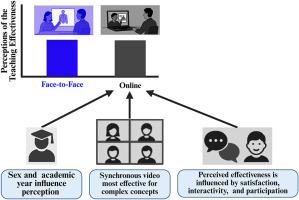
Female students (adjusted odds ratio (aOR) = 0.64, 95 % CI: 0.43–0.94, p = 0.024) had significantly lower odds of perceiving online teaching as effective, whereas Year 2 students (aOR = 1.63, 95 % CI: 1.05–2.55, p = 0.030) had significantly higher odds of doing so. Experiential factors strongly influenced perceived effectiveness: satisfaction with online teaching (aOR = 35.11, 95 % CI: 6.96–177.11, p < 0.001), high interactivity (aOR = 5.17, 95 % CI: 2.46–10.87, p < 0.001), and regular participation in discussions (aOR = 7.58, 95 % CI: 3.47–16.55, p < 0.001) were associated with positive perceptions. Video conferencing was rated as most helpful for complex concepts (Kruskal-Wallis H (5) = 65.58, p < 0.001). The predictive model (Nagelkerke R2 = 0.629) strongly indicated that students perceived online teaching as comparably effective as face-to-face teaching.

Conclusions

Students’ perceptions of online teaching effectiveness are shaped more by interactivity, satisfaction, and active participation than by demographic characteristics. Educators should prioritize interactive, synchronous sessions and foster student engagement to increase acceptance of online physiology teaching in Rwanda.
Abstract Image

生理学模块的在线教学效果如何?对卢旺达卫生科学学生的看法
虽然混合教学在卢旺达医学教育中得到批准,但仅在线授课的生理学模块的有效性尚不清楚。这种不确定性限制了它的继续使用。本研究评估了卢旺达健康科学专业学生对生理学模块在线教学有效性的看法。方法共528名来自卢旺达大学医学和外科(n = 300)、药学(n = 99)、牙科(n = 89)和临床心理学(n = 40)专业的学生完成在线问卷调查。采用多变量logistic回归和具有相应效应量的非参数检验(Mann-Whitney U, Kruskal-Wallis)对数据进行分析。结果女生(调整比值比(aOR) = 0.64, 95% CI: 0.43-0.94, p = 0.024)认为在线教学有效的几率明显较低,而二年级学生(aOR = 1.63, 95% CI: 1.05-2.55, p = 0.030)认为在线教学有效的几率明显较高。经验因素强烈影响感知有效性:在线教学满意度(aOR = 35.11, 95% CI: 6.96 ~ 177.11, p < 0.001)、高交互性(aOR = 5.17, 95% CI: 2.46 ~ 10.87, p < 0.001)和定期参与讨论(aOR = 7.58, 95% CI: 3.47 ~ 16.55, p < 0.001)与积极感知相关。视频会议被认为对复杂概念最有帮助(Kruskal-Wallis H (5) = 65.58, p < 0.001)。预测模型(Nagelkerke R2 = 0.629)强烈表明,学生认为在线教学与面对面教学效果相当。结论学生对在线教学效果的看法更多地受互动性、满意度和积极参与的影响,而不是受人口统计学特征的影响。教育工作者应优先考虑互动、同步的课程,并促进学生的参与,以提高卢旺达对在线生理学教学的接受程度。
本文章由计算机程序翻译,如有差异,请以英文原文为准。
求助全文
约1分钟内获得全文 求助全文
来源期刊
CiteScore
3.20
自引率
0.00%
发文量
0
审稿时长
62 days
×
引用
GB/T 7714-2015
复制
MLA
复制
APA
复制
导出至
BibTeX EndNote RefMan NoteFirst NoteExpress
×
提示
您的信息不完整,为了账户安全,请先补充。
现在去补充
×
提示
您因"违规操作"
具体请查看互助需知
我知道了
×
提示
确定
请完成安全验证×
copy
已复制链接
快去分享给好友吧!
我知道了
右上角分享
点击右上角分享
0
联系我们:info@booksci.cn Book学术提供免费学术资源搜索服务,方便国内外学者检索中英文文献。致力于提供最便捷和优质的服务体验。 Copyright © 2023 布克学术 All rights reserved.
京ICP备2023020795号-1
ghs 京公网安备 11010802042870号
Book学术文献互助
Book学术文献互助群
群 号:604180095
Book学术官方微信
小红书



