
Multi-talented luminescent hydroxyapatite nanocrystals toward high-performance fiber fabric and optoelectronic devices
IF 3.6
3区 物理与天体物理
Q2 OPTICS
Journal of Luminescence
Pub Date : 2026-02-01
Epub Date: 2025-11-28
DOI:10.1016/j.jlumin.2025.121685
引用次数: 0
Abstract
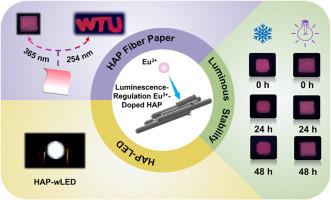
Luminescence enhancement has always been a key research topic for luminescent materials. Rare earth (RE) -doped hydroxyapatite (HAP) luminescent materials have been widely applied in the fields of biological probes and target cell markers due to their excellent biocompatibility. However, hydroxyl groups (-OH) in hydroxyapatite luminescent materials significantly weaken their luminous ability. Here, we introduce an Eu3+-doped hydroxyapatite luminescent material that regulates luminescence by introducing Eu3+ during the experiment. The Eu3+-doped hydroxyapatite did not significantly alter the crystal structure of hydroxyapatite, but the hydroxyapatite nanorods became smaller. Eu3+-doped hydroxyapatite has an excellent red glow under ultraviolet (UV) light. In addition, hydroxyapatite and aramid chopped fibers (ACFs)/polyphenylene sulfide (PPS) composite fibers were composite to obtain luminescent and stable luminescent fibers. This flexible luminescent fiber paper can maintain stable luminescence in environments such as high and low temperatures. The color temperature (CCT) of the white light emitting diode (LED) prepared based on Eu3+-doped HAP is 6761 K, and the color rendering index (CRI) is 92. This study successfully explores the application of hydroxyapatite in the fields of emergency rescue, anti-counterfeiting, and lighting.
用于高性能纤维织物和光电子器件的多天才发光羟基磷灰石纳米晶体
发光增强一直是发光材料的研究热点。稀土(RE)掺杂羟基磷灰石(HAP)发光材料因其优异的生物相容性在生物探针和靶细胞标记领域得到了广泛的应用。然而羟基磷灰石发光材料中的羟基(-OH)明显削弱了其发光能力。在这里,我们引入了一种掺Eu3+的羟基磷灰石发光材料,该材料通过在实验中引入Eu3+来调节发光。掺Eu3+对羟基磷灰石的晶体结构没有明显的影响,但羟基磷灰石纳米棒变小了。Eu3+掺杂羟基磷灰石在紫外光下具有优异的红光。另外,将羟基磷灰石和芳纶短切纤维(ACFs)/聚苯硫醚(PPS)复合,得到发光稳定的发光纤维。这种柔性发光纤维纸可以在高温和低温等环境中保持稳定的发光。Eu3+掺杂HAP制备的白光发光二极管(LED)的色温(CCT)为6761 K,显色指数(CRI)为92。本研究成功探索了羟基磷灰石在应急救援、防伪、照明等领域的应用。
本文章由计算机程序翻译,如有差异,请以英文原文为准。
求助全文
约1分钟内获得全文
求助全文
来源期刊
Journal of Luminescence
物理-光学
CiteScore
6.70
自引率
13.90%
发文量
850
审稿时长
3.8 months
期刊介绍:
The purpose of the Journal of Luminescence is to provide a means of communication between scientists in different disciplines who share a common interest in the electronic excited states of molecular, ionic and covalent systems, whether crystalline, amorphous, or liquid.
We invite original papers and reviews on such subjects as: exciton and polariton dynamics, dynamics of localized excited states, energy and charge transport in ordered and disordered systems, radiative and non-radiative recombination, relaxation processes, vibronic interactions in electronic excited states, photochemistry in condensed systems, excited state resonance, double resonance, spin dynamics, selective excitation spectroscopy, hole burning, coherent processes in excited states, (e.g. coherent optical transients, photon echoes, transient gratings), multiphoton processes, optical bistability, photochromism, and new techniques for the study of excited states. This list is not intended to be exhaustive. Papers in the traditional areas of optical spectroscopy (absorption, MCD, luminescence, Raman scattering) are welcome. Papers on applications (phosphors, scintillators, electro- and cathodo-luminescence, radiography, bioimaging, solar energy, energy conversion, etc.) are also welcome if they present results of scientific, rather than only technological interest. However, papers containing purely theoretical results, not related to phenomena in the excited states, as well as papers using luminescence spectroscopy to perform routine analytical chemistry or biochemistry procedures, are outside the scope of the journal. Some exceptions will be possible at the discretion of the editors.
 求助内容:
求助内容: 应助结果提醒方式:

 京公网安备 11010802042870号


