
Jiajun Luo , Congyuan Zeng , Rui Yang , Jingyun Mao , Hui Xue , Shuangjuan Shen , Yiyin Huang , Yuanyuan Sun , Haoran Jiang , Yaobing Wang
{"title":"Nitrogen-triggered plasmonic bifunctionality in ruthenium/titanium oxynitride Schottky catalyst for energized hydrazine-seawater hydrogen production","authors":"Jiajun Luo , Congyuan Zeng , Rui Yang , Jingyun Mao , Hui Xue , Shuangjuan Shen , Yiyin Huang , Yuanyuan Sun , Haoran Jiang , Yaobing Wang","doi":"10.1016/j.apmate.2025.100384","DOIUrl":null,"url":null,"abstract":"<div><div>Plasmon-coupled hydrazine-seawater electrolysis emerges as an advanced hydrogen generation approach characterized by enhanced product efficiency and renewable utilization. Though the integration of plasmonic effects with bifunctional catalysts promises to revolutionize system design, the design of such catalysts with plasmonic bifunctionality remains a huge challenge. Our work breaks new ground by employing nitrogen as a “molecular switch” to trigger plasmonic bifunctionality in ruthenium/titanium oxynitride (Ru/TiNO<sub>0.6</sub>), achieving intrinsically and plasmon-energized hydrogen evolution reaction (overpotential: 13.5 mV) and hydrazine oxidation reaction (overpotential: 222.3 mV). The plasmonic two-electrode system demonstrates remarkable performance enhancement, boosting current density by 34.6% (127.5 → 171.6 mA cm<sup>−2</sup> at 0.2V) with maintaining near 100% selective conversion to H<sub>2</sub>/N<sub>2</sub>. Through advanced characterization and theoretical analysis, we decode nitrogen's triple role: it narrows band gap of substrate and enhances both photoelectronic and photothermal effects; it enhances Mott-Schottky effects to generate metastable amorphous Ru species, and induces interface charge polarization with creating built-in electric fields that synergistically lower activation barriers. These concerted effects yield optimal hydrogen adsorption energetics (Δ<em>G</em><sub>∗H</sub>) while facilitating ∗N<sub>2</sub>H<sub>3</sub> intermediate formation and shift of rate determining step, establishing a new paradigm for plasmon-driven bifunctional electrocatalysis.</div></div>","PeriodicalId":7283,"journal":{"name":"Advanced Powder Materials","volume":"5 3","pages":"Article 100384"},"PeriodicalIF":0.0000,"publicationDate":"2026-06-01","publicationTypes":"Journal Article","fieldsOfStudy":null,"isOpenAccess":false,"openAccessPdf":"","citationCount":"0","resultStr":null,"platform":"Semanticscholar","paperid":null,"PeriodicalName":"Advanced Powder Materials","FirstCategoryId":"1085","ListUrlMain":"https://www.sciencedirect.com/science/article/pii/S2772834X25001204","RegionNum":0,"RegionCategory":null,"ArticlePicture":[],"TitleCN":null,"AbstractTextCN":null,"PMCID":null,"EPubDate":"2025/11/21 0:00:00","PubModel":"Epub","JCR":"","JCRName":"","Score":null,"Total":0}
引用次数: 0
Abstract
Plasmon-coupled hydrazine-seawater electrolysis emerges as an advanced hydrogen generation approach characterized by enhanced product efficiency and renewable utilization. Though the integration of plasmonic effects with bifunctional catalysts promises to revolutionize system design, the design of such catalysts with plasmonic bifunctionality remains a huge challenge. Our work breaks new ground by employing nitrogen as a “molecular switch” to trigger plasmonic bifunctionality in ruthenium/titanium oxynitride (Ru/TiNO0.6), achieving intrinsically and plasmon-energized hydrogen evolution reaction (overpotential: 13.5 mV) and hydrazine oxidation reaction (overpotential: 222.3 mV). The plasmonic two-electrode system demonstrates remarkable performance enhancement, boosting current density by 34.6% (127.5 → 171.6 mA cm−2 at 0.2V) with maintaining near 100% selective conversion to H2/N2. Through advanced characterization and theoretical analysis, we decode nitrogen's triple role: it narrows band gap of substrate and enhances both photoelectronic and photothermal effects; it enhances Mott-Schottky effects to generate metastable amorphous Ru species, and induces interface charge polarization with creating built-in electric fields that synergistically lower activation barriers. These concerted effects yield optimal hydrogen adsorption energetics (ΔG∗H) while facilitating ∗N2H3 intermediate formation and shift of rate determining step, establishing a new paradigm for plasmon-driven bifunctional electrocatalysis.
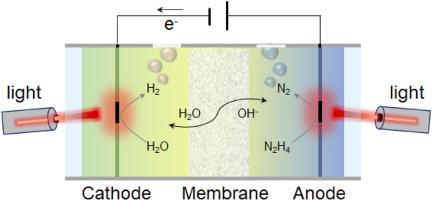
等离子体耦合肼-海水电解是一种先进的制氢方法,具有提高产品效率和可再生利用的特点。虽然等离子体效应与双功能催化剂的整合有望彻底改变系统设计,但这种具有等离子体双功能的催化剂的设计仍然是一个巨大的挑战。我们的工作开辟了新的领域,利用氮作为“分子开关”来触发氧化钌/氧化钛(Ru/TiNO0.6)中的等离子体双功能,实现了本质和等离子体激发的析氢反应(过电位:13.5 mV)和肼氧化反应(过电位:222.3 mV)。等离子体双电极系统表现出显著的性能增强,在0.2V时电流密度提高34.6%(127.5→171.6 mA cm−2),并保持接近100%的H2/N2选择性转化。通过先进的表征和理论分析,我们解码了氮的三重作用:它缩小了衬底的带隙,增强了光电子和光热效应;它增强了Mott-Schottky效应,生成亚稳态非晶钌,并通过产生内置电场来诱导界面电荷极化,从而协同降低激活势垒。这些协同效应产生了最佳的氢吸附能量(ΔG∗H),同时促进了∗N2H3中间产物的形成和速率决定步骤的移动,建立了等离子体驱动双功能电催化的新范式。



