
Model-guided chemical environment and metabolic network design to couple pathways with cell fitness
IF 4.1
Q2 BIOTECHNOLOGY & APPLIED MICROBIOLOGY
Metabolic Engineering Communications
Pub Date : 2025-12-01
Epub Date: 2025-11-22
DOI:10.1016/j.mec.2025.e00267
引用次数: 0
Abstract
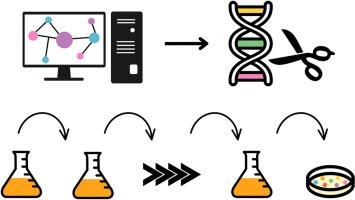
Heterologous compound production is a complex trait since the native metabolic fluxes supplying the precursors, redox power, and energy are under multilevel cellular regulation. Improving complex traits using targeted engineering needs combinatorially charting the complex genetic underpinnings. While this is laborious, adaptive laboratory evolution (ALE) has been used to improve many traits of microbial strains that are of application relevance such as tolerance of harsh conditions and nutrient utilization. However, in contrast to such traits, heterologous production can seldom be intuitively coupled with cellular fitness.
Here, a novel method EvolveXGA was developed for genome-scale metabolic model guided design of strategies combining chemical environments and genetic engineering of the metabolic network to allow ALE of desired traits. Adaptive evolution of traits occurs when the co-variance between the traits and fitness involves a genetic dependency like a flux coupling would indicate. Thus, combinations of chemical environments and metabolic network structures were searched using a genetic algorithm to identify those that render desired traits (i.e., sets of metabolic fluxes) flux-coupled with fitness. The search was performed for the production of 29 heterologous compounds in yeast Saccharomyces cerevisiae. Strategies for coupling the production routes of 13 compounds with fitness were found with four metabolic reaction knock outs and three components in the chemical environment. In addition, strategies for fitness-coupling native fluxes involved in the production was found for the remaining compounds. In addition, a model-guided strategy was implemented for fitness-coupling of heterologous glycolic acid (GA) synthesis in S. cerevisiae via oxaloacetase, oxalyl-CoA synthetase, and oxalyl-CoA reductase (i.e., oxalate pathway). ALE was performed and evolved populations and isolated clones were characterized using whole-genome sequencing and quantitative metabolite analysis. Three out of six isolates had better GA yield from glucose than a non-optimized control strain expressing the oxalate pathway and glyoxylate reductase.
EvolveXGA generalizes metabolic model-guided design of strategies to couple production routes with cell fitness. The strategies bring optimizing heterologous production in engineered microbial cells in the realm of ALE. Slow and expensive strain optimization is a major hinder of novel processes using engineered microbial cells reaching industrial realization. Thus, EvolveXGA contributes to biotechnological solutions for the brighter future.
模型引导的化学环境和代谢网络设计与细胞适应度耦联途径
异源化合物的产生是一个复杂的特性,因为提供前体、氧化还原力和能量的天然代谢通量受到多层次的细胞调节。利用目标工程改进复杂性状需要组合绘制复杂的遗传基础。虽然这很费力,但适应性实验室进化(ALE)已被用于改善微生物菌株的许多特性,这些特性与应用相关,如对恶劣条件的耐受性和营养利用。然而,与这些性状相反,异源生产很少能直观地与细胞适应度相结合。本文开发了一种新的方法EvolveXGA,用于基因组尺度的代谢模型指导设计策略,将化学环境和代谢网络的基因工程相结合,以实现所需性状的ALE。当性状和适应度之间的协方差涉及遗传依赖时,性状的适应性进化就发生了,就像通量耦合所表明的那样。因此,使用遗传算法搜索化学环境和代谢网络结构的组合,以确定那些呈现所需特征(即代谢通量集)通量耦合适应度的特征。对酿酒酵母中29种异源化合物的生产进行了研究。通过4个代谢反应敲除和化学环境中的3个组分,找到了13个化合物与适应度耦合的生产路线。此外,还发现了剩余化合物生产过程中适宜耦合的天然通量策略。此外,采用模型引导策略,通过草酸途径(草酸途径),对酿酒酵母中异源乙醇酸(GA)的合成进行适应度偶联。利用全基因组测序和定量代谢物分析对进化种群和分离克隆进行了表征。6株菌株中有3株表达草酸途径和乙醛酸还原酶的菌株比未优化的对照菌株有更好的葡萄糖GA产量。EvolveXGA推广了代谢模型指导的策略设计,将生产路线与细胞适应度结合起来。这些策略为ALE领域的工程微生物细胞的异种生产带来了优化。缓慢和昂贵的菌株优化是利用工程微生物细胞实现工业实现的新工艺的主要障碍。因此,EvolveXGA致力于为更光明的未来提供生物技术解决方案。
本文章由计算机程序翻译,如有差异,请以英文原文为准。
求助全文
约1分钟内获得全文
求助全文
来源期刊
Metabolic Engineering Communications
Medicine-Endocrinology, Diabetes and Metabolism
CiteScore
13.30
自引率
1.90%
发文量
22
审稿时长
18 weeks
期刊介绍:
Metabolic Engineering Communications, a companion title to Metabolic Engineering (MBE), is devoted to publishing original research in the areas of metabolic engineering, synthetic biology, computational biology and systems biology for problems related to metabolism and the engineering of metabolism for the production of fuels, chemicals, and pharmaceuticals. The journal will carry articles on the design, construction, and analysis of biological systems ranging from pathway components to biological complexes and genomes (including genomic, analytical and bioinformatics methods) in suitable host cells to allow them to produce novel compounds of industrial and medical interest. Demonstrations of regulatory designs and synthetic circuits that alter the performance of biochemical pathways and cellular processes will also be presented. Metabolic Engineering Communications complements MBE by publishing articles that are either shorter than those published in the full journal, or which describe key elements of larger metabolic engineering efforts.
 求助内容:
求助内容: 应助结果提醒方式:

 京公网安备 11010802042870号


