
Catalytically activated isotope exchange in multicomponent systems gas–solid: statistical theory and its application on example of proton-conducting oxides
IF 6.5
1区 化学
Q2 CHEMISTRY, PHYSICAL
引用次数: 0
Abstract
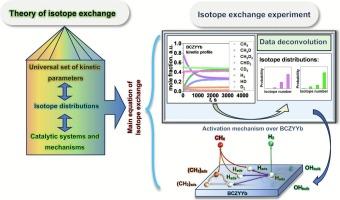
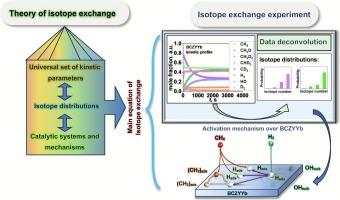
This study aims to develop a comprehensive theory of the kinetics of catalytically activated isotope exchange in closed heterogeneous systems, grounded in the ideal statistical laws governing isotope distribution. Based on this theory, all systems exhibiting isotope exchange are categorised into three groups: one-component, two-component, and multicomponent, according to isotope behaviour. It is demonstrated that any mechanism of catalytically activated isotope exchange can be represented through subtypes of exchange characterised by atom transfer quasireactions, which mediate transitions between distinct types of isotope distribution within the components. An algorithm for describing experimental data within this theoretical framework was formulated and applied to a range of literature data concerning H/D exchange in ethylene, methane, methane–hydrogen, ethane–hydrogen, and methanol–hydrogen mixtures over metal and oxide-supported catalysts. Employing the theory, the mechanism of catalytically activated isotope exchange in pure methane and methane–hydrogen mixtures over BaCe0.7Zr0.1Y0.1Yb0.1O3−α, a promising proton-conducting catalyst, was investigated, revealing catalytic heterogeneity of active sites and H2-induced kinetic isotope effects.
多组分气固体系催化活化同位素交换:统计理论及其在质子导电氧化物实例上的应用
本研究旨在以控制同位素分布的理想统计规律为基础,发展封闭非均相系统中催化活化同位素交换动力学的综合理论。根据这一理论,所有表现出同位素交换的系统根据同位素行为可分为三组:单组分、双组分和多组分。结果表明,任何催化活化的同位素交换机制都可以通过以原子转移反应为特征的交换亚型来表示,原子转移反应介导组分内不同类型同位素分布之间的转换。在这一理论框架内制定了一个描述实验数据的算法,并将其应用于一系列关于金属和金属氧化物负载催化剂上乙烯、甲烷、甲烷-氢、乙烷-氢和甲醇-氢混合物中H/D交换的文献数据。利用这一理论,研究了纯甲烷和甲烷氢混合物在BaCe0.7Zr0.1Y0.1Yb0.1O3−α(一种很有前途的质子导电催化剂)上催化活化同位素交换的机理,揭示了活性位点的催化非均质性和h2诱导的动力学同位素效应。
本文章由计算机程序翻译,如有差异,请以英文原文为准。
求助全文
约1分钟内获得全文
求助全文
来源期刊
Journal of Catalysis
工程技术-工程:化工
CiteScore
12.30
自引率
5.50%
发文量
447
审稿时长
31 days
期刊介绍:
The Journal of Catalysis publishes scholarly articles on both heterogeneous and homogeneous catalysis, covering a wide range of chemical transformations. These include various types of catalysis, such as those mediated by photons, plasmons, and electrons. The focus of the studies is to understand the relationship between catalytic function and the underlying chemical properties of surfaces and metal complexes.
The articles in the journal offer innovative concepts and explore the synthesis and kinetics of inorganic solids and homogeneous complexes. Furthermore, they discuss spectroscopic techniques for characterizing catalysts, investigate the interaction of probes and reacting species with catalysts, and employ theoretical methods.
The research presented in the journal should have direct relevance to the field of catalytic processes, addressing either fundamental aspects or applications of catalysis.
 求助内容:
求助内容: 应助结果提醒方式:

 京公网安备 11010802042870号


