
Personalized intensification of treatment for hormone-sensitive prostate cancer
IF 94.6
1区 医学
Q1 ONCOLOGY
引用次数: 0
Abstract
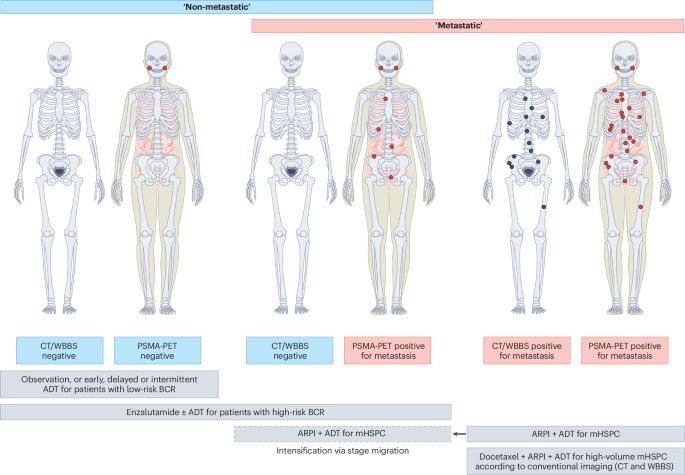
Historically, systemic therapy for hormone-sensitive prostate cancer (HSPC) was predicated on androgen-deprivation therapy (ADT) alone. However, in the past decade, substantial improvements have been made by intensifying treatment based on a better understanding of the broad underlying biology of these cancers. The addition of androgen receptor pathway inhibitors (ARPIs), docetaxel and/or radiotherapy to ADT is of proven benefit in certain patient subgroups, whereas AKT inhibitors, radioligand therapies and poly ADP-ribose polymerase (PARP) inhibitors are being evaluated in patients with metastatic HSPC. The clinical states of HSPC are determined by a history of localized prostate cancer versus presentation with de novo metastatic disease, as well as the extent of disease on conventional computed tomography imaging and whole-body bone scintigraphy. However, modern nuclear imaging modalities such as prostate-specific membrane antigen PET can visualize metastases below the limit of detection of computed tomography and whole-body bone scintigraphy; this earlier and more precise detection of metastases has identified new subgroups of patients for which certain treatment approaches, such as adding docetaxel to ADT plus an ARPI, might or might not apply. In this Review, we discuss the personalized management of both non-metastatic and metastatic HSPC, including how to select patients for docetaxel, choice of ARPI and use of radiotherapy to primary and metastatic disease sites. We also discuss emerging novel therapies and important principles of toxicity mitigation for HSPC. Advances in the management of hormone-sensitive prostate cancer have been achieved through intensification of therapy, although careful patient selection is required. In this Review, the authors discuss personalized treatment strategies for both non-metastatic and metastatic hormone-sensitive prostate cancer, as well as emerging novel therapies and key principles for toxicity mitigation.
激素敏感性前列腺癌的个性化强化治疗
从历史上看,激素敏感性前列腺癌(HSPC)的全身治疗仅以雄激素剥夺治疗(ADT)为基础。然而,在过去的十年中,基于对这些癌症的广泛潜在生物学的更好理解,通过加强治疗,已经取得了实质性的进展。在ADT中加入雄激素受体途径抑制剂(arpi)、多西他赛和/或放疗已被证实对某些患者亚组有益,而AKT抑制剂、放射配体疗法和聚adp核糖聚合酶(PARP)抑制剂正在对转移性HSPC患者进行评估。HSPC的临床状态取决于局限性前列腺癌病史与新发转移性疾病的表现,以及常规计算机断层扫描成像和全身骨显像的疾病程度。然而,现代核成像方式,如前列腺特异性膜抗原PET可以显示转移,低于计算机断层扫描和全身骨显像的检测极限;这种早期和更精确的转移检测已经确定了新的亚组患者,某些治疗方法,如在ADT中添加多西紫杉醇加ARPI,可能适用,也可能不适用。在这篇综述中,我们讨论了非转移性和转移性HSPC的个性化管理,包括如何选择多西他赛患者,ARPI的选择以及对原发和转移性疾病部位的放疗。我们还讨论了新兴的新疗法和减轻HSPC毒性的重要原则。激素敏感性前列腺癌的治疗已通过强化治疗取得进展,尽管需要仔细选择患者。在这篇综述中,作者讨论了非转移性和转移性激素敏感前列腺癌的个性化治疗策略,以及新兴的新疗法和减轻毒性的关键原则。
本文章由计算机程序翻译,如有差异,请以英文原文为准。
求助全文
约1分钟内获得全文
求助全文
来源期刊
CiteScore
99.40
自引率
0.40%
发文量
114
审稿时长
6-12 weeks
期刊介绍:
Nature Reviews publishes clinical content authored by internationally renowned clinical academics and researchers, catering to readers in the medical sciences at postgraduate levels and beyond. Although targeted at practicing doctors, researchers, and academics within specific specialties, the aim is to ensure accessibility for readers across various medical disciplines. The journal features in-depth Reviews offering authoritative and current information, contextualizing topics within the history and development of a field. Perspectives, News & Views articles, and the Research Highlights section provide topical discussions, opinions, and filtered primary research from diverse medical journals.
 求助内容:
求助内容: 应助结果提醒方式:

 京公网安备 11010802042870号


