{"title":"Haloperidol versus Ketamine for Managing Acute Agitation in the Emergency Department: A Randomized Clinical Trial.","authors":"Sayyed Majid Sadrzadeh, Ala Montazeri, Behrang Rezvani Kakhki, Elnaz Vafadar Moradi","doi":"10.30476/beat.2025.106204.1583","DOIUrl":null,"url":null,"abstract":"<p><strong>Objective: </strong>The primary outcome was the management of acute agitation, as measured by the Richmond Agitation-Sedation Scale (RASS). Secondary outcomes included the incidence of adverse effects and the time to onset of the therapeutic effect.</p><p><strong>Methods: </strong>This randomized clinical trial was conducted between March 2021 and March 2022. Participants were recruited from patients presenting with acute agitation who required pharmacological intervention at Emam Reza and Shahid Hasheminejad hospitals (Mashhad, Iran). Eligible participants were adults aged 18 to 65 years. Using a block randomization method with a block size of four, patients were assigned to receive either 5 mg of intravenous (IV) haloperidol or 2 mg/Kg of IV ketamine. Data were analyzed using SPSS software (version 22).</p><p><strong>Results: </strong>A total of 120 participants were randomized. The majority were male, comprising 43 (73%) in the haloperidol group and 45 (75%) in the ketamine group. The mean age was 45.42±16.65 in the ketamine group and 48.28±16.75 years in the haloperidol group (<i>p</i>=0.34). In the haloperidol group, the mean admission RASS score was 1.73±0.75, which decreased to 0.07±1.25 post-intervention. In the ketamine group, the mean admission RASS score was 1.58±0.61, which improved to -0.92±1.19 following treatment.</p><p><strong>Conclusion: </strong>Ketamine demonstrated a faster onset of action in managing acute agitation than haloperidol. These findings suggested that ketamine might represent a viable first-line therapeutic option for acutely agitated patients, particularly in clinical scenarios where rapid symptom control is critical.</p>","PeriodicalId":9333,"journal":{"name":"Bulletin of emergency and trauma","volume":"13 4","pages":"215-220"},"PeriodicalIF":0.0000,"publicationDate":"2025-01-01","publicationTypes":"Journal Article","fieldsOfStudy":null,"isOpenAccess":false,"openAccessPdf":"https://www.ncbi.nlm.nih.gov/pmc/articles/PMC12635519/pdf/","citationCount":"0","resultStr":null,"platform":"Semanticscholar","paperid":null,"PeriodicalName":"Bulletin of emergency and trauma","FirstCategoryId":"1085","ListUrlMain":"https://doi.org/10.30476/beat.2025.106204.1583","RegionNum":0,"RegionCategory":null,"ArticlePicture":[],"TitleCN":null,"AbstractTextCN":null,"PMCID":null,"EPubDate":"","PubModel":"","JCR":"","JCRName":"","Score":null,"Total":0}
引用次数: 0
Abstract
Objective: The primary outcome was the management of acute agitation, as measured by the Richmond Agitation-Sedation Scale (RASS). Secondary outcomes included the incidence of adverse effects and the time to onset of the therapeutic effect.
Methods: This randomized clinical trial was conducted between March 2021 and March 2022. Participants were recruited from patients presenting with acute agitation who required pharmacological intervention at Emam Reza and Shahid Hasheminejad hospitals (Mashhad, Iran). Eligible participants were adults aged 18 to 65 years. Using a block randomization method with a block size of four, patients were assigned to receive either 5 mg of intravenous (IV) haloperidol or 2 mg/Kg of IV ketamine. Data were analyzed using SPSS software (version 22).
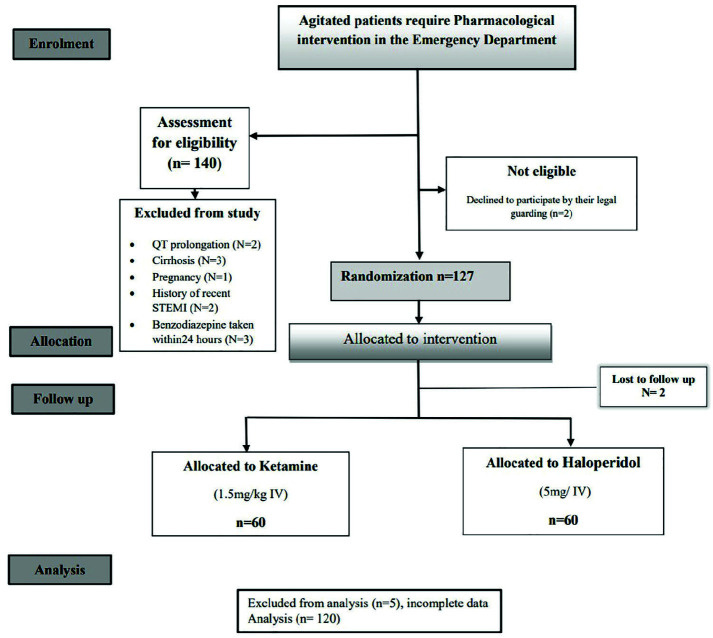
Results: A total of 120 participants were randomized. The majority were male, comprising 43 (73%) in the haloperidol group and 45 (75%) in the ketamine group. The mean age was 45.42±16.65 in the ketamine group and 48.28±16.75 years in the haloperidol group (p=0.34). In the haloperidol group, the mean admission RASS score was 1.73±0.75, which decreased to 0.07±1.25 post-intervention. In the ketamine group, the mean admission RASS score was 1.58±0.61, which improved to -0.92±1.19 following treatment.
Conclusion: Ketamine demonstrated a faster onset of action in managing acute agitation than haloperidol. These findings suggested that ketamine might represent a viable first-line therapeutic option for acutely agitated patients, particularly in clinical scenarios where rapid symptom control is critical.
期刊介绍:
BEAT: Bulletin of Emergency And Trauma is an international, peer-reviewed, quarterly journal coping with original research contributing to the field of emergency medicine and trauma. BEAT is the official journal of the Trauma Research Center (TRC) of Shiraz University of Medical Sciences (SUMS), Hungarian Trauma Society (HTS) and Lusitanian Association for Trauma and Emergency Surgery (ALTEC/LATES) aiming to be a publication of international repute that serves as a medium for dissemination and exchange of scientific knowledge in the emergency medicine and trauma. The aim of BEAT is to publish original research focusing on practicing and training of emergency medicine and trauma to publish peer-reviewed articles of current international interest in the form of original articles, brief communications, reviews, case reports, clinical images, and letters.



 求助内容:
求助内容: 应助结果提醒方式:

 京公网安备 11010802042870号


