
Triassic-Cretaceous sedimentary and magmatic development of the classic SW outcrop of the Antalya Complex, S Türkiye as a developing rift and passive margin bordering the Southern Neotethys
IF 2.4
3区 地球科学
Q2 GEOSCIENCES, MULTIDISCIPLINARY
Journal of Asian Earth Sciences
Pub Date : 2026-01-01
Epub Date: 2025-10-14
DOI:10.1016/j.jseaes.2025.106831
引用次数: 0
Abstract
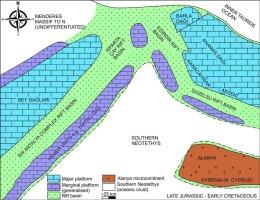
The SW segment of the Antalya Complex (Antalya nappes) documents sedimentation, magmatism and tectonics related to Permian-Triassic continental rifting, Jurassic-Cretaceous passive margin subsidence, Late Cretaceous ophiolite genesis, and latest Cretaceous initial emplacement. Pulsed rifting took place during Late Permian and Early Triassic, followed by continental break-up during Late Triassic, and then Jurassic-Late Cretaceous (Santonian) passive margin subsidence. In the west, the Lower Antalya Unit records Late Triassic (Norian) rifting and collapse of the adjacent carbonate platform (Bey Dağları), then latest Triassic (Rhaetian)-Cenomanian development of a channelised carbonate slope with redeposited shallow-water carbonates. The Middle Antalya Unit begins with Mid-Triassic (Ladinian) radiolarites, overlain by Middle-Upper Triassic siliciclastic turbidites, deep-water hemipelagic carbonates (drift deposits) and radiolarites. Alkaline volcanics erupted during Late Triassic in a deep-water setting. Deep-water radiolarites characterised Rhaetian to Late Cenomanian-Turonian. Within the Upper Antalya Unit farther east, above pre-rift and early syn-rift crust, Middle Triassic (Ladinian) radiolarites were followed by Upper Triassic hemipelagic carbonates, then uppermost Triassic-Cenomanian shallow-water platform carbonates. The SW Antalya Complex restores to the northern margin of the Southern Neotethys. The upper unit (Cambrian-Devonian) rifted during Late Permian, Middle Triassic (Ladinian) and Late Triassic (Carnian-Norian). Rift-related flexural and/or thermal uplift preceded seafloor spreading, similar to the Central-Northern Red Sea. Dismembered ophiolitic rocks were emplaced from the adjacent Southern Neotethys during the latest Cretaceous. Initial ophiolite emplacement resulted in collapse of the passive margin and transgression by mass-flow deposits. Initial emplacement by thrusting and strike-slip, during late Campanian-Maastrichtian, was followed by Paleocene, Eocene and Miocene emplacement events.
安塔利亚杂岩的三叠纪-白垩纪的沉积和岩浆发育,S trkiye是一个发育中的裂谷和与南新特提斯相接壤的被动边缘
安塔利亚杂岩西南段(安塔利亚推覆体)记录了与二叠纪-三叠纪大陆裂陷、侏罗纪-白垩纪被动边缘沉降、晚白垩世蛇绿岩成因和晚白垩世初始侵位有关的沉积、岩浆和构造活动。晚二叠世—早三叠世发生脉冲裂陷,晚三叠世发生大陆分裂,侏罗纪—晚白垩世(三东期)被动边缘沉降。在西部,下安塔利亚单元记录了晚三叠世(Norian)的裂谷作用和相邻碳酸盐岩台地的坍塌(Bey Dağları),然后是晚三叠世(Rhaetian)-Cenomanian的水道化碳酸盐岩斜坡发育,浅水碳酸盐岩再沉积。中安塔利亚单元开始于中三叠统(拉丁统)辐射斑岩,上覆中上三叠统硅质碎屑浊积岩、深水半深海碳酸盐(漂移沉积)和辐射斑岩。碱性火山在晚三叠世的深水环境中喷发。深水放射石特征为雷提亚至晚塞诺曼尼亚-土尔宁世。在较东的上安塔利亚单元内,在裂谷前和早期同裂谷地壳之上,中三叠统(拉底统)放射斑岩其次是上三叠统半深海碳酸盐岩,然后是上三叠统-塞诺曼阶浅水台地碳酸盐岩。西南安塔利亚复合体恢复了南新特提斯的北缘。上单元(寒武系—泥盆系)在晚二叠世、中三叠世(拉迭世)和晚三叠世(卡尼—诺里世)期间发生裂谷。与裂谷相关的弯曲和/或热隆起先于海底扩张,类似于红海中部-北部。被肢解的蛇绿岩是在白垩纪晚期从邻近的南新特提斯形成的。最初的蛇绿岩侵位导致被动边缘塌陷和质量流沉积的海侵。晚坎帕尼亚-马斯垂克期以逆冲和走滑为初始侵位,随后发生了古新世、始新世和中新世侵位事件。
本文章由计算机程序翻译,如有差异,请以英文原文为准。
求助全文
约1分钟内获得全文
求助全文
来源期刊
Journal of Asian Earth Sciences
地学-地球科学综合
CiteScore
5.90
自引率
10.00%
发文量
324
审稿时长
71 days
期刊介绍:
Journal of Asian Earth Sciences has an open access mirror journal Journal of Asian Earth Sciences: X, sharing the same aims and scope, editorial team, submission system and rigorous peer review.
The Journal of Asian Earth Sciences is an international interdisciplinary journal devoted to all aspects of research related to the solid Earth Sciences of Asia. The Journal publishes high quality, peer-reviewed scientific papers on the regional geology, tectonics, geochemistry and geophysics of Asia. It will be devoted primarily to research papers but short communications relating to new developments of broad interest, reviews and book reviews will also be included. Papers must have international appeal and should present work of more than local significance.
The scope includes deep processes of the Asian continent and its adjacent oceans; seismology and earthquakes; orogeny, magmatism, metamorphism and volcanism; growth, deformation and destruction of the Asian crust; crust-mantle interaction; evolution of life (early life, biostratigraphy, biogeography and mass-extinction); fluids, fluxes and reservoirs of mineral and energy resources; surface processes (weathering, erosion, transport and deposition of sediments) and resulting geomorphology; and the response of the Earth to global climate change as viewed within the Asian continent and surrounding oceans.
 求助内容:
求助内容: 应助结果提醒方式:

 京公网安备 11010802042870号


