
Biochar-based “in-vial” stir bar sorptive microextraction for a greener determination of steroid hormones in saliva

IF 3.2
Journal of chromatography open Pub Date : 2026-05-01 Epub Date: 2025-11-14 DOI:10.1016/j.jcoa.2025.100287
Valentina Quarta, Francesca Merlo, Chiara Milanese, Antonella Profumo, Andrea Speltini
{"title":"Biochar-based “in-vial” stir bar sorptive microextraction for a greener determination of steroid hormones in saliva","authors":"Valentina Quarta,&nbsp;Francesca Merlo,&nbsp;Chiara Milanese,&nbsp;Antonella Profumo,&nbsp;Andrea Speltini","doi":"10.1016/j.jcoa.2025.100287","DOIUrl":null,"url":null,"abstract":"<div><div>This work presents a novel application of biochar as a new-generation sorbent to bioanalytical sample preparation. The carbonaceous material produced by pyrolysis of vegetal wastes (orange and pumpkin peels) at 650°C was easily attached (∼ 4 mg) to a small magnetic stir bar (8 × 3 mm), enabling a novel stir bar sorptive microextraction protocol to be performed directly in the HPLC-MS vial. The device was first tested in synthetic saliva samples (1 mL) observing sorption equilibrium in 1 h contact time and full elution was achieved using 300 µL 1 % v/v acetic acid ethanol solution after 30 min. Under the selected conditions, recovery in real saliva, spiked with each analyte in the range 0.5-5 ng mL<sup>-1</sup>, was in the range 88%-112%, with good inter-day inter-batch device-to-device precision (RSD &lt; 18%, <em>n=3</em>), and no need for additional clean-up. Reusability tests confirmed that the device retains its sorption/desorption efficiency over at least 20 consecutive cycles. Additionally, the greenness of this biochar-based “in-vial” approach as a new stir bar sorptive microextraction was proven by using different dedicated software. The practical applicability of the procedure was demonstrated in real saliva samples from healthy volunteers.</div></div>","PeriodicalId":93576,"journal":{"name":"Journal of chromatography open","volume":"9 ","pages":"Article 100287"},"PeriodicalIF":3.2000,"publicationDate":"2026-05-01","publicationTypes":"Journal Article","fieldsOfStudy":null,"isOpenAccess":false,"openAccessPdf":"","citationCount":"0","resultStr":null,"platform":"Semanticscholar","paperid":null,"PeriodicalName":"Journal of chromatography open","FirstCategoryId":"1085","ListUrlMain":"https://www.sciencedirect.com/science/article/pii/S2772391725000866","RegionNum":0,"RegionCategory":null,"ArticlePicture":[],"TitleCN":null,"AbstractTextCN":null,"PMCID":null,"EPubDate":"2025/11/14 0:00:00","PubModel":"Epub","JCR":"","JCRName":"","Score":null,"Total":0}
引用次数: 0

Abstract

This work presents a novel application of biochar as a new-generation sorbent to bioanalytical sample preparation. The carbonaceous material produced by pyrolysis of vegetal wastes (orange and pumpkin peels) at 650°C was easily attached (∼ 4 mg) to a small magnetic stir bar (8 × 3 mm), enabling a novel stir bar sorptive microextraction protocol to be performed directly in the HPLC-MS vial. The device was first tested in synthetic saliva samples (1 mL) observing sorption equilibrium in 1 h contact time and full elution was achieved using 300 µL 1 % v/v acetic acid ethanol solution after 30 min. Under the selected conditions, recovery in real saliva, spiked with each analyte in the range 0.5-5 ng mL-1, was in the range 88%-112%, with good inter-day inter-batch device-to-device precision (RSD < 18%, n=3), and no need for additional clean-up. Reusability tests confirmed that the device retains its sorption/desorption efficiency over at least 20 consecutive cycles. Additionally, the greenness of this biochar-based “in-vial” approach as a new stir bar sorptive microextraction was proven by using different dedicated software. The practical applicability of the procedure was demonstrated in real saliva samples from healthy volunteers.
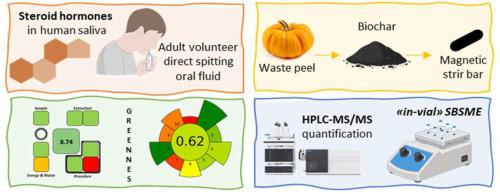
Abstract Image

生物炭为基础的“瓶内”搅拌棒吸附微萃取更环保地测定唾液中的类固醇激素
这项工作提出了生物炭作为新一代吸附剂在生物分析样品制备中的新应用。在650°C下,植物废物(橘子皮和南瓜皮)热解产生的碳质物质很容易(~ 4 mg)附着在一个小的磁性搅拌棒(8 × 3 mm)上,从而使一种新的搅拌棒吸附微萃取方案可以直接在HPLC-MS小瓶中进行。首先在合成唾液样品(1ml)中测试该装置,在1小时的接触时间内观察吸附平衡,并在30分钟后用300µL 1% v/v的醋酸乙醇溶液完全洗脱。在所选择的条件下,在实际唾液中,每种分析物加标在0.5-5 ng mL-1范围内,回收率在88%-112%范围内,具有良好的日间批次间设备到设备的精密度(RSD < 18%, n=3),无需额外的清理。重复使用测试证实,该设备在至少20个连续循环中保持其吸附/解吸效率。此外,通过使用不同的专用软件,证明了这种基于生物炭的“瓶内”方法作为一种新的搅拌棒吸附微萃取方法的环保性。该程序的实际适用性在健康志愿者的真实唾液样本中得到了证明。
本文章由计算机程序翻译,如有差异,请以英文原文为准。
求助全文
约1分钟内获得全文 求助全文
来源期刊
Journal of chromatography open
Journal of chromatography open Analytical Chemistry
CiteScore
2.50
自引率
0.00%
发文量
0
审稿时长
50 days

×
引用
GB/T 7714-2015
复制
MLA
复制
APA
复制
导出至
BibTeX EndNote RefMan NoteFirst NoteExpress
×
提示
您的信息不完整,为了账户安全,请先补充。
现在去补充
×
提示
您因"违规操作"
具体请查看互助需知
我知道了
×
提示
确定
请完成安全验证×
copy
已复制链接
快去分享给好友吧!
我知道了
右上角分享
点击右上角分享
0
联系我们:info@booksci.cn Book学术提供免费学术资源搜索服务,方便国内外学者检索中英文文献。致力于提供最便捷和优质的服务体验。 Copyright © 2023 布克学术 All rights reserved.
京ICP备2023020795号-1
ghs 京公网安备 11010802042870号
Book学术文献互助
Book学术文献互助群
群 号:604180095
Book学术官方微信
小红书


