{"title":"Posttraumatic stress disorder and susceptibility to misinformation for an analogue trauma event.","authors":"Prerika R Sharma, Kimberley A Wade, Laura Jobson","doi":"10.1037/tra0002063","DOIUrl":null,"url":null,"abstract":"<p><strong>Objective: </strong>There is a dearth of research on the relationship between posttraumatic stress disorder (PTSD) and memory distortions that result from external, suggestive influences. This study, therefore, aimed to investigate the relationship between PTSD symptoms and susceptibility to misinformation.</p><p><strong>Method: </strong>To address this aim, we used the trauma film paradigm and misinformation paradigm. One hundred community participants (22-65 years, 72 women, 25 men, three gender diverse) completed measures assessing PTSD symptoms and trauma exposure. Participants then viewed a film about a car accident, received verbal misinformation along with repeated and no repeated information, then completed cued recall, recognition, and source memory tests (immediate retrieval). Ninety participants completed the same memory tasks 1 week later (delayed retrieval).</p><p><strong>Results: </strong>First, a clear misinformation effect was found. Second, PTSD symptom severity was not uniquely associated with the misinformation effect. However, for those with past exposure to a transportation accident, PTSD symptom severity was associated with a smaller misinformation effect on recognition and source memory tests. For those without past exposure, PTSD symptom severity was associated with a larger misinformation effect on the same tests.</p><p><strong>Conclusions: </strong>The relationship between PTSD and the misinformation effect warrants the consideration of event relevance. If findings are replicated, legal and clinical professionals should enact extra caution in avoiding suggestive language when working with individuals with PTSD who have witnessed a novel type of stressful event. (PsycInfo Database Record (c) 2026 APA, all rights reserved).</p>","PeriodicalId":20982,"journal":{"name":"Psychological trauma : theory, research, practice and policy","volume":" ","pages":"876-888"},"PeriodicalIF":2.3000,"publicationDate":"2026-05-01","publicationTypes":"Journal Article","fieldsOfStudy":null,"isOpenAccess":false,"openAccessPdf":"","citationCount":"0","resultStr":null,"platform":"Semanticscholar","paperid":null,"PeriodicalName":"Psychological trauma : theory, research, practice and policy","FirstCategoryId":"102","ListUrlMain":"https://doi.org/10.1037/tra0002063","RegionNum":2,"RegionCategory":"心理学","ArticlePicture":[],"TitleCN":null,"AbstractTextCN":null,"PMCID":null,"EPubDate":"2025/11/17 0:00:00","PubModel":"Epub","JCR":"Q2","JCRName":"PSYCHIATRY","Score":null,"Total":0}
引用次数: 0
Abstract
Objective: There is a dearth of research on the relationship between posttraumatic stress disorder (PTSD) and memory distortions that result from external, suggestive influences. This study, therefore, aimed to investigate the relationship between PTSD symptoms and susceptibility to misinformation.
Method: To address this aim, we used the trauma film paradigm and misinformation paradigm. One hundred community participants (22-65 years, 72 women, 25 men, three gender diverse) completed measures assessing PTSD symptoms and trauma exposure. Participants then viewed a film about a car accident, received verbal misinformation along with repeated and no repeated information, then completed cued recall, recognition, and source memory tests (immediate retrieval). Ninety participants completed the same memory tasks 1 week later (delayed retrieval).
Results: First, a clear misinformation effect was found. Second, PTSD symptom severity was not uniquely associated with the misinformation effect. However, for those with past exposure to a transportation accident, PTSD symptom severity was associated with a smaller misinformation effect on recognition and source memory tests. For those without past exposure, PTSD symptom severity was associated with a larger misinformation effect on the same tests.
Conclusions: The relationship between PTSD and the misinformation effect warrants the consideration of event relevance. If findings are replicated, legal and clinical professionals should enact extra caution in avoiding suggestive language when working with individuals with PTSD who have witnessed a novel type of stressful event. (PsycInfo Database Record (c) 2026 APA, all rights reserved).
期刊介绍:
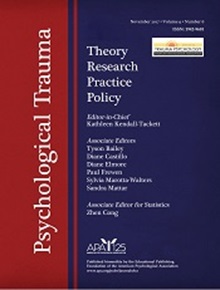
Psychological Trauma: Theory, Research, Practice, and Policy publishes empirical research on the psychological effects of trauma. The journal is intended to be a forum for an interdisciplinary discussion on trauma, blending science, theory, practice, and policy.
The journal publishes empirical research on a wide range of trauma-related topics, including:
-Psychological treatments and effects
-Promotion of education about effects of and treatment for trauma
-Assessment and diagnosis of trauma
-Pathophysiology of trauma reactions
-Health services (delivery of services to trauma populations)
-Epidemiological studies and risk factor studies
-Neuroimaging studies
-Trauma and cultural competence

 求助内容:
求助内容: 应助结果提醒方式:

 京公网安备 11010802042870号


