
Valorization of plastic waste for interfacial solar evaporation: A sustainable pathway towards clean water generation

Q1 Materials Science
Shahd Sefelnasr , Maryam Nooman AlMallahi , Mahmoud Elgendi
{"title":"Valorization of plastic waste for interfacial solar evaporation: A sustainable pathway towards clean water generation","authors":"Shahd Sefelnasr ,&nbsp;Maryam Nooman AlMallahi ,&nbsp;Mahmoud Elgendi","doi":"10.1016/j.mset.2025.10.001","DOIUrl":null,"url":null,"abstract":"<div><div>Plastic pollution and water scarcity are urgent global challenges that demand sustainable solutions. Municipal solid waste (MSW), including plastic waste, is a crucial environmental challenge that contributes to global pollution and threatens ecosystems. MSW can be used in various applications beyond disposal, such as energy recovery systems, biogas production, the development of construction materials, and desalination. For instance, in interfacial solar evaporation (ISE), waste plastic efficiently produces water through solar-driven steam generation. Plastic materials possess properties such as low thermal conductivity and hydrophobicity that can enhance water evaporation efficiency. This review evaluates recent advances in plastic upcycling strategies and fabrication techniques for enhancing ISE. ISE systems using plastic garbage bags with direct repurposing reached a water evaporation rate of 8.96 kg⋅m<sup>−2</sup>⋅h<sup>−1</sup>. Repurposing plastic waste into solar evaporators, transparent solar stills, and insulation materials significantly improves water evaporation efficiency. In addition, the integration of plastic waste in ISE contributes to multiple Sustainable Development Goals (SDGs), including Clean Water and Sanitation (SDG<!--> <!-->6), Responsible Consumption and Production (SDG<!--> <!-->12), and Climate Action (SDG<!--> <!-->13). Furthermore, integrating waste management strategies with innovative water purification technologies enables scholars to assess the potential of waste plastic in advancing ISE for more sustainable water evaporation.</div></div>","PeriodicalId":18283,"journal":{"name":"Materials Science for Energy Technologies","volume":"8 ","pages":"Pages 243-255"},"PeriodicalIF":0.0000,"publicationDate":"2025-01-01","publicationTypes":"Journal Article","fieldsOfStudy":null,"isOpenAccess":false,"openAccessPdf":"","citationCount":"0","resultStr":null,"platform":"Semanticscholar","paperid":null,"PeriodicalName":"Materials Science for Energy Technologies","FirstCategoryId":"1085","ListUrlMain":"https://www.sciencedirect.com/science/article/pii/S2589299125000138","RegionNum":0,"RegionCategory":null,"ArticlePicture":[],"TitleCN":null,"AbstractTextCN":null,"PMCID":null,"EPubDate":"2025/11/7 0:00:00","PubModel":"Epub","JCR":"Q1","JCRName":"Materials Science","Score":null,"Total":0}
引用次数: 0

Abstract

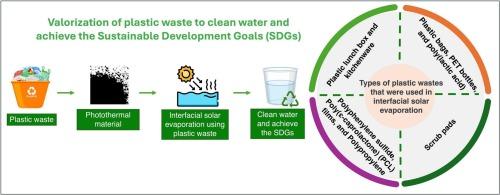
Plastic pollution and water scarcity are urgent global challenges that demand sustainable solutions. Municipal solid waste (MSW), including plastic waste, is a crucial environmental challenge that contributes to global pollution and threatens ecosystems. MSW can be used in various applications beyond disposal, such as energy recovery systems, biogas production, the development of construction materials, and desalination. For instance, in interfacial solar evaporation (ISE), waste plastic efficiently produces water through solar-driven steam generation. Plastic materials possess properties such as low thermal conductivity and hydrophobicity that can enhance water evaporation efficiency. This review evaluates recent advances in plastic upcycling strategies and fabrication techniques for enhancing ISE. ISE systems using plastic garbage bags with direct repurposing reached a water evaporation rate of 8.96 kg⋅m−2⋅h−1. Repurposing plastic waste into solar evaporators, transparent solar stills, and insulation materials significantly improves water evaporation efficiency. In addition, the integration of plastic waste in ISE contributes to multiple Sustainable Development Goals (SDGs), including Clean Water and Sanitation (SDG 6), Responsible Consumption and Production (SDG 12), and Climate Action (SDG 13). Furthermore, integrating waste management strategies with innovative water purification technologies enables scholars to assess the potential of waste plastic in advancing ISE for more sustainable water evaporation.
Abstract Image

用于界面太阳能蒸发的塑料废物的增值:通向清洁水产生的可持续途径
塑料污染和水资源短缺是迫切的全球挑战,需要可持续的解决方案。城市固体废物(MSW),包括塑料废物,是造成全球污染和威胁生态系统的重大环境挑战。除了处理之外,城市生活垃圾还可以用于各种应用,例如能源回收系统、沼气生产、建筑材料的开发和海水淡化。例如,在界面太阳能蒸发(ISE)中,废塑料通过太阳能驱动的蒸汽产生有效地产生水。塑料材料具有低导热性和疏水性等特性,可以提高水的蒸发效率。这篇综述评估了塑料升级回收策略和制造技术的最新进展,以提高ISE。采用塑料垃圾袋直接再利用的ISE系统水蒸发速率为8.96 kg⋅m−2⋅h−1。将塑料废物转化为太阳能蒸发器、透明太阳能蒸馏器和绝缘材料,可显著提高水的蒸发效率。此外,在ISE中整合塑料废物有助于实现多个可持续发展目标(SDG),包括清洁水和卫生(SDG 6),负责任的消费和生产(SDG 12)以及气候行动(SDG 13)。此外,将废物管理策略与创新的水净化技术相结合,使学者能够评估废塑料在推动ISE实现更可持续的水蒸发方面的潜力。
本文章由计算机程序翻译,如有差异,请以英文原文为准。
求助全文
约1分钟内获得全文 求助全文
来源期刊
Materials Science for Energy Technologies
Materials Science for Energy Technologies Materials Science-Materials Science (miscellaneous)
CiteScore
16.50
自引率
0.00%
发文量
41
审稿时长
39 days

×
引用
GB/T 7714-2015
复制
MLA
复制
APA
复制
导出至
BibTeX EndNote RefMan NoteFirst NoteExpress
×
提示
您的信息不完整,为了账户安全,请先补充。
现在去补充
×
提示
您因"违规操作"
具体请查看互助需知
我知道了
×
提示
确定
请完成安全验证×
copy
已复制链接
快去分享给好友吧!
我知道了
右上角分享
点击右上角分享
0
联系我们:info@booksci.cn Book学术提供免费学术资源搜索服务,方便国内外学者检索中英文文献。致力于提供最便捷和优质的服务体验。 Copyright © 2023 布克学术 All rights reserved.
京ICP备2023020795号-1
ghs 京公网安备 11010802042870号
Book学术文献互助
Book学术文献互助群
群 号:604180095
Book学术官方微信
小红书


