
Neurosarcoidosis masquerading as recurrent tumefactive demyelinating-appearing brain lesions: An 8-year diagnostic odyssey
IF 3.1
4区 医学
Q3 IMMUNOLOGY
Journal of neuroimmunology
Pub Date : 2026-01-15
Epub Date: 2025-11-08
DOI:10.1016/j.jneuroim.2025.578802
引用次数: 0
Abstract
Background
Neurosarcoidosis is a rare inflammatory condition that can occasionally present with recurrent tumefactive lesions resembling those of idiopathic demyelinating diseases. Diagnosis is frequently delayed because clinical and radiological features overlap with demyelinating disorders, and systemic signs may initially be absent.
Case presentation
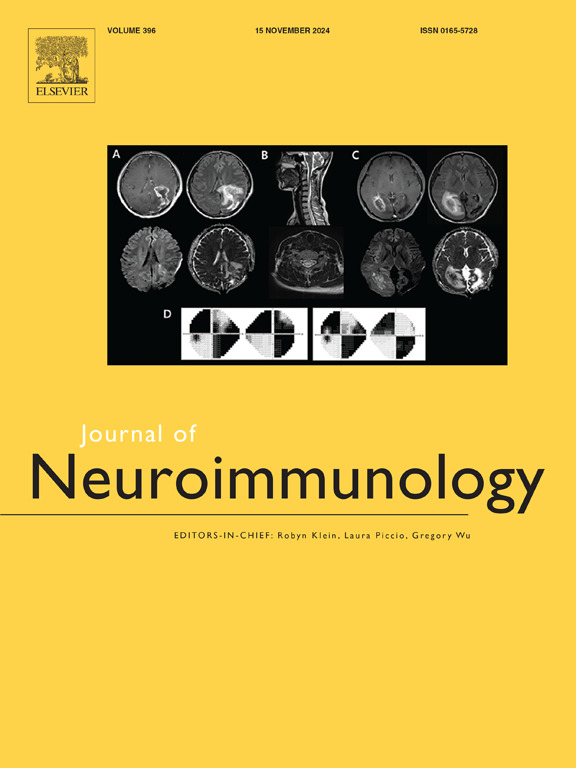
We report a woman who first presented at 23 years of age with a tumefactive demyelinating-appearing brain lesion and, eight years later, experienced recurrence with new involvement of the brain and spinal cord. The second episode featured a new tumefactive demyelinating-appearing brain lesion, longitudinally extensive transverse myelitis, vertebral enhancement, and systemic manifestations. Imaging revealed mediastinal lymphadenopathy and multiple hypodense lesions in the liver and spleen, while histopathologic examination of a mediastinal lymph node demonstrated noncaseating granulomas, confirming sarcoidosis.
Conclusion
To our knowledge, this is the first detailed report of neurosarcoidosis evolving from an initially isolated tumefactive demyelinating-appearing brain lesion to a later episode characterized by recurrent brain involvement with simultaneous spinal and systemic disease after a prolonged asymptomatic interval. Clinicians should consider neurosarcoidosis in the differential diagnosis of tumefactive demyelinating-appearing brain lesions, particularly when an initially isolated presentation is followed by subsequent brain, spinal, and systemic involvement, even in young patients without systemic features at onset.
神经结节病伪装为复发性肿瘤性脱髓鞘脑病变:8年诊断奥德赛。
背景:神经结节病是一种罕见的炎症性疾病,偶尔会出现类似特发性脱髓鞘疾病的复发性肿瘤病变。由于临床和放射学特征与脱髓鞘疾病重叠,并且最初可能没有全身性体征,因此诊断经常延迟。病例介绍:我们报告了一位23岁时首次出现肿瘤性脱髓鞘样脑病变的女性,8年后复发并累及大脑和脊髓。第二次发作表现为新的膨胀性脱髓鞘,表现为脑损伤,纵向广泛的横向脊髓炎,椎体增强和全身表现。影像学显示纵隔淋巴结病变,肝脏和脾脏多发低密度病变,而组织病理学检查显示纵隔淋巴结非干酪化肉芽肿,证实结节病。结论:据我们所知,这是首次详细报道神经结节病从最初孤立的肿瘤性脱髓鞘脑病变发展到后来的发作,其特征是在长时间无症状间隔后复发性脑受累并同时伴有脊柱和全身性疾病。临床医生在鉴别诊断肿瘤性脱髓鞘性脑病变时应考虑神经结节病,特别是当最初的孤立表现随后累及大脑、脊柱和全身时,即使是发病时没有全身特征的年轻患者。
本文章由计算机程序翻译,如有差异,请以英文原文为准。
求助全文
约1分钟内获得全文
求助全文
来源期刊
Journal of neuroimmunology
医学-免疫学
CiteScore
6.10
自引率
3.00%
发文量
154
审稿时长
37 days
期刊介绍:
The Journal of Neuroimmunology affords a forum for the publication of works applying immunologic methodology to the furtherance of the neurological sciences. Studies on all branches of the neurosciences, particularly fundamental and applied neurobiology, neurology, neuropathology, neurochemistry, neurovirology, neuroendocrinology, neuromuscular research, neuropharmacology and psychology, which involve either immunologic methodology (e.g. immunocytochemistry) or fundamental immunology (e.g. antibody and lymphocyte assays), are considered for publication.
 求助内容:
 应助结果提醒方式:


 京公网安备 11010802042870号


