N. E. A. Azhar, N. H. Sulimai, M. J. Salifairus, M. H. Mamat, S. S. Shariffudin, A. Shuhaimi, M. F. Malek, K. A. Eswar, M. Rusop
{"title":"Manipulation of Niobium Dopant concentrations on TiO2 nanotube arrays film via dual-steps electrochemical method for humidity sensor","authors":"N. E. A. Azhar, N. H. Sulimai, M. J. Salifairus, M. H. Mamat, S. S. Shariffudin, A. Shuhaimi, M. F. Malek, K. A. Eswar, M. Rusop","doi":"10.1007/s10934-025-01853-3","DOIUrl":null,"url":null,"abstract":"<div><p>Titanium dioxide (TiO<sub>2</sub>) material is suitable for sensing applications due to higher electron mobility, stability, high sensitivity to water vapor and more easily desorb physisorbed water molecules. However, the non-homogeneous formation of TiO<sub>2</sub> nanotube arrays due to cracking structure is a common issue. Cracking during the preparation of TiO<sub>2</sub> nanotube arrays (TiO<sub>2</sub> NTAs) films can lead to the deterioration and malfunction of the nanotubes. The work presented here describes the niobium-doped TiO<sub>2</sub> NTAs (Nb-doped TiO<sub>2</sub> NTAs) films prepared by the dual-step electrochemical methods at different doping concentrations (1 to 7 at%). It was found that the film doped at 3 at% and annealed at 500 °C showed excellent conductivity with a value of 0.52 S. cm<sup>−1</sup>. Results showed that the TiO<sub>2</sub> NTAs exhibited a humidity sensitivity of 239.85. The humidity sensing performance of the fabricated TiO<sub>2</sub> NTAs has been enhanced to 602.15 by doping with 3 at% of Nb. The enlargement of the area facilitated a slight increment of humidity sensitivity of Nb-doped TiO<sub>2</sub> NTAs films. This phenomenon was induced by reducing the average diameter of NTAs in TiO<sub>2</sub> film when the Nb dopant occupied the TiO<sub>2</sub> structure (59 to 48 nm). Nb is commonly combined with TiO<sub>2</sub> material as its regarded as a promising dopant for modifying crystalline structure. The Nb-doped TiO<sub>2</sub> NTAs shows high sensor stability since the Nb ions widen the host TiO<sub>2</sub> lattice thus improving the conductivity of TiO<sub>2</sub>. The optimized Nb-doped TiO<sub>2</sub> NTAs films using the electrochemical cathodization method shows it is applicable for humidity sensor.</p></div>","PeriodicalId":660,"journal":{"name":"Journal of Porous Materials","volume":"32 6","pages":"2349 - 2372"},"PeriodicalIF":3.0000,"publicationDate":"2025-09-05","publicationTypes":"Journal Article","fieldsOfStudy":null,"isOpenAccess":false,"openAccessPdf":"","citationCount":"0","resultStr":null,"platform":"Semanticscholar","paperid":null,"PeriodicalName":"Journal of Porous Materials","FirstCategoryId":"88","ListUrlMain":"https://link.springer.com/article/10.1007/s10934-025-01853-3","RegionNum":4,"RegionCategory":"材料科学","ArticlePicture":[],"TitleCN":null,"AbstractTextCN":null,"PMCID":null,"EPubDate":"","PubModel":"","JCR":"Q2","JCRName":"CHEMISTRY, APPLIED","Score":null,"Total":0}
引用次数: 0
Abstract
Titanium dioxide (TiO2) material is suitable for sensing applications due to higher electron mobility, stability, high sensitivity to water vapor and more easily desorb physisorbed water molecules. However, the non-homogeneous formation of TiO2 nanotube arrays due to cracking structure is a common issue. Cracking during the preparation of TiO2 nanotube arrays (TiO2 NTAs) films can lead to the deterioration and malfunction of the nanotubes. The work presented here describes the niobium-doped TiO2 NTAs (Nb-doped TiO2 NTAs) films prepared by the dual-step electrochemical methods at different doping concentrations (1 to 7 at%). It was found that the film doped at 3 at% and annealed at 500 °C showed excellent conductivity with a value of 0.52 S. cm−1. Results showed that the TiO2 NTAs exhibited a humidity sensitivity of 239.85. The humidity sensing performance of the fabricated TiO2 NTAs has been enhanced to 602.15 by doping with 3 at% of Nb. The enlargement of the area facilitated a slight increment of humidity sensitivity of Nb-doped TiO2 NTAs films. This phenomenon was induced by reducing the average diameter of NTAs in TiO2 film when the Nb dopant occupied the TiO2 structure (59 to 48 nm). Nb is commonly combined with TiO2 material as its regarded as a promising dopant for modifying crystalline structure. The Nb-doped TiO2 NTAs shows high sensor stability since the Nb ions widen the host TiO2 lattice thus improving the conductivity of TiO2. The optimized Nb-doped TiO2 NTAs films using the electrochemical cathodization method shows it is applicable for humidity sensor.
期刊介绍:
The Journal of Porous Materials is an interdisciplinary and international periodical devoted to all types of porous materials. Its aim is the rapid publication
of high quality, peer-reviewed papers focused on the synthesis, processing, characterization and property evaluation of all porous materials. The objective is to
establish a unique journal that will serve as a principal means of communication for the growing interdisciplinary field of porous materials.
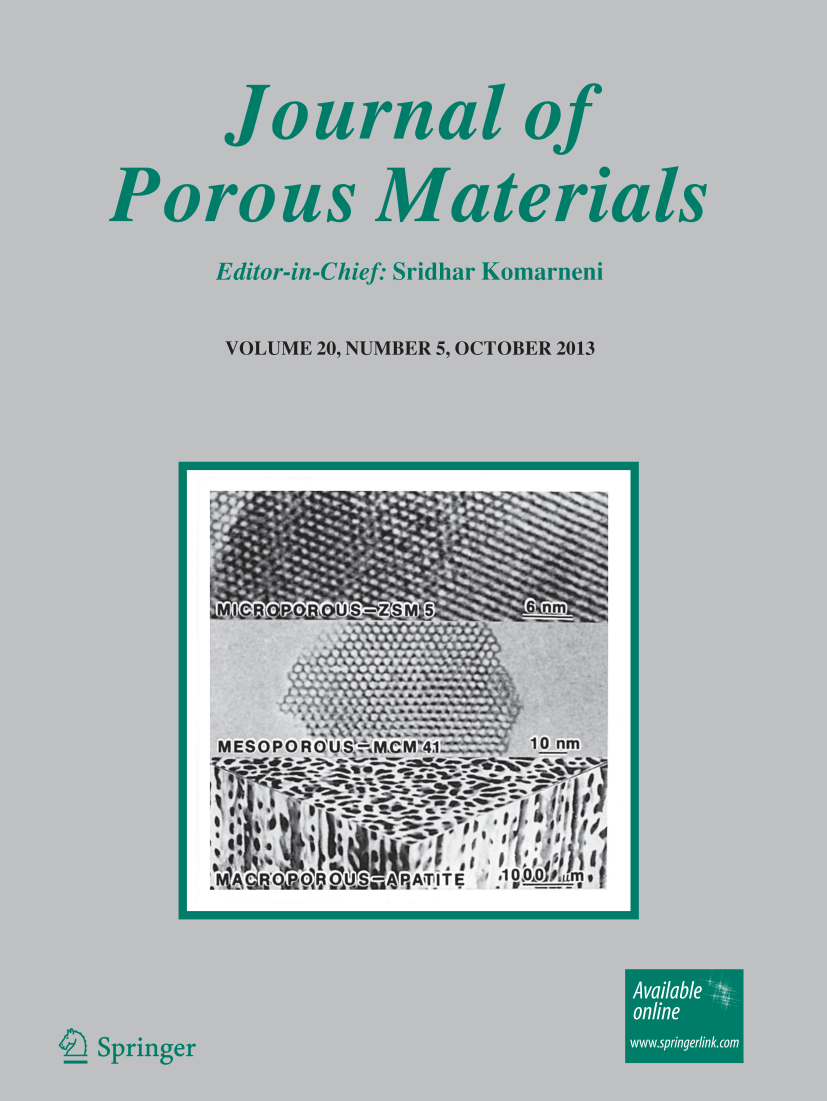
Porous materials include microporous materials with 50 nm pores.
Examples of microporous materials are natural and synthetic molecular sieves, cationic and anionic clays, pillared clays, tobermorites, pillared Zr and Ti
phosphates, spherosilicates, carbons, porous polymers, xerogels, etc. Mesoporous materials include synthetic molecular sieves, xerogels, aerogels, glasses, glass
ceramics, porous polymers, etc.; while macroporous materials include ceramics, glass ceramics, porous polymers, aerogels, cement, etc. The porous materials
can be crystalline, semicrystalline or noncrystalline, or combinations thereof. They can also be either organic, inorganic, or their composites. The overall
objective of the journal is the establishment of one main forum covering the basic and applied aspects of all porous materials.

 求助内容:
求助内容: 应助结果提醒方式:

 京公网安备 11010802042870号


