Hannah Sofiah Roslan, Ana Najwa Mustapa, Ahmad Naqiuddin Muhamad Tajuddin, Suhaiza Hanim Hanipah, Ángel Martín, María José Cocero
{"title":"Synthesis of modified hydrophobic hybrid biopolymer alginate/soy protein isolates aerogels via scCO2 drying for oil removal","authors":"Hannah Sofiah Roslan, Ana Najwa Mustapa, Ahmad Naqiuddin Muhamad Tajuddin, Suhaiza Hanim Hanipah, Ángel Martín, María José Cocero","doi":"10.1007/s10934-025-01836-4","DOIUrl":null,"url":null,"abstract":"<div><p>Oil pollution poses significant environmental challenges, necessitating the development of effective and sustainable solutions for oil absorbents. In this work, sodium alginate (ALG) and soy protein isolate (SPI) were combined via a sol–gel method, followed by surface functionalization using methyltrimethoxysilane (MTMS) and tetraethyl orthosilicate (TEOS) and dried by supercritical carbon dioxide (scCO<sub>2</sub>) to produce a hybrid aerogel oil absorbent. ALG concentration was varied from 1 to 3% w/w, while SPI concentrations were constant at 0.5 and 1.5% w/w. Results showed that the one-step surface modification successfully changed the ALG/SPI aerogel to hydrophobic. ALG/SPI aerogels are capable of absorbing model pollutants (i.e., waste engine oil, heavy-duty oil and chloroform) ranging from 1.34 to 10.3 g/g, with the highest absorption efficiency reaching 91%. Notably, ALG/SPI 1_1.5 appears as the most effective, absorbing waste oil at temperatures from 40 to 80 °C, has a high surface area (210 m<sup>2</sup>∙g<sup>−1</sup>), lightweight (0.107 g·cm<sup>−3</sup>), thermally stable over 196 °C, and is reusable up to four times. ALG/SPI aerogel remains afloat, retaining absorbed pollutants and is biodegradable, hence reducing post-use environmental impact. This study demonstrated that the hybrid ALG/SPI aerogels are promising materials as oil absorbents in the oil/water separation industry.</p></div>","PeriodicalId":660,"journal":{"name":"Journal of Porous Materials","volume":"32 6","pages":"2293 - 2311"},"PeriodicalIF":3.0000,"publicationDate":"2025-08-26","publicationTypes":"Journal Article","fieldsOfStudy":null,"isOpenAccess":false,"openAccessPdf":"https://link.springer.com/content/pdf/10.1007/s10934-025-01836-4.pdf","citationCount":"0","resultStr":null,"platform":"Semanticscholar","paperid":null,"PeriodicalName":"Journal of Porous Materials","FirstCategoryId":"88","ListUrlMain":"https://link.springer.com/article/10.1007/s10934-025-01836-4","RegionNum":4,"RegionCategory":"材料科学","ArticlePicture":[],"TitleCN":null,"AbstractTextCN":null,"PMCID":null,"EPubDate":"","PubModel":"","JCR":"Q2","JCRName":"CHEMISTRY, APPLIED","Score":null,"Total":0}
引用次数: 0
Abstract
Oil pollution poses significant environmental challenges, necessitating the development of effective and sustainable solutions for oil absorbents. In this work, sodium alginate (ALG) and soy protein isolate (SPI) were combined via a sol–gel method, followed by surface functionalization using methyltrimethoxysilane (MTMS) and tetraethyl orthosilicate (TEOS) and dried by supercritical carbon dioxide (scCO2) to produce a hybrid aerogel oil absorbent. ALG concentration was varied from 1 to 3% w/w, while SPI concentrations were constant at 0.5 and 1.5% w/w. Results showed that the one-step surface modification successfully changed the ALG/SPI aerogel to hydrophobic. ALG/SPI aerogels are capable of absorbing model pollutants (i.e., waste engine oil, heavy-duty oil and chloroform) ranging from 1.34 to 10.3 g/g, with the highest absorption efficiency reaching 91%. Notably, ALG/SPI 1_1.5 appears as the most effective, absorbing waste oil at temperatures from 40 to 80 °C, has a high surface area (210 m2∙g−1), lightweight (0.107 g·cm−3), thermally stable over 196 °C, and is reusable up to four times. ALG/SPI aerogel remains afloat, retaining absorbed pollutants and is biodegradable, hence reducing post-use environmental impact. This study demonstrated that the hybrid ALG/SPI aerogels are promising materials as oil absorbents in the oil/water separation industry.
期刊介绍:
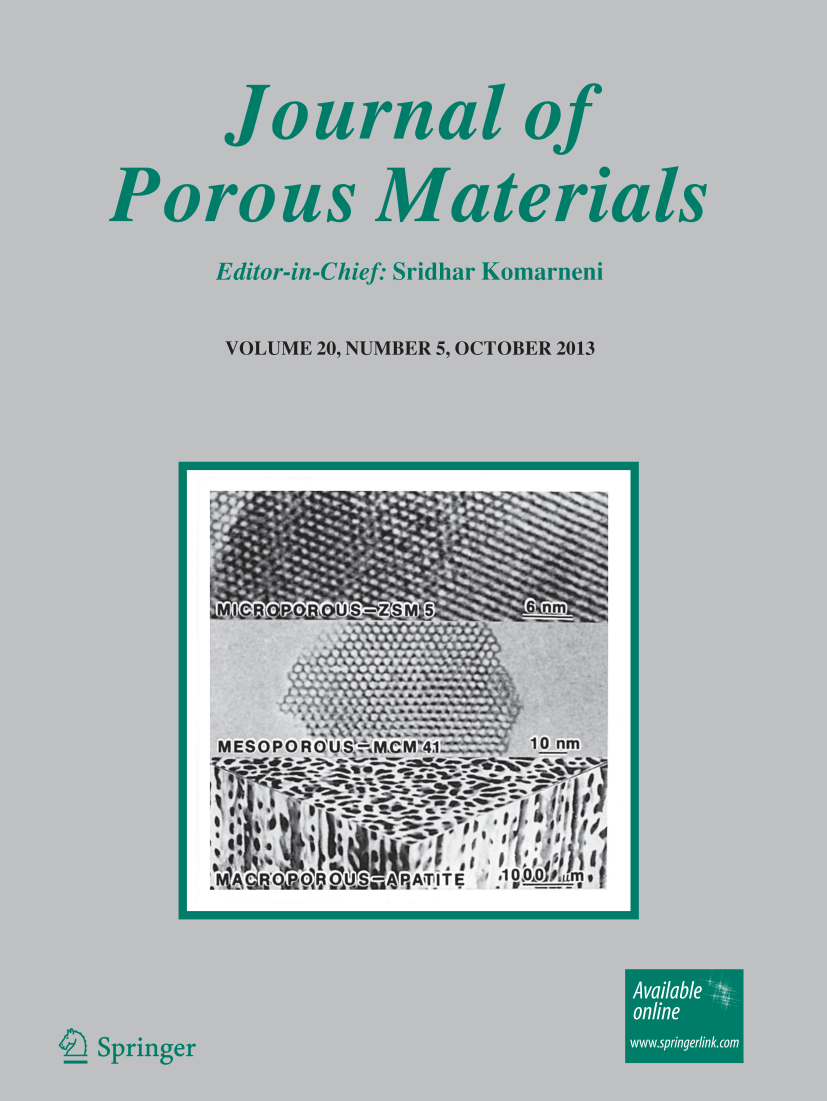
The Journal of Porous Materials is an interdisciplinary and international periodical devoted to all types of porous materials. Its aim is the rapid publication
of high quality, peer-reviewed papers focused on the synthesis, processing, characterization and property evaluation of all porous materials. The objective is to
establish a unique journal that will serve as a principal means of communication for the growing interdisciplinary field of porous materials.
Porous materials include microporous materials with 50 nm pores.
Examples of microporous materials are natural and synthetic molecular sieves, cationic and anionic clays, pillared clays, tobermorites, pillared Zr and Ti
phosphates, spherosilicates, carbons, porous polymers, xerogels, etc. Mesoporous materials include synthetic molecular sieves, xerogels, aerogels, glasses, glass
ceramics, porous polymers, etc.; while macroporous materials include ceramics, glass ceramics, porous polymers, aerogels, cement, etc. The porous materials
can be crystalline, semicrystalline or noncrystalline, or combinations thereof. They can also be either organic, inorganic, or their composites. The overall
objective of the journal is the establishment of one main forum covering the basic and applied aspects of all porous materials.

 求助内容:
求助内容: 应助结果提醒方式:

 京公网安备 11010802042870号


