
A dual-strategy nanocomposite hydrogel platform of nanosuspensions and deformable liposomes for enhanced curcumin delivery against skin cancer cells
IF 4.7
3区 医学
Q1 PHARMACOLOGY & PHARMACY
European Journal of Pharmaceutical Sciences
Pub Date : 2026-01-01
Epub Date: 2025-11-08
DOI:10.1016/j.ejps.2025.107373
引用次数: 0
Abstract
Patient outcomes in skin cancer are compromised by invasive treatments, demanding a paradigm shift toward effective, non-invasive strategies. This study aimed to develop dual-strategy nanocomposite hydrogel platforms for enhanced, localized delivery of curcumin against skin cancer cells. Two distinct nanocarriers, curcumin nanosuspensions (CUR-Ns) and curcumin liposomes (CUR-Lip), were engineered and embedded within a bioadhesive Gantrez™/gelatin hydrogel. Anticancer activity, cellular uptake, and apoptosis induction were assessed in A431 skin cancer cell line. Nanocomposite hydrogels were fabricated by EDC/NHS crosslinking, with nanocurcumin pre-mixed in gelatin to ensure uniform dispersion. Ex vivo skin permeation was evaluated using Franz diffusion cells with neonatal porcine skin. Both formulations demonstrated potent anticancer activity against A431 cells, with CUR-Lip (IC₅₀ = 9.32 µg/mL) and CUR-Ns (IC₅₀ = 13.43 µg/mL) dramatically outperforming free CUR (IC₅₀ = 44.73 µg/mL) while maintaining excellent biocompatibility. Physicochemical characterizations of the hydrogel demonstrated high moisture content, fluid absorbency, and adequate mechanical strength. These favorable properties facilitated effective delivery. Crucially, the nanocarriers displayed unique therapeutic kinetics. CUR-Ns provided a rapid onset of action, characterized by faster initial skin permeation. In contrast, CUR-Lip offered superior sustained efficacy, showing greater cytotoxicity, and achieving significantly higher cumulative skin deposition, with a transdermal flux of 105.52 ng/cm²/h. The hydrogel platform successfully preserved these distinct permeation profiles, confirming its utility as a versatile delivery vehicle. This dual-strategy approach enables tailored curcumin delivery offering either rapid or sustained release and represented a significant advancement in developing non-invasive therapies for skin cancer.
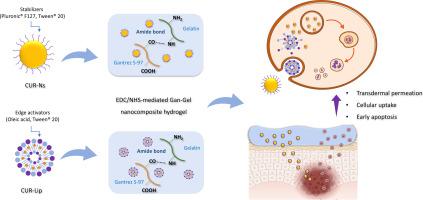
纳米悬浮液和可变形脂质体的双重策略纳米复合水凝胶平台,用于增强姜黄素对皮肤癌细胞的递送。
皮肤癌患者的预后受到侵入性治疗的影响,需要向有效的非侵入性策略转变。本研究旨在开发双策略纳米复合水凝胶平台,用于增强姜黄素的局部递送,以对抗皮肤癌细胞。两种不同的纳米载体,姜黄素纳米悬浮液(curr - ns)和姜黄素脂质体(curr - lip),被设计并嵌入在生物粘合剂Gantrez™/明胶水凝胶中。研究了A431皮肤癌细胞系的抗癌活性、细胞摄取和细胞凋亡诱导。采用EDC/NHS交联法制备纳米复合水凝胶,并将纳米姜黄素预混在明胶中以保证分散均匀。用Franz扩散细胞对新生猪皮肤进行体外渗透评价。两种配方都显示出对A431细胞的有效抗癌活性,其中CUR- lip (IC₅₀ = 9.32µg/mL)和CUR- ns (IC₅₀ = 13.43µg/mL)的性能显著优于游离CUR (IC₅₀ = 44.73µg/mL),同时保持优异的生物相容性。水凝胶的物理化学特征表明其含水量高、吸液性好、机械强度好。这些有利的性质促进了有效的输送。关键是,纳米载体表现出独特的治疗动力学。curn - ns提供快速起效,其特点是更快的初始皮肤渗透。相比之下,CUR-Lip具有更好的持续疗效,表现出更大的细胞毒性,并实现更高的累积皮肤沉积,透皮通量为105.52 ng/cm²/h。水凝胶平台成功地保留了这些不同的渗透剖面,证实了其作为多功能输送工具的实用性。这种双重策略的方法使定制的姜黄素递送提供快速或持续释放,代表了在开发非侵入性治疗皮肤癌方面的重大进步。
本文章由计算机程序翻译,如有差异,请以英文原文为准。
求助全文
约1分钟内获得全文
求助全文
来源期刊
CiteScore
9.60
自引率
2.20%
发文量
248
审稿时长
50 days
期刊介绍:
The journal publishes research articles, review articles and scientific commentaries on all aspects of the pharmaceutical sciences with emphasis on conceptual novelty and scientific quality. The Editors welcome articles in this multidisciplinary field, with a focus on topics relevant for drug discovery and development.
More specifically, the Journal publishes reports on medicinal chemistry, pharmacology, drug absorption and metabolism, pharmacokinetics and pharmacodynamics, pharmaceutical and biomedical analysis, drug delivery (including gene delivery), drug targeting, pharmaceutical technology, pharmaceutical biotechnology and clinical drug evaluation. The journal will typically not give priority to manuscripts focusing primarily on organic synthesis, natural products, adaptation of analytical approaches, or discussions pertaining to drug policy making.
Scientific commentaries and review articles are generally by invitation only or by consent of the Editors. Proceedings of scientific meetings may be published as special issues or supplements to the Journal.
 求助内容:
求助内容: 应助结果提醒方式:

 京公网安备 11010802042870号


