
Targeting neuroinflammation in Parkinson's disease: Immunomodulatory effects of a hyaluronic acid-based nanoreinforced hydrogel loaded with GDNF and mesenchymal stem cells
IF 4.7
3区 医学
Q1 PHARMACOLOGY & PHARMACY
European Journal of Pharmaceutical Sciences
Pub Date : 2026-04-01
Epub Date: 2025-11-06
DOI:10.1016/j.ejps.2025.107368
引用次数: 0
Abstract
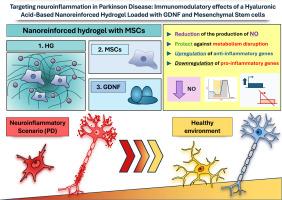
Like other neurodegenerative disorders, Parkinson's disease is marked by widespread neuroinflammation, which may contribute to its etiology and is a key component of its progression. Consequently, anti-inflammatory strategies, which can incorporate regenerative and cell therapy components, are promising therapeutic candidates for the management of the disease. To this end, we have developed a supramolecular hydrogel (HG) based on modified hyaluronic acid that combines nanoencapsulated GDNF (NPs GDNF), a potent neurotrophic factor with a less well-studied anti-inflammatory potential, and mesenchymal stem cells (MSCs). We have evaluated the anti-inflammatory effect of the HG by quantifying the NO produced by a murine microglia cell line against LPS. In addition, we have corroborated these functional results by transcriptomic analyses, where we have also been able to delve deeper into the mechanisms by which the HG exerts this anti-inflammatory effect. We have observed that both HG components (GDNF and MSCs) and the combination of all of them (HG-NPs GDNF-MSCs) are able to decrease NO production in microglia insulted with LPS. Furthermore, we have been able to corroborate these results at the transcriptional level, where HG was able to decrease most of the pathways commonly associated with inflammation, such as interferon regulators or the interleukins IL-1 or TNF-α. In conclusion, the developed HG was able to reduce inflammation in a murine microglial cell line, both transcriptionally, with the suppression of pro-inflammatory pathways, and functionally, with a reduction in nitric oxide production.
靶向帕金森病的神经炎症:透明质酸纳米增强水凝胶负载GDNF和间充质干细胞的免疫调节作用
像其他神经退行性疾病一样,帕金森病的特点是广泛的神经炎症,这可能是其病因的一部分,也是其进展的关键组成部分。因此,可以结合再生和细胞治疗成分的抗炎策略是治疗该疾病的有希望的治疗候选者。为此,我们开发了一种基于修饰透明质酸的超分子水凝胶(HG),该水凝胶结合了纳米封装的GDNF (NPs GDNF),这是一种有效的神经营养因子,具有较少研究的抗炎潜力,以及人间充质干细胞(MSCs)。我们通过量化小鼠小胶质细胞系对LPS产生的NO来评估HG的抗炎作用。此外,我们通过转录组学分析证实了这些功能结果,我们也能够深入研究HG发挥这种抗炎作用的机制。我们观察到HG组分(GDNF和MSCs)和它们的组合(HG- nps GDNF-MSCs)能够减少LPS损伤的小胶质细胞NO的产生。此外,我们已经能够在转录水平上证实这些结果,其中HG能够减少大多数通常与炎症相关的途径,如干扰素调节因子或白细胞介素IL-1或TNF-α。总之,发育的HG能够减少小鼠小胶质细胞系的炎症,转录抑制促炎途径,功能上减少一氧化氮的产生。
本文章由计算机程序翻译,如有差异,请以英文原文为准。
求助全文
约1分钟内获得全文
求助全文
来源期刊
CiteScore
9.60
自引率
2.20%
发文量
248
审稿时长
50 days
期刊介绍:
The journal publishes research articles, review articles and scientific commentaries on all aspects of the pharmaceutical sciences with emphasis on conceptual novelty and scientific quality. The Editors welcome articles in this multidisciplinary field, with a focus on topics relevant for drug discovery and development.
More specifically, the Journal publishes reports on medicinal chemistry, pharmacology, drug absorption and metabolism, pharmacokinetics and pharmacodynamics, pharmaceutical and biomedical analysis, drug delivery (including gene delivery), drug targeting, pharmaceutical technology, pharmaceutical biotechnology and clinical drug evaluation. The journal will typically not give priority to manuscripts focusing primarily on organic synthesis, natural products, adaptation of analytical approaches, or discussions pertaining to drug policy making.
Scientific commentaries and review articles are generally by invitation only or by consent of the Editors. Proceedings of scientific meetings may be published as special issues or supplements to the Journal.
 求助内容:
求助内容: 应助结果提醒方式:

 京公网安备 11010802042870号


