
FD-GCN: Feedback Directed Graph Convolutional Network for skeleton-based action recognition
IF 1.8
4区 计算机科学
Q2 COMPUTER SCIENCE, SOFTWARE ENGINEERING
引用次数: 0
Abstract
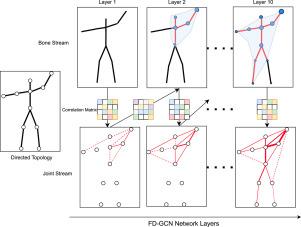
Graph Convolutional Network (GCN) has achieved remarkable result in skeleton-based action recognition. In GCNs, multi-order information has shown notable improvement for recognition and the graph topology, which is the key to fusing and extracting representative features. However, the GCN-based methods still face the following problems: (1) Nodes will have over-smooth problems in deep and complex networks. (2) Lack of efficient methods to fuse data streams of different modalities. In this paper, we proposed a novel data-fusing method, Feedback Directed Graph Convolution (FD-GC), to dynamically construct diverse correlation matrices and effectively aggregate both joint and bone features in different hierarchical update state and utilize them as feedback loops to participate in aggregation respectively for both streams. Our methods significantly reduce the difficulty of modeling multi-streams features at a small parameter cost. Furthermore, the experimental results indicate FD-GC alleviates the over-smooth effect via the feedback mechanism, constructing stronger representation capabilities of fine-grained actions, and performs as well as most skeletal motion recognition algorithms on two large public datasets NTU RGB+D 60, NTU RGB+D 120 and Northwestern-UCLA.
基于骨架动作识别的反馈有向图卷积网络
图卷积网络(GCN)在基于骨架的动作识别中取得了显著的效果。在GCNs中,多阶信息在识别和图拓扑方面表现出显著的改进,而图拓扑是融合和提取代表性特征的关键。然而,基于gcn的方法仍然面临以下问题:(1)节点在深度和复杂网络中存在过光滑问题。(2)缺乏有效的方法来融合不同模式的数据流。本文提出了一种新的数据融合方法——反馈有向图卷积(FD-GC),动态构建不同的关联矩阵,有效地聚合不同层次更新状态的关节和骨骼特征,并将其作为反馈回路分别参与两个流的聚合。我们的方法以较小的参数成本显著降低了多流特征建模的难度。此外,实验结果表明,FD-GC通过反馈机制缓解了过度平滑效应,构建了更强的细粒度动作表征能力,并在NTU RGB+D 60、NTU RGB+D 120和Northwestern-UCLA两个大型公共数据集上表现优于大多数骨骼运动识别算法。
本文章由计算机程序翻译,如有差异,请以英文原文为准。
求助全文
约1分钟内获得全文
求助全文
来源期刊
Graphical Models
工程技术-计算机:软件工程
CiteScore
3.60
自引率
5.90%
发文量
15
审稿时长
47 days
期刊介绍:
Graphical Models is recognized internationally as a highly rated, top tier journal and is focused on the creation, geometric processing, animation, and visualization of graphical models and on their applications in engineering, science, culture, and entertainment. GMOD provides its readers with thoroughly reviewed and carefully selected papers that disseminate exciting innovations, that teach rigorous theoretical foundations, that propose robust and efficient solutions, or that describe ambitious systems or applications in a variety of topics.
We invite papers in five categories: research (contributions of novel theoretical or practical approaches or solutions), survey (opinionated views of the state-of-the-art and challenges in a specific topic), system (the architecture and implementation details of an innovative architecture for a complete system that supports model/animation design, acquisition, analysis, visualization?), application (description of a novel application of know techniques and evaluation of its impact), or lecture (an elegant and inspiring perspective on previously published results that clarifies them and teaches them in a new way).
GMOD offers its authors an accelerated review, feedback from experts in the field, immediate online publication of accepted papers, no restriction on color and length (when justified by the content) in the online version, and a broad promotion of published papers. A prestigious group of editors selected from among the premier international researchers in their fields oversees the review process.
 求助内容:
求助内容: 应助结果提醒方式:

 京公网安备 11010802042870号


