
Increased purity and refolding yield of bacterial inclusion bodies by recursive high pressure homogenization

IF 4 2区 生物学 Q2 BIOTECHNOLOGY & APPLIED MICROBIOLOGY
Journal of biotechnology Pub Date : 2026-01-01 Epub Date: 2025-11-05 DOI:10.1016/j.jbiotec.2025.11.004
Robert Klausser , Lukas Veiter , Julian Kopp , Nikolaus Hammerschmidt , Tiffany Frierss , Florian Gisperg , Mohamed Elshazly , Eva Prada Brichtova , Michael Martinetz , Martin Voigtmann , Oliver Spadiut
{"title":"Increased purity and refolding yield of bacterial inclusion bodies by recursive high pressure homogenization","authors":"Robert Klausser ,&nbsp;Lukas Veiter ,&nbsp;Julian Kopp ,&nbsp;Nikolaus Hammerschmidt ,&nbsp;Tiffany Frierss ,&nbsp;Florian Gisperg ,&nbsp;Mohamed Elshazly ,&nbsp;Eva Prada Brichtova ,&nbsp;Michael Martinetz ,&nbsp;Martin Voigtmann ,&nbsp;Oliver Spadiut","doi":"10.1016/j.jbiotec.2025.11.004","DOIUrl":null,"url":null,"abstract":"<div><div>Therapeutic proteins are often produced intracellularly in the bacterium <em>Escherichia coli</em> in aggregated form, known as inclusion bodies, which must be solubilized and refolded to recover the biologically active product. However, the industrially established refolding method of batch dilution is still carried out at low protein concentrations, leading to high water consumption, large equipment footprints, and poor sustainability. An underexplored way to increase refolding yields and thereby enable higher product concentrations after refolding is the optimization of cell lysis and inclusion body washing. In this study, we developed and evaluated a “recursive high pressure homogenization” approach, wherein wash steps and additional homogenization cycles were combined to enhance the final purity of inclusion bodies before solubilization. The degree of cell lysis, nucleic acid release and final inclusion body purity were compared to conventional “linear washing”, where all homogenization cycles are completed prior to the washing of inclusion bodies. In total, seven process variations were compared and the resulting batches of inclusion bodies were solubilized and refolded to investigate the effect of early downstream processing on the product concentration in the final refolds. For the most efficient process variant, the recursive high pressure homogenization protocol led to the highest measured product concentration of 855 mg/L after refolding. Thus, the proposed recursive high pressure homogenization approach led to an estimated 18 % reduction of CO<sub>2</sub> footprint caused by urea, and increased the product yield per biomass from 5.17 g/kg to 7.84 g/kg compared to its linear wash counterpart — without introducing non-standard equipment or chemicals.</div></div>","PeriodicalId":15153,"journal":{"name":"Journal of biotechnology","volume":"409 ","pages":"Pages 183-194"},"PeriodicalIF":4.0000,"publicationDate":"2026-01-01","publicationTypes":"Journal Article","fieldsOfStudy":null,"isOpenAccess":false,"openAccessPdf":"","citationCount":"0","resultStr":null,"platform":"Semanticscholar","paperid":null,"PeriodicalName":"Journal of biotechnology","FirstCategoryId":"5","ListUrlMain":"https://www.sciencedirect.com/science/article/pii/S0168165625002706","RegionNum":2,"RegionCategory":"生物学","ArticlePicture":[],"TitleCN":null,"AbstractTextCN":null,"PMCID":null,"EPubDate":"2025/11/5 0:00:00","PubModel":"Epub","JCR":"Q2","JCRName":"BIOTECHNOLOGY & APPLIED MICROBIOLOGY","Score":null,"Total":0}
引用次数: 0

Abstract

Therapeutic proteins are often produced intracellularly in the bacterium Escherichia coli in aggregated form, known as inclusion bodies, which must be solubilized and refolded to recover the biologically active product. However, the industrially established refolding method of batch dilution is still carried out at low protein concentrations, leading to high water consumption, large equipment footprints, and poor sustainability. An underexplored way to increase refolding yields and thereby enable higher product concentrations after refolding is the optimization of cell lysis and inclusion body washing. In this study, we developed and evaluated a “recursive high pressure homogenization” approach, wherein wash steps and additional homogenization cycles were combined to enhance the final purity of inclusion bodies before solubilization. The degree of cell lysis, nucleic acid release and final inclusion body purity were compared to conventional “linear washing”, where all homogenization cycles are completed prior to the washing of inclusion bodies. In total, seven process variations were compared and the resulting batches of inclusion bodies were solubilized and refolded to investigate the effect of early downstream processing on the product concentration in the final refolds. For the most efficient process variant, the recursive high pressure homogenization protocol led to the highest measured product concentration of 855 mg/L after refolding. Thus, the proposed recursive high pressure homogenization approach led to an estimated 18 % reduction of CO2 footprint caused by urea, and increased the product yield per biomass from 5.17 g/kg to 7.84 g/kg compared to its linear wash counterpart — without introducing non-standard equipment or chemicals.
通过递推高压均质提高细菌包涵体的纯度和再折叠率。
治疗性蛋白质通常在大肠杆菌的细胞内以聚集形式产生,称为包涵体,必须将其溶解并重新折叠以恢复生物活性产物。然而,工业上建立的分批稀释的折叠法仍然在低蛋白质浓度下进行,导致高用水量,设备占地面积大,可持续性差。提高再折叠产率从而使再折叠后的产物浓度更高的尚未开发的方法是优化细胞裂解和包涵体洗涤。在这项研究中,我们开发并评估了一种“递归高压均质”方法,其中洗涤步骤和额外的均质循环相结合,以提高溶解前包裹体的最终纯度。将细胞裂解程度、核酸释放程度和包涵体最终纯度与常规的“线性洗涤”进行比较,在常规的“线性洗涤”中,所有的均质循环都在包涵体洗涤之前完成。总共比较了7种工艺变化,并对所得到的包裹体进行了溶解和再折叠,以研究早期下游加工对最终再折叠时产品浓度的影响。对于最有效的工艺变体,递归高压均质方案导致折叠式后的最高测量产物浓度为855mg/L。因此,在不引入非标准设备或化学品的情况下,与线性洗涤方法相比,所提出的递归高压均质化方法估计可将尿素引起的二氧化碳足迹减少18%,并将每生物质的产品产量从5.17g/kg提高到7.84g/kg。
本文章由计算机程序翻译,如有差异,请以英文原文为准。
求助全文
约1分钟内获得全文 求助全文
来源期刊
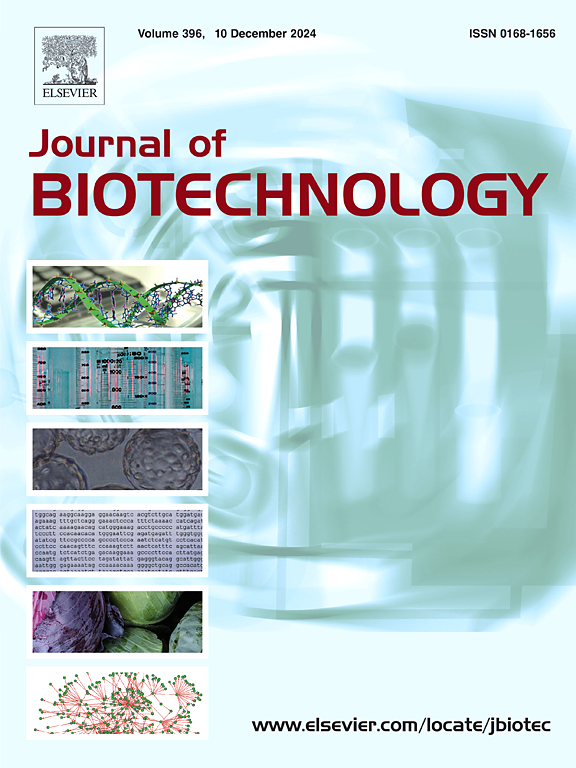
Journal of biotechnology
Journal of biotechnology 工程技术-生物工程与应用微生物
CiteScore
8.90
自引率
2.40%
发文量
190
审稿时长
45 days
期刊介绍: The Journal of Biotechnology has an open access mirror journal, the Journal of Biotechnology: X, sharing the same aims and scope, editorial team, submission system and rigorous peer review. The Journal provides a medium for the rapid publication of both full-length articles and short communications on novel and innovative aspects of biotechnology. The Journal will accept papers ranging from genetic or molecular biological positions to those covering biochemical, chemical or bioprocess engineering aspects as well as computer application of new software concepts, provided that in each case the material is directly relevant to biotechnological systems. Papers presenting information of a multidisciplinary nature that would not be suitable for publication in a journal devoted to a single discipline, are particularly welcome.

×
引用
GB/T 7714-2015
复制
MLA
复制
APA
复制
导出至
BibTeX EndNote RefMan NoteFirst NoteExpress
×
提示
您的信息不完整,为了账户安全,请先补充。
现在去补充
×
提示
您因"违规操作"
具体请查看互助需知
我知道了
×
提示
确定
请完成安全验证×
copy
已复制链接
快去分享给好友吧!
我知道了
右上角分享
点击右上角分享
0
联系我们:info@booksci.cn Book学术提供免费学术资源搜索服务,方便国内外学者检索中英文文献。致力于提供最便捷和优质的服务体验。 Copyright © 2023 布克学术 All rights reserved.
京ICP备2023020795号-1
ghs 京公网安备 11010802042870号
Book学术文献互助
Book学术文献互助群
群 号:604180095
Book学术官方微信
小红书


