{"title":"Inducing biological resistance to invasive plants with adapted native species","authors":"G Scott Clark, Kerri M Crawford","doi":"10.1002/fee.2857","DOIUrl":null,"url":null,"abstract":"<p>Invasive plants often benefit from a change in eco-evolutionary context, escaping the herbivores, pathogens, and competing plants from their native range. Introduced into naïve native communities, invasive plants can spread rapidly, threatening native plant diversity and ecosystem functioning. Increasingly, studies have shown that native species sometimes adapt in response to the selection pressures imposed by an invasive plant. While researchers have periodically suggested using adapted native species in the management of invasive plants, the idea generally has not found its way to the field. Here, we (1) compare the concept to the more established practices of assisted migration, classic biological control, and microbiome engineering; (2) discuss some of the hurdles to practical implementation; and (3) outline directions for further research that would help expose the role of native adaptations in shaping the trajectory of plant invasions.</p>","PeriodicalId":171,"journal":{"name":"Frontiers in Ecology and the Environment","volume":"23 9","pages":""},"PeriodicalIF":6.5000,"publicationDate":"2025-11-04","publicationTypes":"Journal Article","fieldsOfStudy":null,"isOpenAccess":false,"openAccessPdf":"","citationCount":"0","resultStr":null,"platform":"Semanticscholar","paperid":null,"PeriodicalName":"Frontiers in Ecology and the Environment","FirstCategoryId":"93","ListUrlMain":"https://onlinelibrary.wiley.com/doi/10.1002/fee.2857","RegionNum":1,"RegionCategory":"环境科学与生态学","ArticlePicture":[],"TitleCN":null,"AbstractTextCN":null,"PMCID":null,"EPubDate":"2025/6/16 0:00:00","PubModel":"Epub","JCR":"Q1","JCRName":"ECOLOGY","Score":null,"Total":0}
引用次数: 0
Abstract
Invasive plants often benefit from a change in eco-evolutionary context, escaping the herbivores, pathogens, and competing plants from their native range. Introduced into naïve native communities, invasive plants can spread rapidly, threatening native plant diversity and ecosystem functioning. Increasingly, studies have shown that native species sometimes adapt in response to the selection pressures imposed by an invasive plant. While researchers have periodically suggested using adapted native species in the management of invasive plants, the idea generally has not found its way to the field. Here, we (1) compare the concept to the more established practices of assisted migration, classic biological control, and microbiome engineering; (2) discuss some of the hurdles to practical implementation; and (3) outline directions for further research that would help expose the role of native adaptations in shaping the trajectory of plant invasions.
期刊介绍:
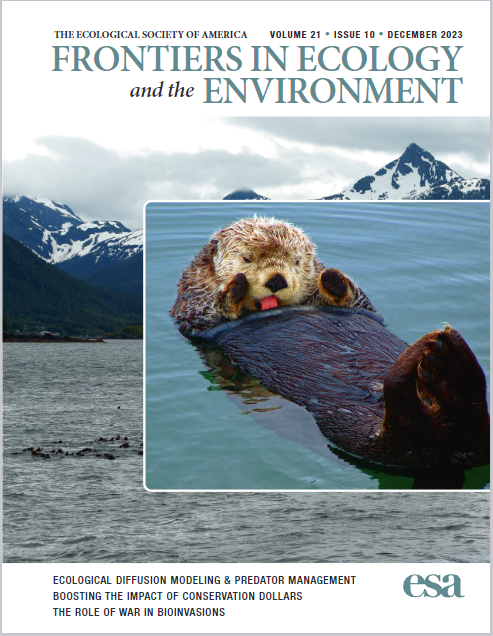
Frontiers in Ecology and the Environment is a publication by the Ecological Society of America that focuses on the significance of ecology and environmental science in various aspects of research and problem-solving. The journal covers topics such as biodiversity conservation, ecosystem preservation, natural resource management, public policy, and other related areas.
The publication features a range of content, including peer-reviewed articles, editorials, commentaries, letters, and occasional special issues and topical series. It releases ten issues per year, excluding January and July. ESA members receive both print and electronic copies of the journal, while institutional subscriptions are also available.
Frontiers in Ecology and the Environment is highly regarded in the field, as indicated by its ranking in the 2021 Journal Citation Reports by Clarivate Analytics. The journal is ranked 4th out of 174 in ecology journals and 11th out of 279 in environmental sciences journals. Its impact factor for 2021 is reported as 13.789, which further demonstrates its influence and importance in the scientific community.

 求助内容:
 应助结果提醒方式:


 京公网安备 11010802042870号


