
Advances in optical microscopy for food structure characterization

IF 7.1 3区 农林科学 Q1 FOOD SCIENCE & TECHNOLOGY
Food Structure-Netherlands Pub Date : 2025-10-01 Epub Date: 2025-10-27 DOI:10.1016/j.foostr.2025.100484
Jose C. Bonilla , Matias A. Via , Jonathan Brewer , Mathias P. Clausen
{"title":"Advances in optical microscopy for food structure characterization","authors":"Jose C. Bonilla ,&nbsp;Matias A. Via ,&nbsp;Jonathan Brewer ,&nbsp;Mathias P. Clausen","doi":"10.1016/j.foostr.2025.100484","DOIUrl":null,"url":null,"abstract":"<div><div>In recent years, advances in optical microscopy techniques have significantly enhanced our ability to study food structures in unprecedented detail. This review introduces state-of-the-art imaging techniques— particularly those offering improvements in spatial resolution (super-resolution), temporal resolution, and label-free imaging—and explores their ability to advance food structure research. These techniques provide access to micrometre- and sub-micrometre-scale structural information that was previously difficult or impossible to obtain. By extending the imaging toolbox beyond traditional instruments such as laser scanning confocal, widefield, and electron microscopes, these innovations open new opportunities to probe the physical, chemical, and structural properties of food matrices. Through the integration of biophysical and materials science approaches with conventional food science, this review highlights both the current capabilities and future potential of advanced optical microscopy for investigation and innovation in food design and processing.</div></div>","PeriodicalId":48640,"journal":{"name":"Food Structure-Netherlands","volume":"46 ","pages":"Article 100484"},"PeriodicalIF":7.1000,"publicationDate":"2025-10-01","publicationTypes":"Journal Article","fieldsOfStudy":null,"isOpenAccess":false,"openAccessPdf":"","citationCount":"0","resultStr":null,"platform":"Semanticscholar","paperid":null,"PeriodicalName":"Food Structure-Netherlands","FirstCategoryId":"97","ListUrlMain":"https://www.sciencedirect.com/science/article/pii/S2213329125000796","RegionNum":3,"RegionCategory":"农林科学","ArticlePicture":[],"TitleCN":null,"AbstractTextCN":null,"PMCID":null,"EPubDate":"2025/10/27 0:00:00","PubModel":"Epub","JCR":"Q1","JCRName":"FOOD SCIENCE & TECHNOLOGY","Score":null,"Total":0}
引用次数: 0

Abstract

In recent years, advances in optical microscopy techniques have significantly enhanced our ability to study food structures in unprecedented detail. This review introduces state-of-the-art imaging techniques— particularly those offering improvements in spatial resolution (super-resolution), temporal resolution, and label-free imaging—and explores their ability to advance food structure research. These techniques provide access to micrometre- and sub-micrometre-scale structural information that was previously difficult or impossible to obtain. By extending the imaging toolbox beyond traditional instruments such as laser scanning confocal, widefield, and electron microscopes, these innovations open new opportunities to probe the physical, chemical, and structural properties of food matrices. Through the integration of biophysical and materials science approaches with conventional food science, this review highlights both the current capabilities and future potential of advanced optical microscopy for investigation and innovation in food design and processing.
食品结构表征的光学显微镜研究进展
近年来,光学显微镜技术的进步大大提高了我们以前所未有的细节研究食物结构的能力。这篇综述介绍了最先进的成像技术,特别是那些在空间分辨率(超分辨率)、时间分辨率和无标签成像方面的改进,并探讨了它们推进食物结构研究的能力。这些技术提供了以前难以或不可能获得的微米和亚微米尺度的结构信息。通过将成像工具箱扩展到传统仪器(如激光扫描共聚焦、宽视场和电子显微镜)之外,这些创新为探测食物基质的物理、化学和结构特性开辟了新的机会。通过将生物物理和材料科学方法与传统食品科学相结合,本文重点介绍了先进光学显微镜在食品设计和加工研究和创新方面的现有能力和未来潜力。
本文章由计算机程序翻译,如有差异,请以英文原文为准。
求助全文
约1分钟内获得全文 求助全文
来源期刊
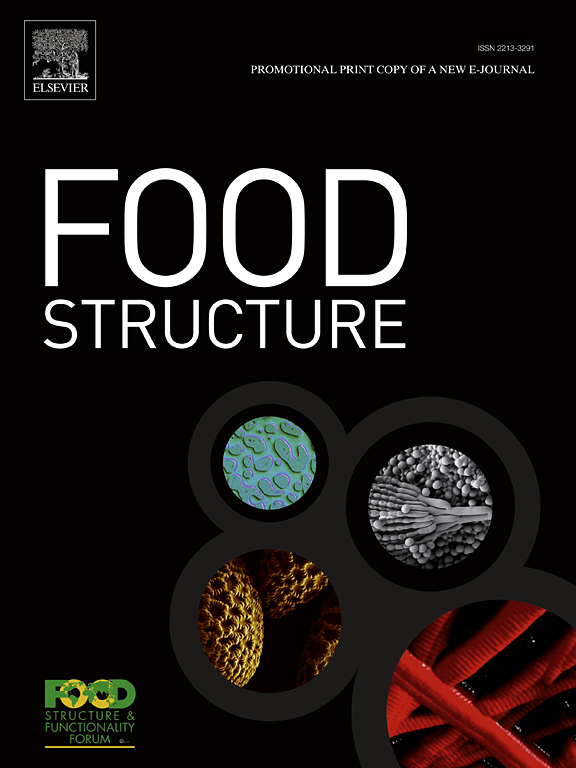
Food Structure-Netherlands
Food Structure-Netherlands Chemical Engineering-Bioengineering
CiteScore
7.20
自引率
0.00%
发文量
48
期刊介绍: Food Structure is the premier international forum devoted to the publication of high-quality original research on food structure. The focus of this journal is on food structure in the context of its relationship with molecular composition, processing and macroscopic properties (e.g., shelf stability, sensory properties, etc.). Manuscripts that only report qualitative findings and micrographs and that lack sound hypothesis-driven, quantitative structure-function research are not accepted. Significance of the research findings for the food science community and/or industry must also be highlighted.

×
引用
GB/T 7714-2015
复制
MLA
复制
APA
复制
导出至
BibTeX EndNote RefMan NoteFirst NoteExpress
×
提示
您的信息不完整,为了账户安全,请先补充。
现在去补充
×
提示
您因"违规操作"
具体请查看互助需知
我知道了
×
提示
确定
请完成安全验证×
copy
已复制链接
快去分享给好友吧!
我知道了
右上角分享
点击右上角分享
0
联系我们:info@booksci.cn Book学术提供免费学术资源搜索服务,方便国内外学者检索中英文文献。致力于提供最便捷和优质的服务体验。 Copyright © 2023 布克学术 All rights reserved.
京ICP备2023020795号-1
ghs 京公网安备 11010802042870号
Book学术文献互助
Book学术文献互助群
群 号:604180095
Book学术官方微信
小红书


