
Dual-oxide WO3-Based ETLs for enhanced charge transport and stability in CsPbIBr2 perovskite solar cells
IF 2.9
4区 工程技术
Q3 MATERIALS SCIENCE, MULTIDISCIPLINARY
引用次数: 0
Abstract
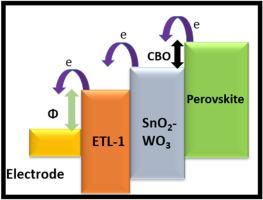
This study is significant for introducing WO3-based composite ETLs (ZrO2-WO3 and SnO2-WO3) that synergistically enhance charge transport, reduce recombination, and improve stability in CsPbIBr2 perovskite solar cells. The novelty lies in the dual-oxide approach, which leverages the complementary structural and electronic properties of WO3 with ZrO2 and SnO2 to achieve higher device efficiency. X-ray diffraction (XRD) analysis confirmed the successful integration of WO3-based films, with calculated crystallite sizes of 36.5 nm for ZrO2-WO3 and 41.8 nm for SnO2-WO3, indicating improved crystallinity for the SnO2-based film. Scanning electron microscope (SEM) showed that SnO2-WO3 film exhibits a smoother, more uniform morphology with smaller grain sizes compared to the ZrO2-WO3 film. Raman spectroscopy validated the phase purity and chemical stability of the prepared films. SEM morphology showed the reduced average grain size for SnO2-WO3 film. UV–Vis (UV–vis) spectroscopy revealed reduced band gaps of 2.71 eV and 2.69 eV for ZrO2-WO3 and SnO2-WO3, respectively, favoring efficient charge transport. Photoluminescence (PL) measurements demonstrated enhanced charge carrier separation. Current-density voltage (J-V) characteristics showed a higher power conversion efficiency of 9.35 % for SnO2-WO3 compared to 8.26 % for ZrO2-WO3. Electrochemical impedance spectroscopy (EIS) revealed reduced charge transfer resistance and increased recombination resistance (1769 Ω) for SnO2-WO3-based devices. These findings highlight the potential of WO3-based ETLs in PSCs for future high-efficiency photovoltaic applications.
基于wo3的双氧化物ETLs增强CsPbIBr2钙钛矿太阳能电池的电荷输运和稳定性
该研究对于引入基于wo3的复合etl (ZrO2-WO3和SnO2-WO3)具有重要意义,它们可以协同增强CsPbIBr2钙钛矿太阳能电池中的电荷输运,减少重组,提高稳定性。新颖之处在于双氧化物方法,它利用WO3与ZrO2和SnO2互补的结构和电子特性来实现更高的器件效率。x射线衍射(XRD)分析证实了wo3基薄膜的成功集成,计算出ZrO2-WO3的晶粒尺寸为36.5 nm, SnO2-WO3的晶粒尺寸为41.8 nm,表明sno2基薄膜的结晶度得到了提高。扫描电镜(SEM)结果表明,与ZrO2-WO3膜相比,SnO2-WO3膜形貌更光滑、均匀,晶粒尺寸更小。拉曼光谱验证了所制备薄膜的相纯度和化学稳定性。SEM形貌显示SnO2-WO3薄膜的平均晶粒尺寸减小。紫外可见光谱显示,ZrO2-WO3和SnO2-WO3的带隙分别减小了2.71 eV和2.69 eV,有利于有效的电荷输运。光致发光(PL)测量表明,电荷载流子分离增强。电流密度电压(J-V)特性表明,SnO2-WO3的功率转换效率为9.35%,而ZrO2-WO3的功率转换效率为8.26%。电化学阻抗谱(EIS)显示,sno2 - wo3基器件的电荷转移电阻降低,复合电阻增加(1769 Ω)。这些发现突出了基于wo3的etl在psc中未来高效光伏应用的潜力。
本文章由计算机程序翻译,如有差异,请以英文原文为准。
求助全文
约1分钟内获得全文
求助全文
来源期刊
Organic Electronics
工程技术-材料科学:综合
CiteScore
6.60
自引率
6.20%
发文量
238
审稿时长
44 days
期刊介绍:
Organic Electronics is a journal whose primary interdisciplinary focus is on materials and phenomena related to organic devices such as light emitting diodes, thin film transistors, photovoltaic cells, sensors, memories, etc.
Papers suitable for publication in this journal cover such topics as photoconductive and electronic properties of organic materials, thin film structures and characterization in the context of organic devices, charge and exciton transport, organic electronic and optoelectronic devices.
 求助内容:
求助内容: 应助结果提醒方式:

 京公网安备 11010802042870号


