
Advanced optical and gamma-ray shielding behavior of Bi2O3-doped molybdenum iron borosilicate glasses
IF 4.3
Q2 CHEMISTRY, PHYSICAL
引用次数: 0
Abstract
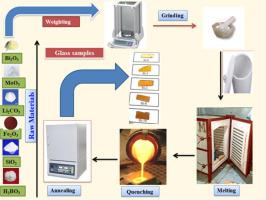
Glasses with the structure 18SiO2–42B2O3–13MoO3–2Fe2O3-(25-x)Li2O-xBi2O3, where x=(0, 2, 4, 8, and 10 mol. %) were synthesized. The density (ρ) increased systematically from 2.88 to 3.69 g/cm3 with the rise in Bi2O3 content. Their optical absorption properties were systematically investigated. In addition, the effect of structural modifications within the glass network was analyzed in detail, revealing how these changes contribute to the enhancement of the optical performance of the prepared glasses. The red shift in the absorption edge, along with the increased proportion of (NBOs), is considered the primary cause for the reduction in the optical band gap. Calculations of the optical band gap revealed a decreasing trend with increasing Bi2O3 content, indicating an increase in structural disorder. In the studied glass samples, the elastic moduli exhibit a decreasing trend with increasing Bi2O3 concentration. The shielding parameters against radiation were assessed. Results showed that the half-value layer (HVL) and mean free path (MFP) decreased progressively. The higher Bi2O3 content is responsible for its superior shielding performance. These findings demonstrate that the samples are effective radiation shielding materials.
掺bi2o3钼铁硼硅酸盐玻璃的先进光学和伽马射线屏蔽性能
合成了结构为18SiO2-42B2O3-13MoO3-2Fe2O3 -(25-x)Li2O-xBi2O3的玻璃,其中x=(0,2,4,8和10 mol. %)。随着Bi2O3含量的增加,密度(ρ)从2.88 g/cm3增加到3.69 g/cm3。系统地研究了它们的光吸收特性。此外,还详细分析了玻璃网络内部结构变化的影响,揭示了这些变化如何有助于提高所制备的玻璃的光学性能。吸收边的红移,以及(NBOs)比例的增加,被认为是光学带隙减小的主要原因。光学带隙的计算结果显示,随着Bi2O3含量的增加,光学带隙减小,表明结构无序性增加。在所研究的玻璃样品中,随着Bi2O3浓度的增加,弹性模量呈下降趋势。对辐射屏蔽参数进行了评估。结果表明,半值层(HVL)和平均自由程(MFP)逐渐减小。较高的Bi2O3含量是其优异屏蔽性能的原因。这些结果表明,样品是有效的辐射屏蔽材料。
本文章由计算机程序翻译,如有差异,请以英文原文为准。
求助全文
约1分钟内获得全文
求助全文
来源期刊
Chemical Physics Impact
Materials Science-Materials Science (miscellaneous)
CiteScore
2.60
自引率
0.00%
发文量
65
审稿时长
46 days
 求助内容:
求助内容: 应助结果提醒方式:

 京公网安备 11010802042870号


