
Mechanical instabilities and snapping phenomena in helical rods with perversion
IF 6.2
2区 工程技术
Q2 MATERIALS SCIENCE, MULTIDISCIPLINARY
Journal of The Mechanics and Physics of Solids
Pub Date : 2026-02-01
Epub Date: 2025-11-07
DOI:10.1016/j.jmps.2025.106402
引用次数: 0
Abstract
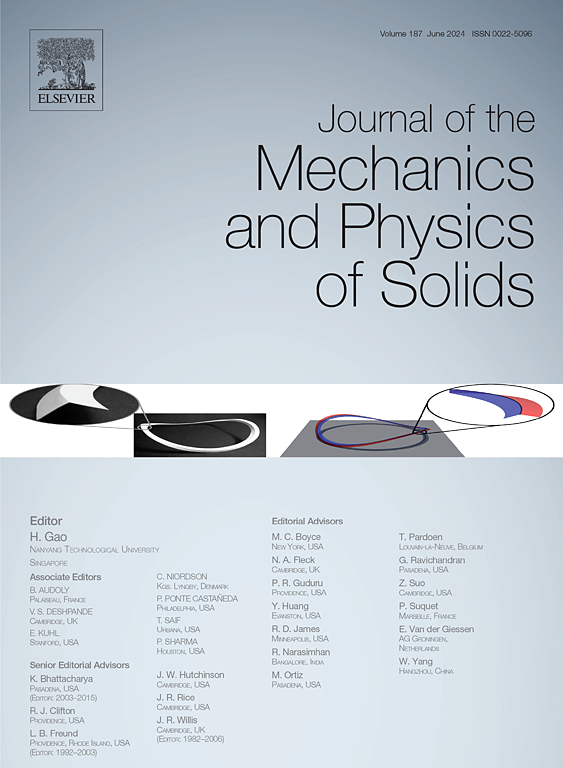
The mechanical instabilities of clamped helical elastic rods under controlled rotation and extension, featuring perversion, are studied experimentally, numerically and theoretically. Perversion appears at a winding lower than the intrinsic one. When the extension and winding are varied, the perversion is involved in three main instabilities. They can all be identified visually as abrupt qualitative modifications of the conformation. Singularities in the axial force and torque acting on the clamps are observed at critical winding and/or extension. (i) Transitioning from a pure helix to a configuration with perversion (and vice versa) is accompanied by a snapping instability. (ii) At zero net turns, the rod undergoes a writhing bifurcation from a straight to a writhed configuration. (iii) The perversion jumps to self-contact at critical extension. While the transitions (i) and (iii) are subcritical bifurcations, the writhing bifurcation is continuous and supercritical. The singularity at the creation of the perversion is reproduced numerically by incorporating clamping effects within path-following methods. A shooting technique, path-following method and finite element simulations are employed to assess the stability of the perversion and the associated snapping towards self-contact.An analogy with first-order phase transitions is discussed.

扭曲螺旋杆的力学不稳定性和断裂现象
本文从实验、数值和理论三个方面研究了夹持螺旋弹性杆在具有扭转特性的可控旋转和拉伸作用下的力学不稳定性。畸变出现在比固有绕组低的一个绕组上。当延伸和绕组变化时,扭曲涉及三个主要的不稳定性。它们都可以从视觉上识别为构象的突然质的改变。在临界缠绕和/或延伸时,观察到作用在夹钳上的轴向力和扭矩的奇异性。(1)从纯螺旋过渡到扭曲构型(反之亦然)是伴随着断裂不稳定性的。(ii)净转数为零时,杆由直向扭向分叉。(iii)变态在临界扩展时跳到自接触。过渡(i)和(iii)是亚临界分岔,而扭动分岔是连续的超临界分岔。通过在路径跟踪方法中合并夹紧效应,在数值上再现了变态产生的奇点。采用射击技术、路径跟踪方法和有限元模拟来评估扭曲的稳定性和相关的自接触断裂。讨论了与一阶相变的类比。
本文章由计算机程序翻译,如有差异,请以英文原文为准。
求助全文
约1分钟内获得全文
求助全文
来源期刊
CiteScore
9.80
自引率
9.40%
发文量
276
审稿时长
52 days
期刊介绍:
The aim of Journal of The Mechanics and Physics of Solids is to publish research of the highest quality and of lasting significance on the mechanics of solids. The scope is broad, from fundamental concepts in mechanics to the analysis of novel phenomena and applications. Solids are interpreted broadly to include both hard and soft materials as well as natural and synthetic structures. The approach can be theoretical, experimental or computational.This research activity sits within engineering science and the allied areas of applied mathematics, materials science, bio-mechanics, applied physics, and geophysics.
The Journal was founded in 1952 by Rodney Hill, who was its Editor-in-Chief until 1968. The topics of interest to the Journal evolve with developments in the subject but its basic ethos remains the same: to publish research of the highest quality relating to the mechanics of solids. Thus, emphasis is placed on the development of fundamental concepts of mechanics and novel applications of these concepts based on theoretical, experimental or computational approaches, drawing upon the various branches of engineering science and the allied areas within applied mathematics, materials science, structural engineering, applied physics, and geophysics.
The main purpose of the Journal is to foster scientific understanding of the processes of deformation and mechanical failure of all solid materials, both technological and natural, and the connections between these processes and their underlying physical mechanisms. In this sense, the content of the Journal should reflect the current state of the discipline in analysis, experimental observation, and numerical simulation. In the interest of achieving this goal, authors are encouraged to consider the significance of their contributions for the field of mechanics and the implications of their results, in addition to describing the details of their work.
 求助内容:
 应助结果提醒方式:


 京公网安备 11010802042870号


