{"title":"Histological study on the prenatal development of compartment 1 of the stomach of the camel (<i>Camelus dromedarius</i>).","authors":"Abdelhay Mohamed Ali","doi":"10.5455/OVJ.2025.v15.i9.63","DOIUrl":null,"url":null,"abstract":"<p><strong>Background: </strong>The largest portion of the dromedary camel's stomach, known as Compartment 1, plays a vital role in the microbial fermentation of ingested food.</p><p><strong>Aim: </strong>This study aimed to investigate the prenatal development of Compartment 1 in camel fetuses during the three gestational trimesters.</p><p><strong>Methods: </strong>Stomach samples were collected from 21 healthy camel fetuses of both sexes at various gestational ages (79-390 days). The samples were fixed in 10% buffered formalin and histologically examined.</p><p><strong>Results: </strong>The primitive stomach wall consisted of three layers in the early first trimester (79 days): epithelial, pluripotent blastemic tissue, and myoblastic. By 87-115 days, the wall displayed smooth to undulating surface regions and comprised four layers: epithelium, lamina propria-submucosa, tunica muscularis, and serosa. At 120-128 days, the smooth surface region of Compartment 1 was lined with stratified epithelium comprising a basal layer of cuboidal cells and 2-3 layers of lightly stained polyhedral cells. In contrast, the undulating surface was lined with pseudostratified columnar epithelium. During the second trimester (163-234 days), the smooth surface region differentiated into a non-glandular zone composed of three layers: stratum basale, spinosum, and granulosum. The folded surface developed into a glandular region characterized by multiple folds and deep pits forming chamber-like structures. These folds exhibited distinct epithelial linings: stratified epithelium at the apices, pseudostratified epithelium on the lateral sides, and simple columnar epithelium in the chambers. In the third trimester (270-390 days), a superficial layer of squamous cells forming the stratum corneum appeared above the three epithelial strata in the non-glandular region. Additionally, the glandular region's lamina propria contained simple tubular glands lined by simple columnar epithelium.</p><p><strong>Conclusion: </strong>Compartment 1 of the dromedary camel undergoes marked histological differentiation throughout gestation, evolving from a simple three-layered wall to a highly specialized organ. Notably, the apical folds develop lateral vertical projections in the glandular region where the stratified epithelium transitions into the pseudostratified epithelium, demonstrating regional specialization and functional differentiation.</p>","PeriodicalId":19531,"journal":{"name":"Open Veterinary Journal","volume":"15 9","pages":"4569-4577"},"PeriodicalIF":1.0000,"publicationDate":"2025-09-01","publicationTypes":"Journal Article","fieldsOfStudy":null,"isOpenAccess":false,"openAccessPdf":"https://www.ncbi.nlm.nih.gov/pmc/articles/PMC12587775/pdf/","citationCount":"0","resultStr":null,"platform":"Semanticscholar","paperid":null,"PeriodicalName":"Open Veterinary Journal","FirstCategoryId":"1085","ListUrlMain":"https://doi.org/10.5455/OVJ.2025.v15.i9.63","RegionNum":0,"RegionCategory":null,"ArticlePicture":[],"TitleCN":null,"AbstractTextCN":null,"PMCID":null,"EPubDate":"2025/9/30 0:00:00","PubModel":"Epub","JCR":"Q3","JCRName":"VETERINARY SCIENCES","Score":null,"Total":0}
引用次数: 0
Abstract
Background: The largest portion of the dromedary camel's stomach, known as Compartment 1, plays a vital role in the microbial fermentation of ingested food.
Aim: This study aimed to investigate the prenatal development of Compartment 1 in camel fetuses during the three gestational trimesters.
Methods: Stomach samples were collected from 21 healthy camel fetuses of both sexes at various gestational ages (79-390 days). The samples were fixed in 10% buffered formalin and histologically examined.
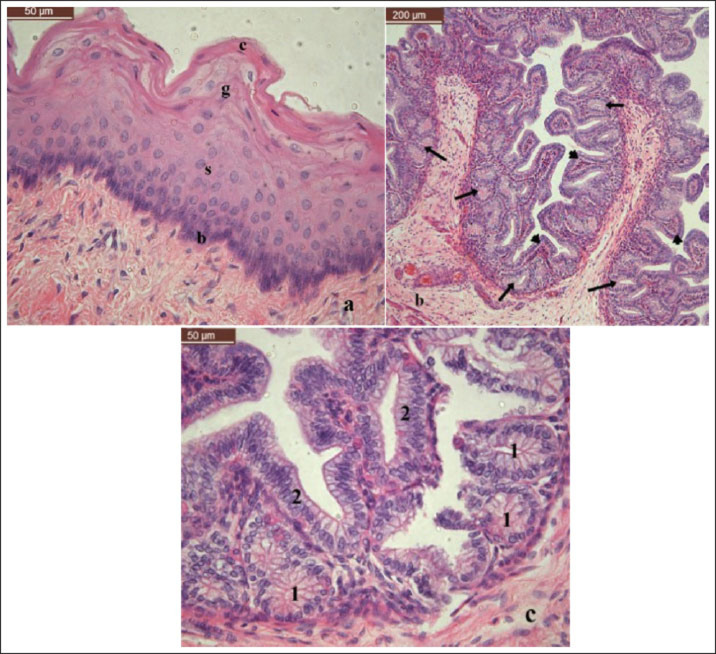
Results: The primitive stomach wall consisted of three layers in the early first trimester (79 days): epithelial, pluripotent blastemic tissue, and myoblastic. By 87-115 days, the wall displayed smooth to undulating surface regions and comprised four layers: epithelium, lamina propria-submucosa, tunica muscularis, and serosa. At 120-128 days, the smooth surface region of Compartment 1 was lined with stratified epithelium comprising a basal layer of cuboidal cells and 2-3 layers of lightly stained polyhedral cells. In contrast, the undulating surface was lined with pseudostratified columnar epithelium. During the second trimester (163-234 days), the smooth surface region differentiated into a non-glandular zone composed of three layers: stratum basale, spinosum, and granulosum. The folded surface developed into a glandular region characterized by multiple folds and deep pits forming chamber-like structures. These folds exhibited distinct epithelial linings: stratified epithelium at the apices, pseudostratified epithelium on the lateral sides, and simple columnar epithelium in the chambers. In the third trimester (270-390 days), a superficial layer of squamous cells forming the stratum corneum appeared above the three epithelial strata in the non-glandular region. Additionally, the glandular region's lamina propria contained simple tubular glands lined by simple columnar epithelium.
Conclusion: Compartment 1 of the dromedary camel undergoes marked histological differentiation throughout gestation, evolving from a simple three-layered wall to a highly specialized organ. Notably, the apical folds develop lateral vertical projections in the glandular region where the stratified epithelium transitions into the pseudostratified epithelium, demonstrating regional specialization and functional differentiation.
期刊介绍:
Open Veterinary Journal is a peer-reviewed international open access online and printed journal that publishes high-quality original research articles. reviews, short communications and case reports dedicated to all aspects of veterinary sciences and its related subjects. Research areas include the following: Infectious diseases of zoonotic/food-borne importance, applied biochemistry, parasitology, endocrinology, microbiology, immunology, pathology, pharmacology, physiology, epidemiology, molecular biology, immunogenetics, surgery, ophthalmology, dermatology, oncology and animal reproduction. All papers are peer-reviewed. Moreover, with the presence of well-qualified group of international referees, the process of publication will be done meticulously and to the highest standards.




 求助内容:
求助内容: 应助结果提醒方式:

 京公网安备 11010802042870号


