Julia Strupp, Stephanie Kunkel, Kevin Liu, Anne Dorr, Johannes Best, Alfred Paul, Almut Föller, Raymond Voltz
{"title":"Specialised Palliative Care in Day Clinic, Hospital Unit or at Home: Which for Whom and When? A Retrospective Routine Data Analysis.","authors":"Julia Strupp, Stephanie Kunkel, Kevin Liu, Anne Dorr, Johannes Best, Alfred Paul, Almut Föller, Raymond Voltz","doi":"10.1177/11786329251388784","DOIUrl":null,"url":null,"abstract":"<p><strong>Background: </strong>Palliative care units and specialised palliative home care teams are well established in many countries. Palliative day-care clinics, however, are not. Studies assessing which patients benefit from this setting of care are rare.</p><p><strong>Aim: </strong>This is the first routine data analysis of patients treated in three settings of specialised palliative care within a single geographical region. Our aim was to gain understanding of how patients in this region, where specialised palliative care structures are well-established, differ in their characteristics and treatments, and to explore the potential role of a palliative day-care clinic.</p><p><strong>Design: </strong>Retrospective data were extracted from medical records and analysed using SPSS<sup>®</sup> and R<sup>®</sup>. Data were analysed using the Shapiro-Wilk, Chi-Square, and Kruskal-Wallis tests. Setting/Participants: Patients (n = 603) were included if they received treatment at either a palliative day-care clinic, a palliative care unit, or a specialised palliative home care service. To cover the \"normal\" pre-pandemic period, the analysis was conducted retrospectively from 31 December 2019.</p><p><strong>Results: </strong>Patients attending the palliative day-care clinic were more likely to have cancer (90%, <i>P</i> < .001), were younger than those receiving specialised palliative home care (66.1, <i>P</i> < .001), had a better ECOG performance status (2, <i>P</i> < .001) and fewer high-complexity symptom domains (3.4, <i>P</i> < .001). Patients in the palliative day-care clinic and the palliative care unit underwent similar numbers of medical procedures and interventions. The majority of patients were admitted to the palliative day-care clinic from home (76%, <i>P</i> < .001) and discharged to the palliative care unit (41.5%, <i>P</i> < .001).</p><p><strong>Conclusions: </strong>The three care models differ in their patient populations, time-based criteria and symptom burden-with the palliative day-care clinic treating younger patients at earlier stages of the disease, with a lower ECOG score and a less complex symptom burden. These variations emphasise the importance of tailoring palliative care to the needs of patients and the progression of their disease. Recognising these differences can enhance integrated care pathways and patient-centred outcomes in various settings.</p>","PeriodicalId":12876,"journal":{"name":"Health Services Insights","volume":"18 ","pages":"11786329251388784"},"PeriodicalIF":2.5000,"publicationDate":"2025-11-03","publicationTypes":"Journal Article","fieldsOfStudy":null,"isOpenAccess":false,"openAccessPdf":"https://www.ncbi.nlm.nih.gov/pmc/articles/PMC12586867/pdf/","citationCount":"0","resultStr":null,"platform":"Semanticscholar","paperid":null,"PeriodicalName":"Health Services Insights","FirstCategoryId":"1085","ListUrlMain":"https://doi.org/10.1177/11786329251388784","RegionNum":0,"RegionCategory":null,"ArticlePicture":[],"TitleCN":null,"AbstractTextCN":null,"PMCID":null,"EPubDate":"2025/1/1 0:00:00","PubModel":"eCollection","JCR":"Q2","JCRName":"HEALTH CARE SCIENCES & SERVICES","Score":null,"Total":0}
引用次数: 0
Abstract
Background: Palliative care units and specialised palliative home care teams are well established in many countries. Palliative day-care clinics, however, are not. Studies assessing which patients benefit from this setting of care are rare.
Aim: This is the first routine data analysis of patients treated in three settings of specialised palliative care within a single geographical region. Our aim was to gain understanding of how patients in this region, where specialised palliative care structures are well-established, differ in their characteristics and treatments, and to explore the potential role of a palliative day-care clinic.
Design: Retrospective data were extracted from medical records and analysed using SPSS® and R®. Data were analysed using the Shapiro-Wilk, Chi-Square, and Kruskal-Wallis tests. Setting/Participants: Patients (n = 603) were included if they received treatment at either a palliative day-care clinic, a palliative care unit, or a specialised palliative home care service. To cover the "normal" pre-pandemic period, the analysis was conducted retrospectively from 31 December 2019.
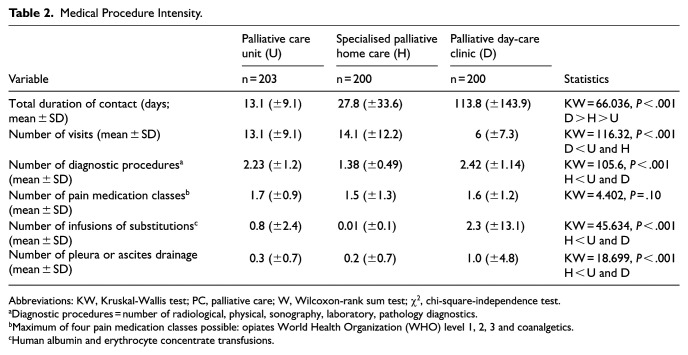
Results: Patients attending the palliative day-care clinic were more likely to have cancer (90%, P < .001), were younger than those receiving specialised palliative home care (66.1, P < .001), had a better ECOG performance status (2, P < .001) and fewer high-complexity symptom domains (3.4, P < .001). Patients in the palliative day-care clinic and the palliative care unit underwent similar numbers of medical procedures and interventions. The majority of patients were admitted to the palliative day-care clinic from home (76%, P < .001) and discharged to the palliative care unit (41.5%, P < .001).
Conclusions: The three care models differ in their patient populations, time-based criteria and symptom burden-with the palliative day-care clinic treating younger patients at earlier stages of the disease, with a lower ECOG score and a less complex symptom burden. These variations emphasise the importance of tailoring palliative care to the needs of patients and the progression of their disease. Recognising these differences can enhance integrated care pathways and patient-centred outcomes in various settings.



 求助内容:
求助内容: 应助结果提醒方式:

 京公网安备 11010802042870号


