Miguel Rodríguez-Fernández, Rocio Herrero, Pilar González-De-La-Aleja, María Dolores Valverde-Fredet, María-Paz Ventero, Marta Trigo-Rodríguez, Livia Giner, Ana Isabel Aller-García, Héctor Pinargote-Celorio, Reinaldo Espíndola-Gómez, Mónica Parra, Pedro Martínez Pérez-Crespo, José-Manuel Ramos-Rincón, Antonio Fernández-Pevida, Joaquín Lanz-García, Eva León, Lucía Valiente-De-Santis, Juan E Corzo, Juan-Carlos Rodríguez, Esperanza Merino, Nicolás Merchante
{"title":"Clinical Impact of Implementing a Specific Clinical Pathway for the Management of Clostridioides difficile Infection.","authors":"Miguel Rodríguez-Fernández, Rocio Herrero, Pilar González-De-La-Aleja, María Dolores Valverde-Fredet, María-Paz Ventero, Marta Trigo-Rodríguez, Livia Giner, Ana Isabel Aller-García, Héctor Pinargote-Celorio, Reinaldo Espíndola-Gómez, Mónica Parra, Pedro Martínez Pérez-Crespo, José-Manuel Ramos-Rincón, Antonio Fernández-Pevida, Joaquín Lanz-García, Eva León, Lucía Valiente-De-Santis, Juan E Corzo, Juan-Carlos Rodríguez, Esperanza Merino, Nicolás Merchante","doi":"10.1007/s40121-025-01261-9","DOIUrl":null,"url":null,"abstract":"<p><strong>Introduction: </strong>Despite Clostridioides difficile infection (CDI) being a leading healthcare-associated infection with high morbimortality, there is little evidence on specific antimicrobial stewardship program (ASP) interventions for CDI. The objective of this study was to assess the clinical impact of implementing a specific clinical pathway for CDI management at two Spanish hospitals.</p><p><strong>Methods: </strong>This was a quasi-experimental pre-post intervention study, and three periods were evaluated: historical (2014-2017), educational-ASP (2018-2020), and intervention (2021-2023), after implementation of a CDI-specific measures bundle. Key measures included: (1) updated local CDI guidelines; (2) 24/7 diagnostic testing and real-time positive results notification to ASP-CDI team; (3) systematic evaluation of new cases; (4) optimizing CDI antibiotic treatment and overall management; and (5) structured follow-up until 8 weeks post-treatment. Primary outcome was first CDI recurrence, and secondary outcomes were readmissions during recurrent CDI episodes and 30-day all-cause mortality.</p><p><strong>Results: </strong>In total, there were 1435 patients with CDI included: 370 in the historical period (2014-2017), 537 in the educational-ASP period (2018-2020), and 528 in the CDI-specific clinical pathway period (2021-2023). First CDI recurrence rates significantly declined across periods in high-risk groups: immunocompromised patients, 29% in 2014-2017, 22% in 2018-2020, and 15% in 2021-2023 (p = 0.038); those with severe/fulminant initial CDI, from 38% to 34% to 24% (p = 0.027); and patients aged 65-79 years, from 29% to 31% to 13% (p = 0.003). Hospitalization during recurrent CDI episodes and mortality were significantly reduced in the CDI-specific clinical pathway period: readmissions, 11% (2014-2017), 13% (2018-2020), and 6% (2021-2023) (p = 0.017); mortality, 7%, 6%, and 4% (p = 0.023).</p><p><strong>Conclusions: </strong>The implementation of a structured, multifaceted clinical pathway specifically designed for CDI management had significant clinical benefits, including a reduction of recurrences in high-risk groups, readmissions, and mortality.</p><p><strong>Trial registration: </strong>ClinicalTrials.gov identifier NCT04801862.</p>","PeriodicalId":13592,"journal":{"name":"Infectious Diseases and Therapy","volume":" ","pages":"85-100"},"PeriodicalIF":5.3000,"publicationDate":"2026-01-01","publicationTypes":"Journal Article","fieldsOfStudy":null,"isOpenAccess":false,"openAccessPdf":"https://www.ncbi.nlm.nih.gov/pmc/articles/PMC12783481/pdf/","citationCount":"0","resultStr":null,"platform":"Semanticscholar","paperid":null,"PeriodicalName":"Infectious Diseases and Therapy","FirstCategoryId":"3","ListUrlMain":"https://doi.org/10.1007/s40121-025-01261-9","RegionNum":3,"RegionCategory":"医学","ArticlePicture":[],"TitleCN":null,"AbstractTextCN":null,"PMCID":null,"EPubDate":"2025/11/7 0:00:00","PubModel":"Epub","JCR":"Q1","JCRName":"INFECTIOUS DISEASES","Score":null,"Total":0}
引用次数: 0
Abstract
Introduction: Despite Clostridioides difficile infection (CDI) being a leading healthcare-associated infection with high morbimortality, there is little evidence on specific antimicrobial stewardship program (ASP) interventions for CDI. The objective of this study was to assess the clinical impact of implementing a specific clinical pathway for CDI management at two Spanish hospitals.
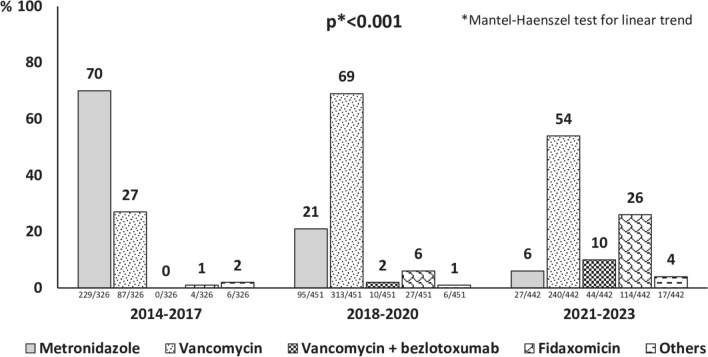
Methods: This was a quasi-experimental pre-post intervention study, and three periods were evaluated: historical (2014-2017), educational-ASP (2018-2020), and intervention (2021-2023), after implementation of a CDI-specific measures bundle. Key measures included: (1) updated local CDI guidelines; (2) 24/7 diagnostic testing and real-time positive results notification to ASP-CDI team; (3) systematic evaluation of new cases; (4) optimizing CDI antibiotic treatment and overall management; and (5) structured follow-up until 8 weeks post-treatment. Primary outcome was first CDI recurrence, and secondary outcomes were readmissions during recurrent CDI episodes and 30-day all-cause mortality.
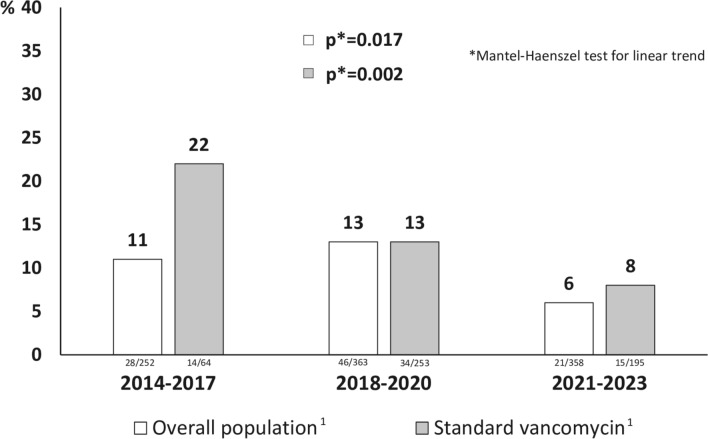
Results: In total, there were 1435 patients with CDI included: 370 in the historical period (2014-2017), 537 in the educational-ASP period (2018-2020), and 528 in the CDI-specific clinical pathway period (2021-2023). First CDI recurrence rates significantly declined across periods in high-risk groups: immunocompromised patients, 29% in 2014-2017, 22% in 2018-2020, and 15% in 2021-2023 (p = 0.038); those with severe/fulminant initial CDI, from 38% to 34% to 24% (p = 0.027); and patients aged 65-79 years, from 29% to 31% to 13% (p = 0.003). Hospitalization during recurrent CDI episodes and mortality were significantly reduced in the CDI-specific clinical pathway period: readmissions, 11% (2014-2017), 13% (2018-2020), and 6% (2021-2023) (p = 0.017); mortality, 7%, 6%, and 4% (p = 0.023).
Conclusions: The implementation of a structured, multifaceted clinical pathway specifically designed for CDI management had significant clinical benefits, including a reduction of recurrences in high-risk groups, readmissions, and mortality.
期刊介绍:
Infectious Diseases and Therapy is an international, open access, peer-reviewed, rapid publication journal dedicated to the publication of high-quality clinical (all phases), observational, real-world, and health outcomes research around the discovery, development, and use of infectious disease therapies and interventions, including vaccines and devices. Studies relating to diagnostic products and diagnosis, pharmacoeconomics, public health, epidemiology, quality of life, and patient care, management, and education are also encouraged.
Areas of focus include, but are not limited to, bacterial and fungal infections, viral infections (including HIV/AIDS and hepatitis), parasitological diseases, tuberculosis and other mycobacterial diseases, vaccinations and other interventions, and drug-resistance, chronic infections, epidemiology and tropical, emergent, pediatric, dermal and sexually-transmitted diseases.


 求助内容:
求助内容: 应助结果提醒方式:

 京公网安备 11010802042870号


