{"title":"Quench below the critical temperature in the Ising model: asymptotic state versus equilibrium under various boundary conditions","authors":"Annalisa Fierro, Antonio Coniglio, Marco Zannetti","doi":"10.1140/epjb/s10051-025-01082-2","DOIUrl":null,"url":null,"abstract":"<p>The nature of the asymptotic state toward which the system evolves after a quench to below the critical temperature has been recently addressed in the Ising model through exact results, scaling arguments, and numerical simulations. It has been suggested that this state is critical. While this may seem trivial, given that domain coarsening fundamentally involves the unbounded growth of a time-dependent correlation length, which roughly matches the average domain size, the situation is more complex. This complexity arises from the presence of a critical state below the critical temperature, which sharply contradicts the usual Ising equilibrium picture, characterised by symmetry breaking, ferromagnetic order, and short-range correlations. We aim to clarify this issue by analysing the subtle yet crucial role of boundary conditions.</p>","PeriodicalId":787,"journal":{"name":"The European Physical Journal B","volume":"98 11","pages":""},"PeriodicalIF":1.7000,"publicationDate":"2025-11-05","publicationTypes":"Journal Article","fieldsOfStudy":null,"isOpenAccess":false,"openAccessPdf":"","citationCount":"0","resultStr":null,"platform":"Semanticscholar","paperid":null,"PeriodicalName":"The European Physical Journal B","FirstCategoryId":"4","ListUrlMain":"https://link.springer.com/article/10.1140/epjb/s10051-025-01082-2","RegionNum":4,"RegionCategory":"物理与天体物理","ArticlePicture":[],"TitleCN":null,"AbstractTextCN":null,"PMCID":null,"EPubDate":"","PubModel":"","JCR":"Q3","JCRName":"PHYSICS, CONDENSED MATTER","Score":null,"Total":0}
引用次数: 0
Abstract
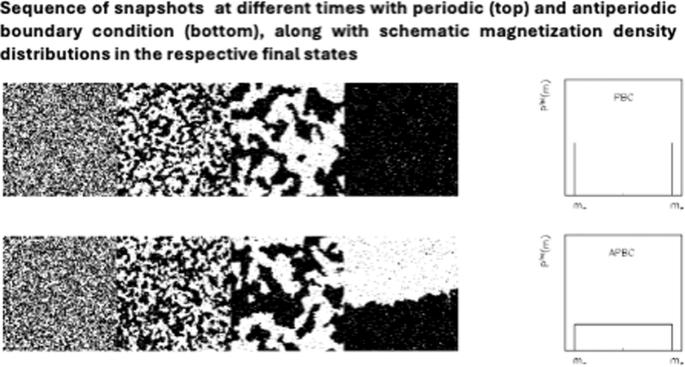
The nature of the asymptotic state toward which the system evolves after a quench to below the critical temperature has been recently addressed in the Ising model through exact results, scaling arguments, and numerical simulations. It has been suggested that this state is critical. While this may seem trivial, given that domain coarsening fundamentally involves the unbounded growth of a time-dependent correlation length, which roughly matches the average domain size, the situation is more complex. This complexity arises from the presence of a critical state below the critical temperature, which sharply contradicts the usual Ising equilibrium picture, characterised by symmetry breaking, ferromagnetic order, and short-range correlations. We aim to clarify this issue by analysing the subtle yet crucial role of boundary conditions.


 求助内容:
求助内容: 应助结果提醒方式:

 京公网安备 11010802042870号


