Debarati Nath, Debajit Deb, Joseph Roy, Pamulapati Soujanya
{"title":"Machine learning approach to predict the spacer layer thickness-dependent tunnel magnetoresistance in organic magnetic tunnel junctions","authors":"Debarati Nath, Debajit Deb, Joseph Roy, Pamulapati Soujanya","doi":"10.1140/epjb/s10051-025-01083-1","DOIUrl":null,"url":null,"abstract":"<div><p>A machine learning framework has been established to predict the thickness-dependent Spintronic Device characteristics (<i>R</i><sub>P</sub>: Parallel Resistance, <i>R</i><sub>AP</sub>: Antiparallel Resistance, TMR: Tunnel Magnetoresistance (%), STT-IN: In-plane Spin Transfer Torque, STT-OUT: Out of Plane STT) versus voltage behaviour for Organic Magnetic Tunnel Junction (MTJ) devices (<i>x</i>/Rubrene/Co, <i>x</i> = La<sub>2</sub>O<sub>3</sub>, LaMnO<sub>3</sub>, La<sub>0.7</sub>Ca<sub>0.3</sub>MnO<sub>3</sub>, La<sub>0.7</sub>Sr<sub>0.3</sub>MnO<sub>3</sub>). Machine learning (ML) analysis reveals that variation in thickness and interfacial scattering strongly influence spintronic parameters. With proper hyperparameter tuning of the polynomial linear regression and support vector regression model, resistance profiles are well predicted for three MTJs, except La<sub>2</sub>O<sub>3</sub>. The spin-split band structure of La<sub>2</sub>O<sub>3</sub> exhibits a higher density of electronic states near the Fermi level, which modifies the spin-dependent tunnelling behaviour; consequently, spin-flip-related transport requires more complex models. Optimised Gaussian process regression model with multiple kernels not only accurately predicts MTJ TMR responses across voltages and barrier thicknesses but also captures both simple and complex physical relationships arising from different physical effects. In La<sub>2</sub>O<sub>3</sub>, the ML model fails to capture in-plane and out-of-plane STT responses due to weak magnetic coupling between the electrodes, which abruptly enhances spin-damping compensation with changing barrier thickness. In contrast, varying model complexity in three MTJs, except La<sub>2</sub>O<sub>3</sub>, provides insights into underlying transport mechanisms, such as spin-flip scattering and spin-damping compensation. Our findings indicate that by leveraging ML approaches, unexplored TMR responses can be predicted for different thickness and voltage settings, when the transport physics of the MTJ are consistent. By utilising simulation and ML models, the study provides significant insights into achieving high TMR for next-generation memory, logic, and quantum technologies. The approach not only enables accurate prediction of MTJ performance but also reduces computational and experimental requirements, whilst simultaneously offering valuable information on device physics after visualising various parameters.</p><h3>Graphical abstract</h3>\n<div><figure><div><div><picture><source><img></source></picture></div></div></figure></div></div>","PeriodicalId":787,"journal":{"name":"The European Physical Journal B","volume":"98 11","pages":""},"PeriodicalIF":1.7000,"publicationDate":"2025-11-07","publicationTypes":"Journal Article","fieldsOfStudy":null,"isOpenAccess":false,"openAccessPdf":"","citationCount":"0","resultStr":null,"platform":"Semanticscholar","paperid":null,"PeriodicalName":"The European Physical Journal B","FirstCategoryId":"4","ListUrlMain":"https://link.springer.com/article/10.1140/epjb/s10051-025-01083-1","RegionNum":4,"RegionCategory":"物理与天体物理","ArticlePicture":[],"TitleCN":null,"AbstractTextCN":null,"PMCID":null,"EPubDate":"","PubModel":"","JCR":"Q3","JCRName":"PHYSICS, CONDENSED MATTER","Score":null,"Total":0}
引用次数: 0
Abstract
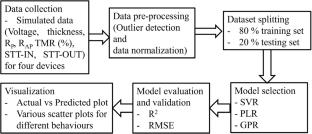
A machine learning framework has been established to predict the thickness-dependent Spintronic Device characteristics (RP: Parallel Resistance, RAP: Antiparallel Resistance, TMR: Tunnel Magnetoresistance (%), STT-IN: In-plane Spin Transfer Torque, STT-OUT: Out of Plane STT) versus voltage behaviour for Organic Magnetic Tunnel Junction (MTJ) devices (x/Rubrene/Co, x = La2O3, LaMnO3, La0.7Ca0.3MnO3, La0.7Sr0.3MnO3). Machine learning (ML) analysis reveals that variation in thickness and interfacial scattering strongly influence spintronic parameters. With proper hyperparameter tuning of the polynomial linear regression and support vector regression model, resistance profiles are well predicted for three MTJs, except La2O3. The spin-split band structure of La2O3 exhibits a higher density of electronic states near the Fermi level, which modifies the spin-dependent tunnelling behaviour; consequently, spin-flip-related transport requires more complex models. Optimised Gaussian process regression model with multiple kernels not only accurately predicts MTJ TMR responses across voltages and barrier thicknesses but also captures both simple and complex physical relationships arising from different physical effects. In La2O3, the ML model fails to capture in-plane and out-of-plane STT responses due to weak magnetic coupling between the electrodes, which abruptly enhances spin-damping compensation with changing barrier thickness. In contrast, varying model complexity in three MTJs, except La2O3, provides insights into underlying transport mechanisms, such as spin-flip scattering and spin-damping compensation. Our findings indicate that by leveraging ML approaches, unexplored TMR responses can be predicted for different thickness and voltage settings, when the transport physics of the MTJ are consistent. By utilising simulation and ML models, the study provides significant insights into achieving high TMR for next-generation memory, logic, and quantum technologies. The approach not only enables accurate prediction of MTJ performance but also reduces computational and experimental requirements, whilst simultaneously offering valuable information on device physics after visualising various parameters.


 求助内容:
求助内容: 应助结果提醒方式:

 京公网安备 11010802042870号


