
Assessment of pulmonary delivery efficacy of archaeal tetraether lipids based ICG- and DiR-loaded liposomes for antitumoral photodynamic therapy
IF 4.7
3区 医学
Q1 PHARMACOLOGY & PHARMACY
European Journal of Pharmaceutical Sciences
Pub Date : 2026-01-01
Epub Date: 2025-11-04
DOI:10.1016/j.ejps.2025.107362
引用次数: 0
Abstract
Lung cancer remains a leading cause of cancer-related deaths worldwide, highlighting the urgent need for novel therapeutic strategies, whereby pulmonary delivery offers a more promising approach, as it delivers the therapeutic moiety directly to the lungs, reducing systemic toxicity. Among emerging novel treatment strategies, photodynamic therapy (PDT) has emerged as a minimally invasive approach for treating various diseases, including lung cancer. However, the practical application of photosensitizers remains challenging due to their poor stability and limited availability at the targeted site. In this study, archaeal tetraether lipid (TEL)-based liposomes were developed to encapsulate indocyanine green (ICG) and 1,1′-dioctadecyl-3,3,3′,3′-tetramethylindotricarbocyanine iodide (DiR), two near-infrared (NIR) fluorescent photosensitizers, for inhalable, lung-targeted PDT. Liposomes were prepared using the thin-film hydration method with a lipid composition of 1,2-dipalmitoyl-sn‑glycero-3-phosphocholine (DPPC), cholesterol (Chol), and hydrolyzed glycerol dialkyl nonitol tetraether (hGDNT) in a molar ratio of 85:10:5 and DPPC, Chol, and polar lipid fraction E (PLFE) in a molar ratio of 85:10:5. Physicochemical characterization demonstrated that both hGDNT- and PLFE-based liposomes were in the nanometer size range with good monodispersity. Compared to hGDNT-liposomes, PLFE-based formulations were generally smaller, more uniform, and exhibited greater surface charge stability. All formulations exhibited excellent colloidal stability for up to two weeks (14 days), maintaining their physicochemical characteristics both during storage and after aerosolization using a vibrating-mesh nebulizer. A spherical nanoscale morphology was revealed by atomic force microscopy (AFM). Alterations in membrane properties induced by the incorporation of the drug were highlighted by phase imaging, confirming successful encapsulation and structural modulation, whereas transmission electron microscopy (TEM) revealed the unilamellarity of the liposomal formulations. PDT assessment on A549 cells revealed that DiR-loaded hGDNT-lipsomes (DiR-hGDNT-LPs) exhibited greater phototoxicity with a 50 % inhibitory concentration (IC₅₀) of 9.65 µg/mL, compared to 16.45 µg/mL for ICG-loaded-hGDNT-liposomes (ICG-hGDNT-LPs) upon NIR irradiation. Confocal laser scanning microscopy analysis demonstrated that DiR-hGDNT-LPs and ICG-hGDNT-LPs were efficiently taken up by A549 cells, with fluorescence predominantly localized in the cytoplasm, indicating effective intracellular retention. Intracellular reactive oxygen species (ROS) generation was confirmed using the 2′,7′-dichlorofluorescin diacetate assay, which exhibited strong light-dependent ROS production upon NIR radiation. These results suggest that TEL liposomes are highly stable, efficient nanocarriers that enhance the therapeutic potential of photosensitizers for non-invasive lung-targeted PDT.
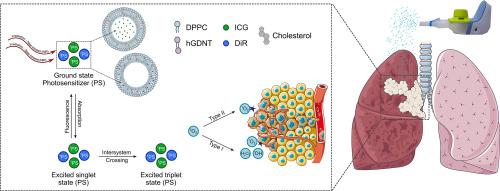
古菌四醚脂质ICG-和dir -负载脂质体抗肿瘤光动力治疗的肺递送效果评估。
肺癌仍然是世界范围内癌症相关死亡的主要原因,强调迫切需要新的治疗策略,其中肺输送提供了一个更有前途的方法,因为它将治疗部分直接输送到肺部,减少全身毒性。在新兴的新型治疗策略中,光动力疗法(PDT)已成为治疗包括肺癌在内的各种疾病的微创方法。然而,光敏剂的实际应用仍然具有挑战性,因为它们的稳定性差,在目标部位的可用性有限。本研究利用古细菌四醚脂质(TEL)脂质体,包封吲哚菁绿(ICG)和1,1'-二十八烷基-3,3,3',3'-四甲基吲哚三碳氰碘(DiR)这两种近红外(NIR)荧光光敏剂,用于可吸入的肺靶向PDT。采用薄膜水合法制备脂质体,脂质组成为:1,2-二棕榈酰- n-甘油-3-磷脂胆碱(DPPC)、胆固醇(Chol)和水解甘油二烷基壬醇四醚(hGDNT),摩尔比为85:10:5;DPPC、Chol和极性脂质组分E (PLFE),摩尔比为85:10:5。理化性质表征表明,hGDNT-和plfe基脂质体均在纳米尺度范围内,单分散性良好。与hgdnt脂质体相比,基于plfe的制剂通常更小,更均匀,并且表现出更高的表面电荷稳定性。所有配方都表现出优异的胶体稳定性长达两周(14天),在储存期间和使用振动网雾化器雾化后保持其物理化学特性。原子力显微镜(AFM)观察到球形纳米形貌。药物掺入引起的膜性质改变通过相成像被突出显示,证实了成功的包封和结构调制,而透射电子显微镜(TEM)显示了脂质体配方的单链性。对A549细胞的PDT评估显示,装载dir的hgdnt -脂质体(DiR-hGDNT-LPs)表现出更大的光毒性,50%的抑制浓度(IC₅0)为9.65µg/mL,而在近红外照射下,装载icg的hgdnt -脂质体(ICG-hGDNT-LPs)为16.45µg/mL。共聚焦激光扫描显微镜分析表明,DiR-hGDNT-LPs和ICG-hGDNT-LPs被A549细胞有效吸收,荧光主要定位于细胞质,表明细胞内有效保留。用2',7'-二氯荧光素测定法证实了细胞内活性氧(ROS)的产生,在近红外辐射下显示出强烈的光依赖性ROS的产生。这些结果表明,TEL脂质体是一种高度稳定、高效的纳米载体,可以增强光敏剂对非侵入性肺靶向PDT的治疗潜力。
本文章由计算机程序翻译,如有差异,请以英文原文为准。
求助全文
约1分钟内获得全文
求助全文
来源期刊
CiteScore
9.60
自引率
2.20%
发文量
248
审稿时长
50 days
期刊介绍:
The journal publishes research articles, review articles and scientific commentaries on all aspects of the pharmaceutical sciences with emphasis on conceptual novelty and scientific quality. The Editors welcome articles in this multidisciplinary field, with a focus on topics relevant for drug discovery and development.
More specifically, the Journal publishes reports on medicinal chemistry, pharmacology, drug absorption and metabolism, pharmacokinetics and pharmacodynamics, pharmaceutical and biomedical analysis, drug delivery (including gene delivery), drug targeting, pharmaceutical technology, pharmaceutical biotechnology and clinical drug evaluation. The journal will typically not give priority to manuscripts focusing primarily on organic synthesis, natural products, adaptation of analytical approaches, or discussions pertaining to drug policy making.
Scientific commentaries and review articles are generally by invitation only or by consent of the Editors. Proceedings of scientific meetings may be published as special issues or supplements to the Journal.
 求助内容:
求助内容: 应助结果提醒方式:

 京公网安备 11010802042870号


