Jun Seo Park, Dong Geon Lee, Dal-Hee Min, Sung Joong Lee
{"title":"Glioblastoma Immunotherapy Adjuvants for Glial Cell Polarization Regulation.","authors":"Jun Seo Park, Dong Geon Lee, Dal-Hee Min, Sung Joong Lee","doi":"10.5607/en25026","DOIUrl":null,"url":null,"abstract":"<p><p>Glioblastoma (GBM) remains fatal despite maximal surgical resection, temozolomide chemotherapy, and radiotherapy. Within the GBM microenvironment, tumor-educated microglia and astrocytes adopt immunoregulatory-like STAT3-high and ARG1/TGF-β-high phenotypes, respectively, which shield GBM cells from adaptive immune attack. In this review, we examine emerging adjuvant strategies designed to molecularly reprogram glial cells toward pro-inflammatory C3-high and IFN/NF-κB-high states, amplifying antitumor immunity. First, we summarize key aspects of GBM pathobiology and identify why conventional treatments fail to achieve durable control. Next, we dissect the signaling networks that govern glial phase states, including NF-κB, STAT3, IRF3, NLRP3, and cGAS-STING axes. We then provide a mechanism-centric analysis of pattern-recognition receptor (PRR) agonists, inflammasome modulators, and cyclic-dinucleotide STING agonists, integrating quantitative preclinical data with early clinical trial results. For each adjuvant, we distinguish between direct astrocytic engagement and indirect cytokine-mediated reprogramming. Modulation of glial phase states holds considerable promise for enhancing personalized vaccine efficacy and for converting immunologically \"cold\" GBM into a T cell-inflamed tumor. Consequently, targeting glial cell phase modulation is a highly attractive strategy for GBM immunotherapy, with the potential to maximize therapeutic benefit. Despite advances in chemo-, radio-, and checkpoint-blockade therapies, the immunosuppressive tumor microenvironment (TME) of GBM and its failure to establish memory immunity limit their impact. Tumor-polarized astrocytes and microglia form a barrier to effective T cell-mediated attack. Emerging evidence shows that redirecting glia toward pro-inflammatory phenotypes can recondition the TME, creating a more permissive landscape for immunotherapy. This review highlights glial phase reprogramming as a promising immunoadjuvant approach, emphasizing molecular circuits, synthetic modulators, and translational prospects.</p>","PeriodicalId":12263,"journal":{"name":"Experimental Neurobiology","volume":" ","pages":"235-247"},"PeriodicalIF":2.1000,"publicationDate":"2025-12-31","publicationTypes":"Journal Article","fieldsOfStudy":null,"isOpenAccess":false,"openAccessPdf":"https://www.ncbi.nlm.nih.gov/pmc/articles/PMC12741670/pdf/","citationCount":"0","resultStr":null,"platform":"Semanticscholar","paperid":null,"PeriodicalName":"Experimental Neurobiology","FirstCategoryId":"3","ListUrlMain":"https://doi.org/10.5607/en25026","RegionNum":4,"RegionCategory":"医学","ArticlePicture":[],"TitleCN":null,"AbstractTextCN":null,"PMCID":null,"EPubDate":"2025/11/4 0:00:00","PubModel":"Epub","JCR":"Q3","JCRName":"MEDICINE, RESEARCH & EXPERIMENTAL","Score":null,"Total":0}
引用次数: 0
Abstract
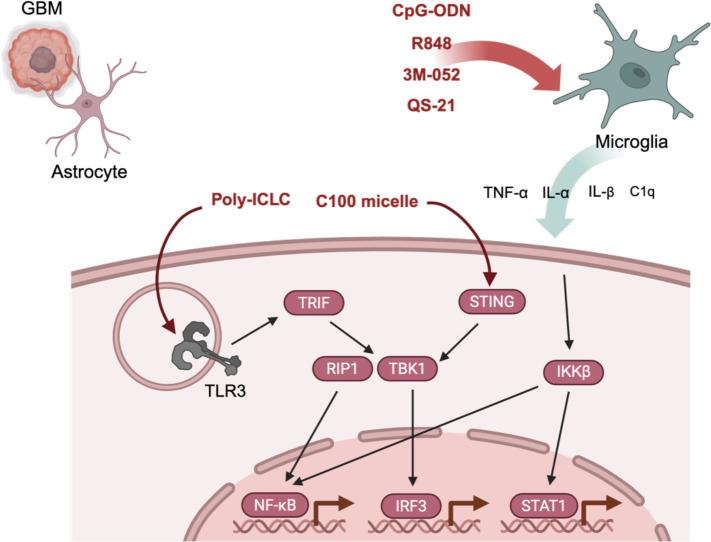
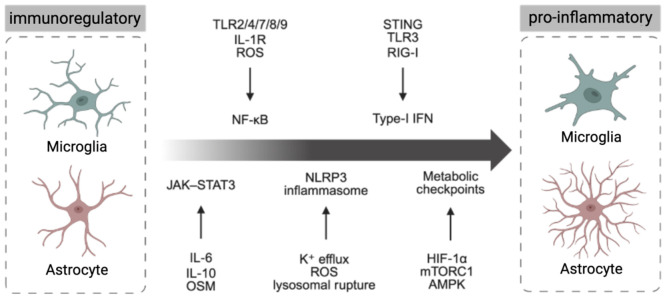
Glioblastoma (GBM) remains fatal despite maximal surgical resection, temozolomide chemotherapy, and radiotherapy. Within the GBM microenvironment, tumor-educated microglia and astrocytes adopt immunoregulatory-like STAT3-high and ARG1/TGF-β-high phenotypes, respectively, which shield GBM cells from adaptive immune attack. In this review, we examine emerging adjuvant strategies designed to molecularly reprogram glial cells toward pro-inflammatory C3-high and IFN/NF-κB-high states, amplifying antitumor immunity. First, we summarize key aspects of GBM pathobiology and identify why conventional treatments fail to achieve durable control. Next, we dissect the signaling networks that govern glial phase states, including NF-κB, STAT3, IRF3, NLRP3, and cGAS-STING axes. We then provide a mechanism-centric analysis of pattern-recognition receptor (PRR) agonists, inflammasome modulators, and cyclic-dinucleotide STING agonists, integrating quantitative preclinical data with early clinical trial results. For each adjuvant, we distinguish between direct astrocytic engagement and indirect cytokine-mediated reprogramming. Modulation of glial phase states holds considerable promise for enhancing personalized vaccine efficacy and for converting immunologically "cold" GBM into a T cell-inflamed tumor. Consequently, targeting glial cell phase modulation is a highly attractive strategy for GBM immunotherapy, with the potential to maximize therapeutic benefit. Despite advances in chemo-, radio-, and checkpoint-blockade therapies, the immunosuppressive tumor microenvironment (TME) of GBM and its failure to establish memory immunity limit their impact. Tumor-polarized astrocytes and microglia form a barrier to effective T cell-mediated attack. Emerging evidence shows that redirecting glia toward pro-inflammatory phenotypes can recondition the TME, creating a more permissive landscape for immunotherapy. This review highlights glial phase reprogramming as a promising immunoadjuvant approach, emphasizing molecular circuits, synthetic modulators, and translational prospects.
胶质母细胞瘤(GBM)仍然是致命的,尽管最大的手术切除,替莫唑胺化疗和放疗。在GBM微环境中,受肿瘤教育的小胶质细胞和星形胶质细胞分别具有免疫调节样的STAT3-high和ARG1/TGF-β-high表型,从而保护GBM细胞免受适应性免疫攻击。在这篇综述中,我们研究了新出现的辅助策略,旨在分子重编程胶质细胞,使其达到促炎c3 -高和IFN/NF-κ b -高状态,从而增强抗肿瘤免疫。首先,我们总结了GBM病理生物学的关键方面,并确定了传统治疗无法实现持久控制的原因。接下来,我们剖析了控制胶质相状态的信号网络,包括NF-κB、STAT3、IRF3、NLRP3和cGAS-STING轴。然后,我们对模式识别受体(PRR)激动剂、炎性小体调节剂和环二核苷酸STING激动剂进行了以机制为中心的分析,将定量临床前数据与早期临床试验结果相结合。对于每种佐剂,我们区分了直接星形细胞参与和间接细胞因子介导的重编程。神经胶质相状态的调节在增强个性化疫苗效力和将免疫“冷”GBM转化为T细胞炎症肿瘤方面具有相当大的前景。因此,靶向胶质细胞相位调节是GBM免疫治疗的一种极具吸引力的策略,具有最大治疗效益的潜力。尽管化疗、放疗和检查点阻断疗法取得了进展,但GBM的免疫抑制肿瘤微环境(TME)及其无法建立记忆免疫限制了它们的影响。肿瘤极化星形胶质细胞和小胶质细胞形成有效的T细胞介导的攻击屏障。新出现的证据表明,将神经胶质细胞重定向到促炎表型可以修复TME,为免疫治疗创造更宽松的环境。这篇综述强调了胶质期重编程作为一种有前途的免疫佐剂方法,强调了分子电路、合成调节剂和翻译前景。
期刊介绍:
Experimental Neurobiology is an international forum for interdisciplinary investigations of the nervous system. The journal aims to publish papers that present novel observations in all fields of neuroscience, encompassing cellular & molecular neuroscience, development/differentiation/plasticity, neurobiology of disease, systems/cognitive/behavioral neuroscience, drug development & industrial application, brain-machine interface, methodologies/tools, and clinical neuroscience. It should be of interest to a broad scientific audience working on the biochemical, molecular biological, cell biological, pharmacological, physiological, psychophysical, clinical, anatomical, cognitive, and biotechnological aspects of neuroscience. The journal publishes both original research articles and review articles. Experimental Neurobiology is an open access, peer-reviewed online journal. The journal is published jointly by The Korean Society for Brain and Neural Sciences & The Korean Society for Neurodegenerative Disease.


 求助内容:
求助内容: 应助结果提醒方式:

 京公网安备 11010802042870号


