
Dissolution behaviour and mechanism of fly ash in acid activators
引用次数: 0
Abstract
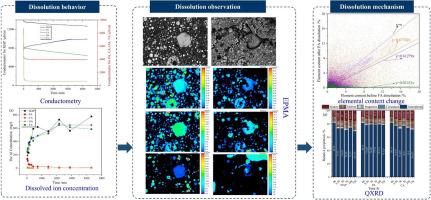
Clarifying the dissolution behaviour and mechanism of fly ash in acid activators is essential to understand the properties of fly ash-based silico-aluminophosphate geopolymer. This paper investigated the in-situ dissolution behaviour of fly ash (FA) in aluminium dihydrogen phosphate (MAP), phosphoric acid (PA), citric acid (CA), oxalic acid (OA), and tartaric acid (TA) using optical microscopy and electron probe microscopic analysis (EPMA). The phase and elemental changes before and after dissolution were further investigated using quantitative X-ray Diffraction (QXRD) and 2D-Fourier transform infrared (FTIR) spectrometry. In addition, the changes in dissolved elements were elucidated from a liquid phase perspective. The results showed that the capacity of each acid to dissolve FA was CA>MAP>PA>TA>OA. Ca-containing phases in FA were preferentially dissolved in all acids. The main contributor to FA dissolution in acid was the amorphous phase, and the Si![]() O
O![]() Si bond in quartz was more sensitive than other chemical bonds to acid. When FA was dissolved in OA and TA, new crystalline phases—calcium oxalate and calcium citrate—formed on the FA surface, inhibiting further dissolution.
Si bond in quartz was more sensitive than other chemical bonds to acid. When FA was dissolved in OA and TA, new crystalline phases—calcium oxalate and calcium citrate—formed on the FA surface, inhibiting further dissolution.
粉煤灰在酸性活化剂中的溶解行为及机理
弄清粉煤灰在酸性活化剂中的溶解行为和机理,对了解粉煤灰基硅铝磷酸酯地聚合物的性能具有重要意义。利用光学显微镜和电子探针显微镜(EPMA)研究了粉煤灰(FA)在磷酸二氢铝(MAP)、磷酸(PA)、柠檬酸(CA)、草酸(OA)和酒石酸(TA)中的原位溶解行为。利用定量x射线衍射(QXRD)和二维傅里叶变换红外光谱(FTIR)进一步研究了溶解前后的物相和元素变化。此外,还从液相角度分析了溶解元素的变化。结果表明,各酸对FA的溶解能力分别为CA>;MAP>PA>TA>;OA。FA中含钙相优先溶解于所有酸中。FA在酸中溶解的主要原因是无定形相,石英中的SiOSi键比其他化学键对酸更敏感。当FA溶解在OA和TA中时,FA表面会形成新的结晶相——草酸钙和柠檬酸钙,从而抑制了FA的进一步溶解。
本文章由计算机程序翻译,如有差异,请以英文原文为准。
求助全文
约1分钟内获得全文
求助全文

文献相关原料
公司名称
产品信息
麦克林
tartaric acid (TA)
麦克林
oxalic acid (OA)
麦克林
citric acid (CA)
麦克林
Phosphoric acid (PA)
 求助内容:
求助内容: 应助结果提醒方式:

 京公网安备 11010802042870号


