
Refining the phenotype of patients with atrial fibrillation and spontaneous restoration of sinus rhythm
IF 2.2
3区 医学
Q2 CARDIAC & CARDIOVASCULAR SYSTEMS
Archives of Cardiovascular Diseases
Pub Date : 2026-05-01
Epub Date: 2025-10-10
DOI:10.1016/j.acvd.2025.09.003
引用次数: 0
Abstract
Background
In atrial fibrillation (AF), few studies have focused on the influence of the mode of restoration of sinus rhythm (SR) on cardiac cavities remodelling, especially after spontaneous restoration.
Objectives
To determine the phenotype of patients with AF and spontaneous restoration of SR.
Methods
We prospectively studied 184 patients hospitalized for AF with restoration of SR at 6-month follow-up. Patients were divided into two groups at 6 months according to the type of restoration of SR: spontaneous (Spontaneous SR group; n = 57) or active (pharmacological and/or electrical and/or ablation; Active SR group; n = 127). Each patient underwent comprehensive clinical, biological and two-dimensional (2D) transthoracic echocardiography studies at 6-month follow-up. 2D parameters, including strain parameters, were analysed offline using Ultrasound Workspace software (Philips).
Results
At 6-month follow-up, 111 patients (60.3%) were male, the median (interquartile range) age was 66.7 (55.6–73.4) years and 48 (26.1%) had a CHA2DS2-VA score ≥ 2. On univariate analysis, the Spontaneous SR group had lower body surface area, less heart failure (HF) associated with AF, lower glycated haemoglobin, lower B-type natriuretic peptide and higher high-density lipoprotein cholesterol than the Active SR group at 6-month follow-up. Concerning the echocardiographic evaluation, the Spontaneous SR group had lower biplane left atrial (LA) volume, higher LA reservoir, conduit and contractile strains, and higher right ventricular free wall strain than the Active SR group at 6-month follow-up. Lower body surface area (odds ratio [OR] 0.79 per 0.1 m2 increase, 95% confidence interval [CI] 0.65–0.95; P = 0.012), absence of HF associated with AF (OR 0.17 for HF, 95% CI 0.05–0.54; P = 0.003) and higher LA reservoir strain (OR 1.21 per 5% increase, 95% CI 1.02–1.45; P = 0.028) remained significantly associated with spontaneous restoration of SR after multivariable adjustment.
Conclusions
Spontaneous restoration of SR corresponds to a distinct phenotypic group of patients with AF with less atrial remodelling. LA reservoir strain appears to be an interesting biomarker for differentiating the degree of atrial remodelling. Further investigations are warranted to determine the impact of such abnormalities on the risk of AF recurrence and cardiovascular events.
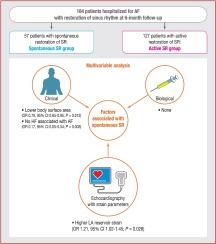
改善房颤患者的表型和窦性心律的自发恢复。
背景:在房颤(AF)中,很少有研究关注窦性心律(SR)恢复模式对心腔重构的影响,特别是自发恢复后。目的:了解房颤患者的表型和自发性SR恢复。方法:对184例房颤住院患者进行为期6个月的前瞻性随访。6个月时根据SR恢复的类型将患者分为两组:自发性SR组(自发性SR组,n=57)和活动性SR组(药物和/或电和/或消融;活动性SR组,n=127)。每位患者在随访6个月时接受了全面的临床、生物学和二维(2D)经胸超声心动图检查。使用Philips超声工作空间软件离线分析二维参数,包括应变参数。结果:随访6个月,男性111例(60.3%),年龄中位数(四分位间距)为66.7(55.6-73.4)岁,CHA2DS2-VA评分≥2者48例(26.1%)。单因素分析显示,在6个月的随访中,自发性SR组比主动SR组体表面积更小,AF相关心力衰竭(HF)更少,糖化血红蛋白、b型利钠肽和高密度脂蛋白胆固醇更低。超声心动图评价:随访6个月,自发性SR组左房双平面容积低于主动SR组,左房储层、导管和收缩应变高于主动SR组,右心室游离壁应变高于主动SR组。多变量调整后,下体表面积(比值比[OR] 0.79 / 0.1 m2增加,95%可信区间[CI] 0.65-0.95, P=0.012)、HF缺失与AF相关(HF的比值比[OR] 0.17, 95% CI 0.05-0.54, P=0.003)和高LA库菌株(比值比[OR] 1.21 / 5%增加,95% CI 1.02-1.45, P=0.028)仍与SR的自发恢复显著相关。结论:心房重构较少的房颤患者的自发性SR恢复对应于一个独特的表型组。LA库菌株似乎是区分心房重构程度的一个有趣的生物标志物。需要进一步的研究来确定这些异常对房颤复发和心血管事件风险的影响。
本文章由计算机程序翻译,如有差异,请以英文原文为准。
求助全文
约1分钟内获得全文
求助全文
来源期刊
Archives of Cardiovascular Diseases
医学-心血管系统
CiteScore
4.40
自引率
6.70%
发文量
87
审稿时长
34 days
期刊介绍:
The Journal publishes original peer-reviewed clinical and research articles, epidemiological studies, new methodological clinical approaches, review articles and editorials. Topics covered include coronary artery and valve diseases, interventional and pediatric cardiology, cardiovascular surgery, cardiomyopathy and heart failure, arrhythmias and stimulation, cardiovascular imaging, vascular medicine and hypertension, epidemiology and risk factors, and large multicenter studies. Archives of Cardiovascular Diseases also publishes abstracts of papers presented at the annual sessions of the Journées Européennes de la Société Française de Cardiologie and the guidelines edited by the French Society of Cardiology.
 求助内容:
求助内容: 应助结果提醒方式:

 京公网安备 11010802042870号


