
Toxicity by contact of Bordeaux mixture but no behavioral responses of the egg parasitoid Trichogramma cordubensis
IF 2.5
2区 农林科学
Q1 AGRONOMY
引用次数: 0
Abstract
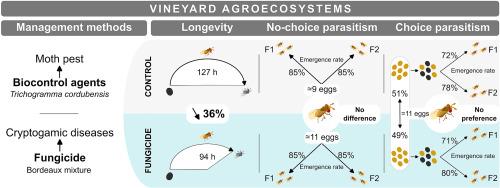
The increasing use of pesticides is recognized as a threat to pest natural enemies. We investigated the effects of Bordeaux mixture, a fungicide widely used in viticulture, on Trichogramma cordubensis, a biological control agent used against the major vineyard pest Lobesia botrana. The lethal and sublethal effects of 20 g.L−1 Bordeaux mixture on T. cordubensis were studied. To assess the potential persistence of Bordeaux mixture, each experiment was conducted at four different time scales after pesticide application. A first experiment aimed to assess the effects of surface contaminations to Bordeaux mixture on the longevity of T. cordubensis, which was reduced by 26 % when exposed to the fungicide. A second experiment aimed to assess the oviposition dynamics of T. cordubensis during the three first days after its emergence in contaminated or unexposed environments. No differences in oviposition were observed when T. cordubensis was exposed to Bordeaux mixture. A third experiment aimed to assess the oviposition choices of T. cordubensis between hosts on either contaminated or unexposed surfaces. No evidence of an oviposition deterrence was detected. Overall, surface contact with Bordeaux mixture was found harmless on T. cordubensis life parameters. Time after fungicide applications did not differently impact our results on longevity and behavior. However, time after both control and pesticide applications may have led to altered micro-environmental conditions affecting T. cordubensis’ development. This study suggests that T. cordubensis inability to discriminate against a copper contaminated environment is a crucial factor in enhancing its effectiveness as a biological control agent.
波尔多混合液对卵类赤眼蜂的毒性作用,但对卵类赤眼蜂无行为反应
农药使用量的增加被认为是对害虫天敌的威胁。本文研究了葡萄栽培中广泛使用的杀菌剂波尔多混合剂对葡萄栽培中主要害虫红赤眼蜂(Trichogramma cordubensis)的生物防治效果。20克的致死和亚致死效应。研究了L−1波尔多混合液对紫毛霉的影响。为了评估波尔多混合物的潜在持久性,每个实验在施用农药后的四个不同时间尺度进行。第一个实验旨在评估波尔多混合物表面污染对T. cordubensis寿命的影响,当暴露于杀菌剂时,T. cordubensis寿命减少了26%。第二个实验的目的是评估在污染或未暴露的环境中,绒绒瓢虫出现后的头三天内的产卵动态。与波尔多混合液接触后,红毛瓢虫产卵量无显著差异。第三个实验的目的是评估在污染或未暴露的表面上不同寄主的产卵选择。没有检测到产卵威慑的证据。总体而言,与波尔多混合物的表面接触对白毛瓢虫的寿命参数无害。使用杀菌剂后的时间对寿命和行为的影响没有不同。然而,控制和施用农药后的时间可能导致微环境条件的改变,从而影响了灯心草的发育。本研究表明,铜绒瓢虫对铜污染环境的不识别能力是提高其生物防治效果的关键因素。
本文章由计算机程序翻译,如有差异,请以英文原文为准。
求助全文
约1分钟内获得全文
求助全文
来源期刊
Crop Protection
农林科学-农艺学
CiteScore
6.10
自引率
3.60%
发文量
200
审稿时长
29 days
期刊介绍:
The Editors of Crop Protection especially welcome papers describing an interdisciplinary approach showing how different control strategies can be integrated into practical pest management programs, covering high and low input agricultural systems worldwide. Crop Protection particularly emphasizes the practical aspects of control in the field and for protected crops, and includes work which may lead in the near future to more effective control. The journal does not duplicate the many existing excellent biological science journals, which deal mainly with the more fundamental aspects of plant pathology, applied zoology and weed science. Crop Protection covers all practical aspects of pest, disease and weed control, including the following topics:
-Abiotic damage-
Agronomic control methods-
Assessment of pest and disease damage-
Molecular methods for the detection and assessment of pests and diseases-
Biological control-
Biorational pesticides-
Control of animal pests of world crops-
Control of diseases of crop plants caused by microorganisms-
Control of weeds and integrated management-
Economic considerations-
Effects of plant growth regulators-
Environmental benefits of reduced pesticide use-
Environmental effects of pesticides-
Epidemiology of pests and diseases in relation to control-
GM Crops, and genetic engineering applications-
Importance and control of postharvest crop losses-
Integrated control-
Interrelationships and compatibility among different control strategies-
Invasive species as they relate to implications for crop protection-
Pesticide application methods-
Pest management-
Phytobiomes for pest and disease control-
Resistance management-
Sampling and monitoring schemes for diseases, nematodes, pests and weeds.
 求助内容:
求助内容: 应助结果提醒方式:

 京公网安备 11010802042870号


