
Unusual methionine-derived glucosinolates in Turritis glabra (Brassicaceae) include previously missing side chain lengths as well as 3-oxo and 3-hydroxy derivatives, characterized by NMR and tandem mass spectrometry
IF 2.2
4区 生物学
Q4 BIOCHEMISTRY & MOLECULAR BIOLOGY
Biochemical Systematics and Ecology
Pub Date : 2026-01-01
Epub Date: 2025-10-24
DOI:10.1016/j.bse.2025.105150
引用次数: 0
Abstract
Several previously unreported glucosinolates (GSLs) were detected in rosette leaves of the Brassicaceous plant Turritis glabra. Four of them were isolated as desulfated derivatives. From MS/MS, NMR and UV of desulfoGSLs, four major T. glabra leaf GSLs were identified as 6-(methylsulfonyl)hexylGSL (78), 7-(methylsulfonyl)heptylGSL (160), 3-hydroxy-7-(methylsulfonyl)heptylGSL (161), and 6-(methylsulfonyl)-3-oxohexylGSL (162). The existence of intact 78, 160, 161 and 162 were supported by MS and demonstration of loss of hydrogen sulfate in MS/MS as well as sensitivity to Sinapis alba myrosinase. The identification of the position of the keto-group in 162 was challenging but confirmed by extensive 2D-NMR and MS of desulfo 162. Attention was paid to equilibrium between a ring-closed and an open form of desulfo 162 due to the oxo group, an atypical UV spectrum, and observed semi-stable exchange of side chain hydrogens with deuterium from D2O in the alpha-position relative to the oxo group, which were all in agreement with the structural conclusion. Tentative interpretation of the remaining GSL profile (investigated by LC-MS/MS of desulfated derivatives) suggests that T. glabra contains further yet undescribed but minor GSLs including 5-(methylsulfonyl)pentylGSL ([81]) as well as some previously known, structurally related GSLs. A reference seed accession of T. glabra allowing easy, permanent access to plants with this atypical GSL content, was characterized including DNA barcode confirmation of identity.
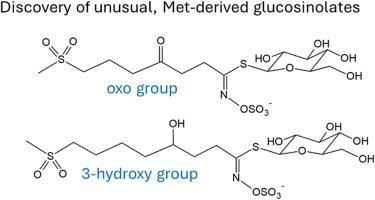
通过核磁共振和串联质谱分析,发现在十字花科植物Turritis glabra (Brassicaceae)中,不寻常的蛋氨酸衍生硫代葡萄糖苷包括先前缺失的侧链长度以及3-氧和3-羟基衍生物
在十字花科植物turtis glabra的莲座叶中检测到几种以前未报道的硫代葡萄糖苷(GSLs)。其中4个被分离为脱硫衍生物。从质谱、核磁共振和紫外光谱分析中,鉴定出4种主要的光藓叶片脱硫剂,分别为6-(甲基磺酰基)己基gsl(78)、7-(甲基磺酰基)庚基lgsl(160)、3-羟基-7-(甲基磺酰基)庚基lgsl(161)和6-(甲基磺酰基)-3-氧己基gsl(162)。质谱分析证实了完整菌株78、160、161和162的存在,并证实了硫酸氢的损失和对白刺黑氨酸酶的敏感性。确定162中酮基的位置是具有挑战性的,但通过广泛的2D-NMR和MS对脱硫162进行了证实。注意到由于氧基的存在,脱硫162在封闭环和开放环之间的平衡,非典型紫外光谱,并观察到侧链氢与D2O中相对于氧基的氘在α位置的半稳定交换,这些都与结构结论一致。对剩余GSL谱的初步解释(通过脱硫衍生物的LC-MS/MS研究)表明,T. glabra含有进一步未被描述但次要的GSL,包括5-(甲基磺酰基)戊基GSL([81])以及一些先前已知的结构相关的GSL。对一种具有非典型GSL含量的T. glabra的参考种子进行了鉴定,包括DNA条形码的身份确认。
本文章由计算机程序翻译,如有差异,请以英文原文为准。
求助全文
约1分钟内获得全文
求助全文
来源期刊
Biochemical Systematics and Ecology
生物-进化生物学
CiteScore
3.00
自引率
12.50%
发文量
147
审稿时长
43 days
期刊介绍:
Biochemical Systematics and Ecology is devoted to the publication of original papers and reviews, both submitted and invited, in two subject areas: I) the application of biochemistry to problems relating to systematic biology of organisms (biochemical systematics); II) the role of biochemistry in interactions between organisms or between an organism and its environment (biochemical ecology).
In the Biochemical Systematics subject area, comparative studies of the distribution of (secondary) metabolites within a wider taxon (e.g. genus or family) are welcome. Comparative studies, encompassing multiple accessions of each of the taxa within their distribution are particularly encouraged. Welcome are also studies combining classical chemosystematic studies (such as comparative HPLC-MS or GC-MS investigations) with (macro-) molecular phylogenetic studies. Studies that involve the comparative use of compounds to help differentiate among species such as adulterants or substitutes that illustrate the applied use of chemosystematics are welcome. In contrast, studies solely employing macromolecular phylogenetic techniques (gene sequences, RAPD studies etc.) will be considered out of scope. Discouraged are manuscripts that report known or new compounds from a single source taxon without addressing a systematic hypothesis. Also considered out of scope are studies using outdated and hard to reproduce macromolecular techniques such as RAPDs in combination with standard chemosystematic techniques such as GC-FID and GC-MS.
 求助内容:
求助内容: 应助结果提醒方式:

 京公网安备 11010802042870号


