
Variations in Greenland surface melt and extreme events from 1958 to 2023
IF 5.6
1区 地球科学
Q1 ENVIRONMENTAL SCIENCES
Advances in Climate Change Research
Pub Date : 2025-10-01
Epub Date: 2025-05-27
DOI:10.1016/j.accre.2025.05.004
引用次数: 0
Abstract
Surface melt and subsequent runoff have been the main contributors to recent Greenland mass loss. However, previous studies mainly focused on the extent and persistence of surface melt. The variations in surface melt rates and extreme events have not been adequately known, especially the role of extremes in the long-term surface melt changes. Here, using two high-resolution regional climate models (RACMO2.3p2 and MARv3.14), we analyzed the variations in Greenland surface melt in 1958–2023. Both models (RACMO/MAR) show that annual surface melt is rapidly increasing post-1990 at a rate of 8.6 ± 4.9/7.2 ± 4.4 Gt per year. The northern regions show the strongest relative regional increase rate (3.9% ± 1.9%/3.4% ± 1.6% per year), contributing more surface melt to the whole Greenland. Based on the 90th percentile of the daily distribution, we found that extreme surface melt events from May to September (M−S) have become more frequent post-1990 (0.7/0.8 ± 0.5 d per year). Compared with 1958–1990, M−S surface melt from extreme events has increased by 134/105 Gt per year and dominates the increase in the total surface melt. During extreme surface melt events, we found an increase in downward longwave radiation, net shortwave radiation and sensible heat flux. The rise in surface melt and extreme events post-1990 is linked to more frequent atmospheric blocking. This study improves our understanding of the role in ice sheet mass balance played by long-term variations in ice sheet surface melt and extreme events.
1958年至2023年格陵兰岛表面融化和极端事件的变化
地表融化和随后的径流是最近格陵兰岛质量损失的主要原因。然而,以往的研究主要集中在地表融化的程度和持续时间上。地表融化速率和极端事件的变化尚未得到充分认识,特别是极端事件在长期地表融化变化中的作用。本文利用两个高分辨率区域气候模式(RACMO2.3p2和MARv3.14),分析了1958-2023年格陵兰岛地表融化的变化。两种模式(RACMO/MAR)均显示,1990年以后,年表面融化量以8.6±4.9/7.2±4.4 Gt /年的速率快速增加。北部地区的相对区域增长率最强(3.9%±1.9%/3.4%±1.6% /年),对整个格陵兰岛的地表融化贡献较大。从日分布的第90个百分点来看,1990年以后,5 ~ 9月(M ~ S)极端地表融化事件的发生频率增加(每年0.7/0.8±0.5 d)。与1958-1990年相比,极端事件造成的M−S表面融化增加了134/105 Gt /年,并主导了表面融化总量的增加。在极端地表融化事件中,长波向下辐射、短波净辐射和感热通量增加。1990年以后,地表融化和极端事件的增加与更频繁的大气阻塞有关。这项研究提高了我们对冰盖表面融化和极端事件的长期变化对冰盖质量平衡的作用的理解。
本文章由计算机程序翻译,如有差异,请以英文原文为准。
求助全文
约1分钟内获得全文
求助全文
来源期刊
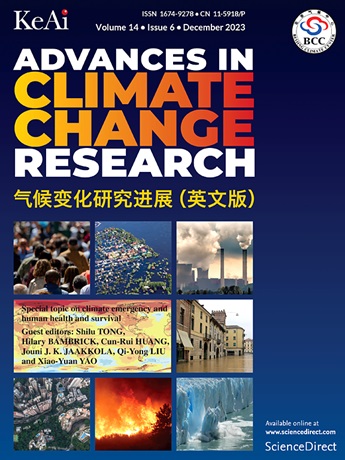
Advances in Climate Change Research
Earth and Planetary Sciences-Atmospheric Science
CiteScore
9.80
自引率
4.10%
发文量
424
审稿时长
107 days
期刊介绍:
Advances in Climate Change Research publishes scientific research and analyses on climate change and the interactions of climate change with society. This journal encompasses basic science and economic, social, and policy research, including studies on mitigation and adaptation to climate change.
Advances in Climate Change Research attempts to promote research in climate change and provide an impetus for the application of research achievements in numerous aspects, such as socioeconomic sustainable development, responses to the adaptation and mitigation of climate change, diplomatic negotiations of climate and environment policies, and the protection and exploitation of natural resources.
 求助内容:
 应助结果提醒方式:


 京公网安备 11010802042870号


