
The intensification of soil extreme heat further accelerates the rise of atmospheric extreme temperature over China
IF 5.6
1区 地球科学
Q1 ENVIRONMENTAL SCIENCES
Advances in Climate Change Research
Pub Date : 2025-10-01
Epub Date: 2025-04-29
DOI:10.1016/j.accre.2025.04.016
引用次数: 0
Abstract
Soil temperature is recognized as a fundamental factor influencing the intensity and frequency of heatwaves. However, the degree to which soil temperature regulates the release of organic carbon through soil respiration and its contribution to atmospheric warming still needs to be clarified. Through site and reanalysis data, the trend of soil extreme high heat intensity index exceeded that of air in about 75% of regions in China from 1961 to 2023. For extreme high heat frequency and duration, this proportion is even greater, reaching 78% and 88% respectively. Particularly in Northeast China, the increasing trend for soil extreme heat is nearly double that of air. In this context, the intensified soil extreme heat is markedly accelerating soil respiration rates, with a remarkable increase of 33.6% reported in North China. This further enhances carbon dioxide (CO2) release, with forest and agricultural ecosystems identified as significant contributors to carbon emissions in Northeast China. Furthermore, the impact of rising soil extreme heat on air temperatures is projected to intensify in the future, especially in North China, which is expected to increase by 30% as the global temperature escalating from 1.5 to 2.0°C. Future increases in soil extreme heat intensity could further enhance soil respiration, exacerbating CO2 emissions and accelerating future warming.
土壤极端高温的加剧进一步加速了中国大气极端温度的上升
土壤温度被认为是影响热浪强度和频率的基本因素。然而,土壤温度对有机碳通过土壤呼吸释放的调节程度及其对大气变暖的贡献仍有待明确。1961 - 2023年,中国约75%的地区土壤极端高热强度指数趋势超过空气极端高热强度指数趋势。对于极端高温频率和持续时间,这一比例更大,分别达到78%和88%。特别是在东北地区,土壤极端高温的增加趋势几乎是空气极端高温的两倍。在此背景下,土壤极端高温加剧显著加速了土壤呼吸速率,华北地区土壤呼吸速率显著增加33.6%。这进一步增加了二氧化碳(CO2)的释放,森林和农业生态系统被认为是东北地区碳排放的重要贡献者。未来土壤极端热升高对气温的影响将会加剧,特别是在华北地区,随着全球气温从1.5°C上升到2.0°C,土壤极端热升高对气温的影响预计将增加30%。未来土壤极端热强度的增加可能进一步增强土壤呼吸,加剧二氧化碳排放,加速未来变暖。
本文章由计算机程序翻译,如有差异,请以英文原文为准。
求助全文
约1分钟内获得全文
求助全文
来源期刊
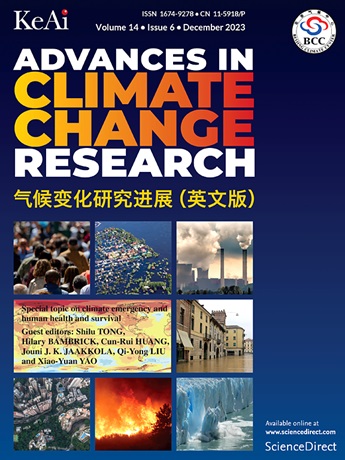
Advances in Climate Change Research
Earth and Planetary Sciences-Atmospheric Science
CiteScore
9.80
自引率
4.10%
发文量
424
审稿时长
107 days
期刊介绍:
Advances in Climate Change Research publishes scientific research and analyses on climate change and the interactions of climate change with society. This journal encompasses basic science and economic, social, and policy research, including studies on mitigation and adaptation to climate change.
Advances in Climate Change Research attempts to promote research in climate change and provide an impetus for the application of research achievements in numerous aspects, such as socioeconomic sustainable development, responses to the adaptation and mitigation of climate change, diplomatic negotiations of climate and environment policies, and the protection and exploitation of natural resources.
 求助内容:
 应助结果提醒方式:


 京公网安备 11010802042870号


