
Enantioselective toxicity of 3,4-methylenedioxypyrovalerone in Daphnia magna: Assessment of morphophysiological, behavioural, biochemical and reproductive responses
IF 4.3
3区 环境科学与生态学
Q2 BIOCHEMISTRY & MOLECULAR BIOLOGY
Comparative Biochemistry and Physiology C-toxicology & Pharmacology
Pub Date : 2026-01-01
Epub Date: 2025-10-18
DOI:10.1016/j.cbpc.2025.110375
引用次数: 0
Abstract
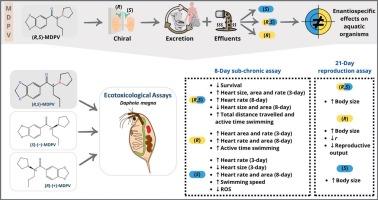
The enantioselective toxicity of 3,4-methylenedioxypyrovalerone (MDPV) remains unexplored in freshwater organisms. This study investigated the effects of MDPV racemate and its enantiomers in Daphnia magna using two approaches: (i) an 8-day sub-chronic assay focused on early development stages; and (ii) the standard 21-day reproduction assay. The sub-chronic assay tested two environmental concentrations (0.10 and 1.0 μg L−1), for both racemate or individual enantiomers, and a higher sublethal concentration of 10 μg L−1 for the racemate. Survival, morphophysiological, behavioural, reproductive, and biochemical responses were evaluated. The reproduction assay tested concentrations from 0.10 to 1.79 μg L−1, and evaluated survival, body size, and reproductive effects.
Sub-chronic exposure to 10 μg L−1 (R,S)-MDPV decreased survival. MDPV racemate and its enantiomers changed morphophysiological parameters, except for body growth. In juveniles, the heart area increased with 0.10 μg L−1 of (R)-MDPV whereas the heart size decreased with 0.10 and 1.0 μg L−1 of (S)-MDPV. Enantioselective effects were observed in swimming behaviour: (S)-MDPV increased speed and (R)-MDPV increased active time. No effects were observed in biochemical (except in reactive oxygen species for (S)-MDPV) and early reproductive parameters. The reproduction assay revealed enhanced growth in all MDPV forms (except at 0.56 μg L−1). A nonsignificant reduction in survival to the higher concentrations of (R)-MDPV was accompanied by reduced reproductive output (at 1.00 and 1.79 μg L−1) and intrinsic rate of population increase (at 1.79 μg L−1). Our findings suggest that, in general, (S)-MDPV triggers more severe sub-chronic effects, whereas (R)-MDPV is associated with harmful effects for longer time exposure.
3,4-亚甲基二氧基丙烯酮对大水蚤的对映选择性毒性:形态、生理、行为、生化和生殖反应的评估。
3,4-亚甲基二氧基戊烷酮(MDPV)在淡水生物中的对映选择性毒性尚未研究。本研究通过两种方法研究了MDPV外消旋体及其对映异构体对大水蚤的影响:(i)一项为期8天的亚慢性实验,重点关注水蚤的早期发育阶段;(ii)标准的21天繁殖试验。亚慢性试验测试了两种环境浓度(0.10和1.0 μg L-1),对外消旋体或单个对映体,并在更高的亚致死浓度(10 μg L-1)下测试了外消旋体。评估生存、形态生理、行为、生殖和生化反应。繁殖试验测试浓度为0.10至1.79 μg L-1,并评估存活率、体型和繁殖效果。亚慢性暴露于10 μg L-1 (R,S)-MDPV降低了生存率。MDPV外消旋体及其对映体除了对机体生长有影响外,还能改变机体的形态生理参数。(R)-MDPV的心脏面积增加0.10 μg L-1, (S)-MDPV的心脏大小减少0.10和1.0 μg L-1。在游泳行为中观察到对映体选择效应:(S)-MDPV增加速度,(R)-MDPV增加活动时间。生物化学(除(S)-MDPV的活性氧外)和早期生殖参数未见影响。繁殖试验显示,所有MDPV形式的生长都增强了(0.56 μg L-1除外)。在(R)-MDPV浓度较高的情况下,存活率不显著降低,同时生殖产量降低(分别为1.00和1.79 μg L-1),种群内在增长率降低(1.79 μg L-1)。我们的研究结果表明,一般来说,(S)-MDPV引发更严重的亚慢性效应,而(R)-MDPV与长时间暴露的有害效应有关。
本文章由计算机程序翻译,如有差异,请以英文原文为准。
求助全文
约1分钟内获得全文
求助全文
来源期刊
CiteScore
7.50
自引率
5.10%
发文量
206
审稿时长
30 days
期刊介绍:
Part C: Toxicology and Pharmacology. This journal is concerned with chemical and drug action at different levels of organization, biotransformation of xenobiotics, mechanisms of toxicity, including reactive oxygen species and carcinogenesis, endocrine disruptors, natural products chemistry, and signal transduction with a molecular approach to these fields.
 求助内容:
求助内容: 应助结果提醒方式:

 京公网安备 11010802042870号


