
Hyperfine interactions and magnetic order in oxyborate Co3BO5 according to 10,11B and 59Co NMR data
IF 2.4
3区 化学
Q4 CHEMISTRY, PHYSICAL
Solid state nuclear magnetic resonance
Pub Date : 2025-12-01
Epub Date: 2025-10-11
DOI:10.1016/j.ssnmr.2025.102047
引用次数: 0
Abstract
Information on the local charge and magnetic environment of 10,11B and 59Co nuclei in homometallic oxyborate Co3BO5 has been obtained using NMR spectroscopy. The data were obtained over a wide range of temperatures, in both paramagnetic and magnetically ordered states of the sample, as well as in various magnetic fields. The parameters of the electric field gradient tensor and the values hyperfine fields at the positions of the studied nuclei have been experimentally determined, which is possible only by NMR methods. The data indicate the presence of super-superexchange Co – O – B – O – Co interactions, which presumably occur with the participation of sp2-hybridized orbitals of the B3+ ion. A model of super-superexchange involving orbitals of the Co3+ ion in the low-spin (LS) 3 d6 state is proposed. The 59Co NMR data in the magnetically ordered phase most likely relate to cobalt ions in the LS state with local fields of 31.5 (3) kOe induced on the nuclei. Based on NMR data from 10,11B and 59Co, a magnetic order model is proposed in which the magnetic moments of cobalt ions are directed predominantly along the b axis of the crystal.
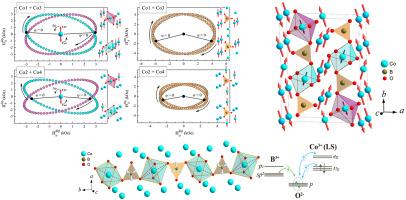
根据10、11B和59Co核磁共振数据,氧硼酸盐Co3BO5的超精细相互作用和磁序。
利用核磁共振波谱法获得了同金属氧化硼酸盐Co3BO5中10、11B和59Co核的局部电荷和磁环境信息。这些数据是在很宽的温度范围内获得的,在样品的顺磁性和磁性有序状态下,以及在不同的磁场中。电场梯度张量的参数和所研究的原子核位置的超精细场的值已经通过实验确定,这只有通过核磁共振方法才能实现。数据表明存在超交换Co - O - B - O - Co相互作用,这可能是在B3+离子的sp2杂化轨道参与下发生的。提出了低自旋(LS) 3d6态Co3+离子轨道的超超交换模型。磁有序相的59Co核磁共振数据很可能与LS态的钴离子有关,在核上诱导出31.5 (3)kOe的局部场。基于10、11B和59Co的核磁共振数据,提出了钴离子磁矩主要沿晶体b轴方向的磁序模型。
本文章由计算机程序翻译,如有差异,请以英文原文为准。
求助全文
约1分钟内获得全文
求助全文
来源期刊
CiteScore
5.30
自引率
9.40%
发文量
42
审稿时长
72 days
期刊介绍:
The journal Solid State Nuclear Magnetic Resonance publishes original manuscripts of high scientific quality dealing with all experimental and theoretical aspects of solid state NMR. This includes advances in instrumentation, development of new experimental techniques and methodology, new theoretical insights, new data processing and simulation methods, and original applications of established or novel methods to scientific problems.
 求助内容:
求助内容: 应助结果提醒方式:

 京公网安备 11010802042870号


