
Nanomaterial ZIF8@ZIF67 may regulate ROS/BmRelish axis to enhance the silkworm resistance against Bacillus cereus
IF 2.4
3区 生物学
Q1 ZOOLOGY
Journal of invertebrate pathology
Pub Date : 2026-02-01
Epub Date: 2025-10-14
DOI:10.1016/j.jip.2025.108476
引用次数: 0
Abstract
Nanomaterials have broad application prospects in biomedicine, environmental protection, improving agricultural production efficiency and pest control. Our previous study demonstrated that the nanomaterial ZIF-8@ZIF-67 improves the survival rate of silkworms following Bacillus cereus infection. However, the underlying mechanism remained unclear. Here, we elucidated the molecular basis of this enhanced resistance by employing integrated transcriptomic and metabolomic analyses. We propose that ZIF-8@ZIF-67 induces ROS generation, which could in turn activate BmRelish, a key immune pathway component, thereby strengthening host immunity. Transcriptomic profiling identified a total of 547 significantly differentially expressed genes (DEGs). Among these, the short peptidoglycan recognition proteins PGRP-S7 and PGRP-S3 were significantly upregulated and the oxidative phosphorylation pathway was notably enriched. PGRP-S3 expression in the ZIF8@ZIF67-treated group was elevated by 28.5-fold compared to the control, highlighting a strong immune-related transcriptional response to nanomaterial exposure. Furthermore, ZIF8@ZIF67 exposure induced a 3.8-fold upregulation of BmRelish, a critical downstream effector of the Imd signaling pathway, and concurrently activated multiple components of the Toll pathway—including PGRP-S7/S3, GNBP3, TLR3, and Dorsal. These transcriptional changes collectively promoted robust induction of antimicrobial peptides such as BmAttacin, BmCecA, and BmCecB1. Metabolomic analysis revealed 317 differentially accumulated metabolites (DAMs), including key molecules such as α-linolenic acid and glutathione (GSH/GSSG), which collectively modulated antioxidant defense, energy metabolism, and lipid metabolism. Integrated omics analysis further identified that BmRelish may act as a central regulatory node, orchestrating the coordination between immune signaling pathways and metabolic homeostasis to establish a functional “immune-metabolic network”. This regulatory framework enhanced the antimicrobial capacity of silkworms.

纳米材料ZIF8@ZIF67可能通过调控ROS/ bm津津轴增强家蚕对蜡样芽孢杆菌的抗性。
纳米材料在生物医学、环境保护、提高农业生产效率和害虫防治等方面具有广阔的应用前景。我们之前的研究表明,纳米材料ZIF-8@ZIF-67可以提高蜡样芽孢杆菌感染后家蚕的存活率。然而,潜在的机制仍不清楚。在这里,我们通过综合转录组学和代谢组学分析阐明了这种增强抗性的分子基础。我们认为ZIF-8@ZIF-67诱导ROS的产生,进而激活一个关键的免疫通路成分bmenjoy,从而增强宿主免疫力。转录组学分析共鉴定出547个显著差异表达基因(DEGs)。其中,短肽聚糖识别蛋白PGRP-S7和PGRP-S3显著上调,氧化磷酸化途径显著富集。与对照组相比,ZIF8@ZIF67-treated组的PGRP-S3表达升高了28.5倍,突出了对纳米材料暴露的强烈免疫相关转录反应。此外,ZIF8@ZIF67暴露诱导了Imd信号通路的关键下游效应物bmenjoy的3.8倍上调,并同时激活了Toll通路的多个组分,包括PGRP-S7/S3、GNBP3、TLR3和Dorsal。这些转录变化共同促进了抗菌肽如BmAttacin、BmCecA和BmCecB1的强大诱导。代谢组学分析发现了317种差异积累代谢物(DAMs),包括α-亚麻酸和谷胱甘肽(GSH/GSSG)等关键分子,它们共同调节抗氧化防御、能量代谢和脂质代谢。综合组学分析进一步确定bm津津可能作为一个中心调控节点,协调免疫信号通路和代谢稳态之间的协调,建立一个功能性的“免疫代谢网络”。这一调控框架增强了家蚕的抗微生物能力。
本文章由计算机程序翻译,如有差异,请以英文原文为准。
求助全文
约1分钟内获得全文
求助全文
来源期刊
CiteScore
6.10
自引率
5.90%
发文量
94
审稿时长
1 months
期刊介绍:
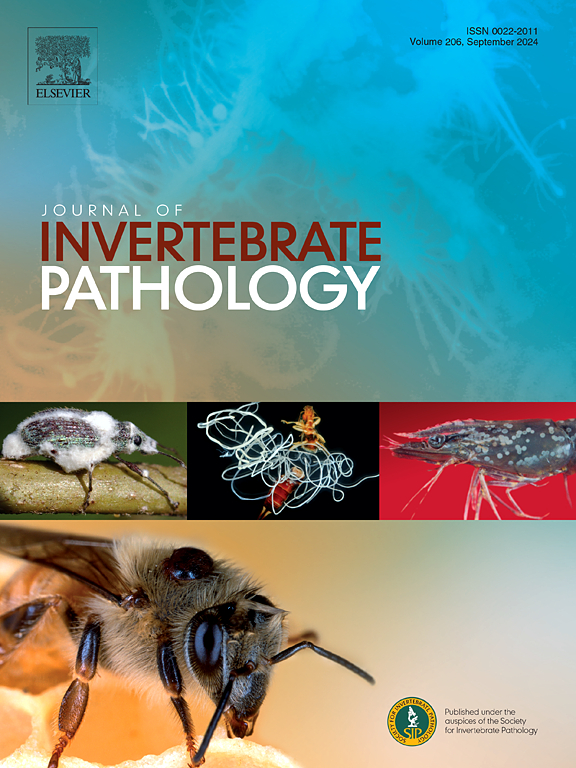
The Journal of Invertebrate Pathology presents original research articles and notes on the induction and pathogenesis of diseases of invertebrates, including the suppression of diseases in beneficial species, and the use of diseases in controlling undesirable species. In addition, the journal publishes the results of physiological, morphological, genetic, immunological and ecological studies as related to the etiologic agents of diseases of invertebrates.
The Journal of Invertebrate Pathology is the adopted journal of the Society for Invertebrate Pathology, and is available to SIP members at a special reduced price.
 求助内容:
 应助结果提醒方式:


 京公网安备 11010802042870号


