Novel immunohistochemical assay utilizing the INSM1 (SP493) antibody demonstrates high specificity and sensitivity in detecting primary neuroendocrine lung neoplasms.
{"title":"Novel immunohistochemical assay utilizing the INSM1 (SP493) antibody demonstrates high specificity and sensitivity in detecting primary neuroendocrine lung neoplasms.","authors":"Katerina Dvorak, Alexander Gomez, Rafael Sainz","doi":"10.1186/s13000-025-01724-0","DOIUrl":null,"url":null,"abstract":"<p><p>INTRODUCTION: About 15–20% of lung neoplasms are of neuroendocrine origin. In addition to evaluation of morphological features, these neoplasms can be identified by immunohistochemistry (IHC) using antibodies against neuroendocrine markers such as synaptophysin, chromogranin A, and neural cell adhesion molecule, CD56. Recent studies have shown that insulinoma-associated protein 1 (INSM1) is increasingly used as a diagnostic marker for neoplasms of neuroendocrine origin, as it is highly sensitive and specific. The primary focus of this study was to evaluate the sensitivity and specificity of a recently developed assay that uses a new INSM1 (SP493) antibody for detecting primary neuroendocrine lung neoplasms and to compare this IHC assay with currently used neuroendocrine markers. METHOD: Tissue microarrays containing 391 lung neoplasms were stained with INSM1 (SP493) antibody, INSM1 (MRQ-70) antibody, CONFIRM anti-Synaptophysin (SP11) antibody, anti-Chromogranin A (LK2H10) antibody, and CD56 (MRQ-42) antibody on BenchMark ULTRA instruments using OptiView IHC DAB Detection Kit or ultraView Universal DAB Detection Kit using manufacturer’s recommended protocols. Sensitivity, specificity, and accuracy were calculated for each biomarker. RESULTS: The sensitivity and specificity of the new assay using INSM1 (SP493) antibody for detecting primary lung neoplasms with neuroendocrine differentiation were 96.8% and 92.3%, respectively. Comparable results were seen for the lung neoplastic cases stained with INSM1 (MRQ-70) antibody, yielding a sensitivity of 94.9% and specificity of 94.1%. In contrast, the anti-Chromogranin A (LK2H10) antibody and CD56 (MRQ-42) antibody showed considerably lower sensitivities. The sensitivity was 78.7% for the anti-Chromogranin A (LK2H10) antibody and 85.4% for the CD56 (MRQ-42) antibody. However, the specificities of anti-Chromogranin A (LK2H10) antibody and CD56 (MRQ-42) antibody were comparable with the specificity of the INSM1 (SP493) antibody [91.7% for anti-Chromogranin A (LK2H10) antibody, 90.4% for CD56 (MRQ-42) antibody]. The performance of the anti-Synaptophysin (SP11) antibody was suboptimal, with a sensitivity of 82.9% and a specificity of 87.6%. CONCLUSIONS: Overall, our data demonstrate that the IHC assay using the newly developed INSM1 (SP493) antibody is highly specific and sensitive for identifying primary neuroendocrine lung neoplasms. </p>","PeriodicalId":11237,"journal":{"name":"Diagnostic Pathology","volume":"20 1","pages":"118"},"PeriodicalIF":3.5000,"publicationDate":"2025-10-16","publicationTypes":"Journal Article","fieldsOfStudy":null,"isOpenAccess":false,"openAccessPdf":"https://www.ncbi.nlm.nih.gov/pmc/articles/PMC12532420/pdf/","citationCount":"0","resultStr":null,"platform":"Semanticscholar","paperid":null,"PeriodicalName":"Diagnostic Pathology","FirstCategoryId":"3","ListUrlMain":"https://doi.org/10.1186/s13000-025-01724-0","RegionNum":3,"RegionCategory":"医学","ArticlePicture":[],"TitleCN":null,"AbstractTextCN":null,"PMCID":null,"EPubDate":"","PubModel":"","JCR":"Q2","JCRName":"PATHOLOGY","Score":null,"Total":0}
引用次数: 0
Abstract
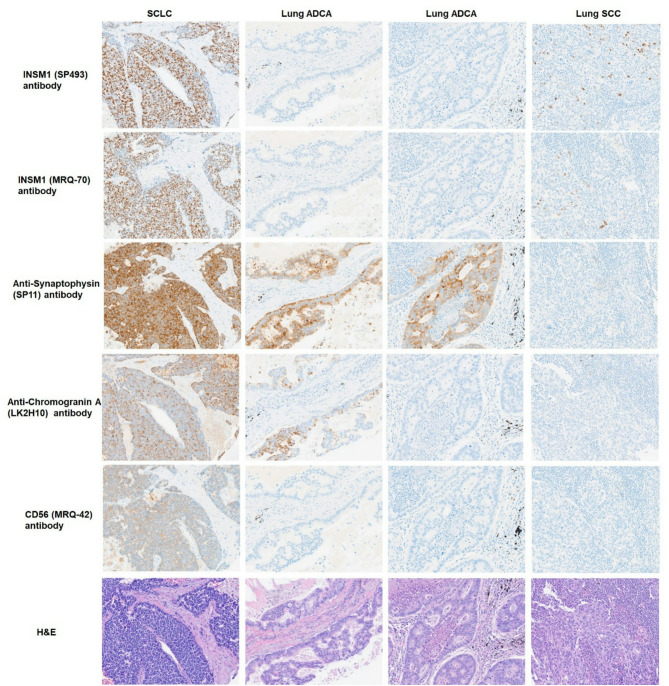
INTRODUCTION: About 15–20% of lung neoplasms are of neuroendocrine origin. In addition to evaluation of morphological features, these neoplasms can be identified by immunohistochemistry (IHC) using antibodies against neuroendocrine markers such as synaptophysin, chromogranin A, and neural cell adhesion molecule, CD56. Recent studies have shown that insulinoma-associated protein 1 (INSM1) is increasingly used as a diagnostic marker for neoplasms of neuroendocrine origin, as it is highly sensitive and specific. The primary focus of this study was to evaluate the sensitivity and specificity of a recently developed assay that uses a new INSM1 (SP493) antibody for detecting primary neuroendocrine lung neoplasms and to compare this IHC assay with currently used neuroendocrine markers. METHOD: Tissue microarrays containing 391 lung neoplasms were stained with INSM1 (SP493) antibody, INSM1 (MRQ-70) antibody, CONFIRM anti-Synaptophysin (SP11) antibody, anti-Chromogranin A (LK2H10) antibody, and CD56 (MRQ-42) antibody on BenchMark ULTRA instruments using OptiView IHC DAB Detection Kit or ultraView Universal DAB Detection Kit using manufacturer’s recommended protocols. Sensitivity, specificity, and accuracy were calculated for each biomarker. RESULTS: The sensitivity and specificity of the new assay using INSM1 (SP493) antibody for detecting primary lung neoplasms with neuroendocrine differentiation were 96.8% and 92.3%, respectively. Comparable results were seen for the lung neoplastic cases stained with INSM1 (MRQ-70) antibody, yielding a sensitivity of 94.9% and specificity of 94.1%. In contrast, the anti-Chromogranin A (LK2H10) antibody and CD56 (MRQ-42) antibody showed considerably lower sensitivities. The sensitivity was 78.7% for the anti-Chromogranin A (LK2H10) antibody and 85.4% for the CD56 (MRQ-42) antibody. However, the specificities of anti-Chromogranin A (LK2H10) antibody and CD56 (MRQ-42) antibody were comparable with the specificity of the INSM1 (SP493) antibody [91.7% for anti-Chromogranin A (LK2H10) antibody, 90.4% for CD56 (MRQ-42) antibody]. The performance of the anti-Synaptophysin (SP11) antibody was suboptimal, with a sensitivity of 82.9% and a specificity of 87.6%. CONCLUSIONS: Overall, our data demonstrate that the IHC assay using the newly developed INSM1 (SP493) antibody is highly specific and sensitive for identifying primary neuroendocrine lung neoplasms.
期刊介绍:
Diagnostic Pathology is an open access, peer-reviewed, online journal that considers research in surgical and clinical pathology, immunology, and biology, with a special focus on cutting-edge approaches in diagnostic pathology and tissue-based therapy. The journal covers all aspects of surgical pathology, including classic diagnostic pathology, prognosis-related diagnosis (tumor stages, prognosis markers, such as MIB-percentage, hormone receptors, etc.), and therapy-related findings. The journal also focuses on the technological aspects of pathology, including molecular biology techniques, morphometry aspects (stereology, DNA analysis, syntactic structure analysis), communication aspects (telecommunication, virtual microscopy, virtual pathology institutions, etc.), and electronic education and quality assurance (for example interactive publication, on-line references with automated updating, etc.).

 求助内容:
 应助结果提醒方式:


 京公网安备 11010802042870号


